In this guide
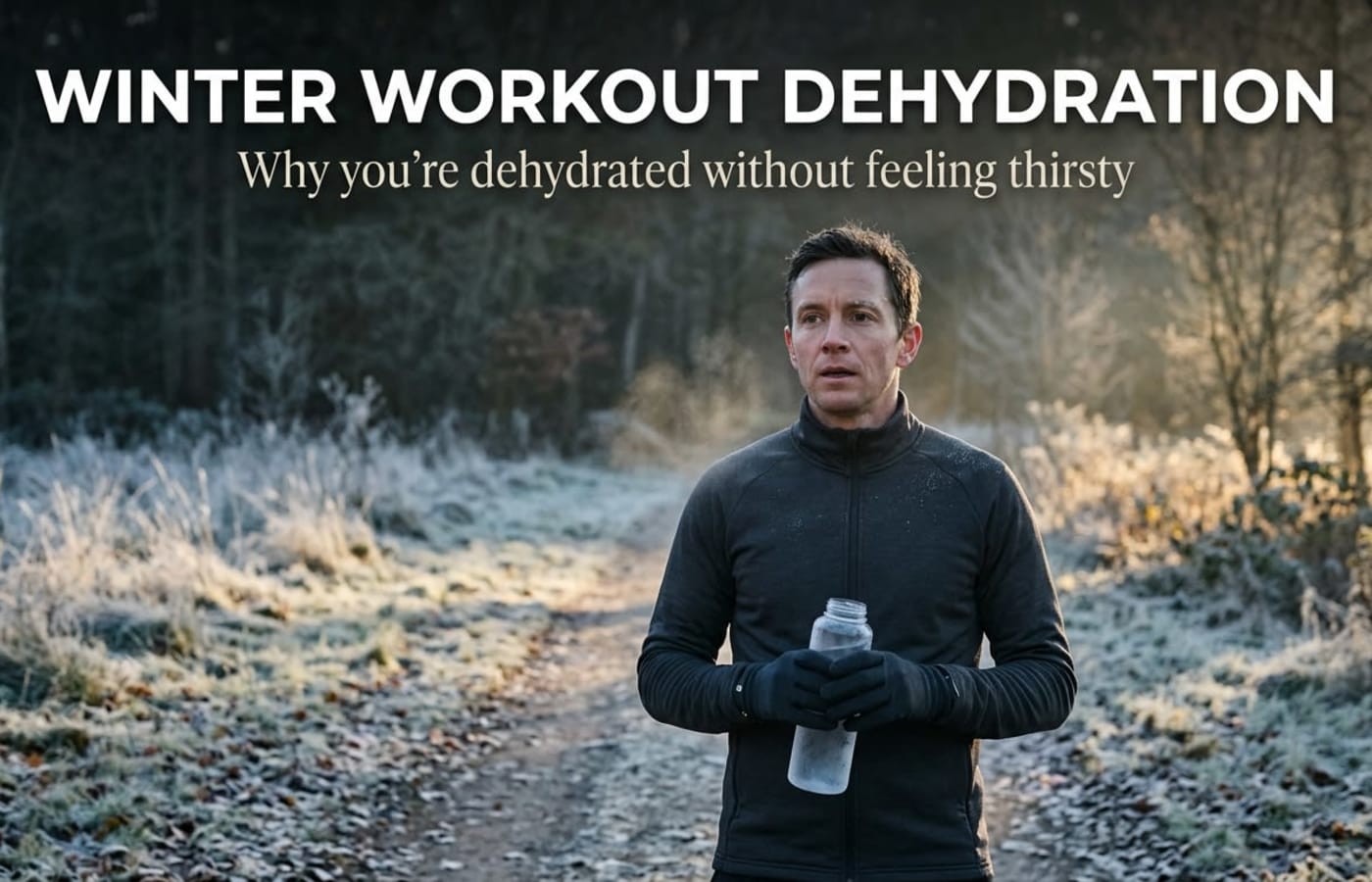
It is a cold morning. You put on your running clothes, step outside and begin your usual workout. Unlike a summer session, you barely feel yourself sweating. You do not feel particularly thirsty either, so you finish the run without drinking anything.
It seems reasonable. You are not hot, your clothes are relatively dry and your body is not sending the familiar signals that normally remind you to drink.
But there is a problem with relying on thirst alone during cold-weather exercise: cold exposure can reduce the sensation of thirst, even when the body is already short of water.
That does not mean every winter workout causes significant dehydration. A short, easy walk in cool weather is different from a long run, cycling session or physically demanding outdoor training. Nevertheless, winter creates a combination of physiological and practical conditions that can make fluid replacement less reliable.
We examine research on cold-induced thirst suppression, urinary fluid loss, sweating, exercise performance and practical hydration strategies to explain how dehydration can develop when you do not feel particularly thirsty.
The short version: Cold exposure can blunt thirst perception by as much as approximately 40% under some experimental conditions. Sweat, respiratory water loss and cold-related changes in urine production can still contribute to fluid loss. A 2014 exercise study involving 10 healthy men found similar body-mass losses in cold and warm exercise trials despite lower voluntary drinking in the cold. Hydration should therefore account for exercise duration, intensity, sweat losses and environmental conditions rather than relying exclusively on thirst or a universal daily water target.
Can You Get Dehydrated in Cold Weather?
Yes. Dehydration is not exclusive to hot weather.
Your body continuously loses water through several routes:
Sweating from the skin.
Water vapour lost through breathing.
Urine production.
Normal gastrointestinal losses.
During winter exercise, these losses can continue even when you feel cold.
The important difference is that some of the usual warning signals may be less noticeable. Cold exposure changes blood circulation, thirst perception and, in certain circumstances, urine production.
Meanwhile, people may drink less because water feels unpleasantly cold, bottles are inconvenient to carry or they simply do not feel thirsty.
This combination creates a situation where fluid intake can fall behind actual losses.
Why Winter Suppresses Your Thirst
Thirst is regulated by several interconnected systems that monitor blood concentration, circulating blood volume and fluid balance.
When body water decreases, the concentration of dissolved particles in the blood can rise. Specialized receptors detect these changes and help stimulate thirst and the release of arginine vasopressin, also known as antidiuretic hormone.
Cold exposure can interfere with the normal perception of thirst.
What happens to blood circulation?
When you are exposed to cold, blood vessels near the skin constrict. This process, known as peripheral vasoconstriction, helps reduce heat loss.
The redistribution of blood towards the central circulation can make the body perceive a greater central blood volume.
This change may influence hormonal and neural signals involved in fluid regulation, including thirst.
What did the research find?
Kenefick and colleagues investigated thirst sensations and arginine vasopressin responses during exercise in cold and temperate environments.
Their 2004 study included small experimental groups of healthy men who completed exercise trials under different hydration and temperature conditions.
The researchers reported that cold exposure attenuated thirst by up to approximately 40%, including during hypohydration.
This is an important finding because it demonstrates that thirst perception does not always reflect the body's actual hydration status during cold exposure.
However, the study was small and involved controlled conditions. The reported percentage should not be treated as a fixed reduction in thirst for everyone.
Cold-Induced Diuresis Explained
Another physiological response associated with cold exposure is cold-induced diuresis.
The term describes an increase in urine production that can occur when the body is exposed to cold.
The proposed mechanism involves peripheral vasoconstriction and the redistribution of blood towards the central circulation. This can alter kidney-related fluid regulation and contribute to increased urine output.
Why does it matter for winter exercise?
Imagine that you begin a morning workout without drinking much water. Your body is already experiencing some fluid loss through normal overnight processes.
If cold exposure increases urine production while your thirst response is reduced, you may be less likely to replace the fluid you lose.
However, cold-induced diuresis varies according to the individual, temperature, hydration status and duration of exposure. It is not correct to assume that everyone loses a large amount of water simply by walking outside in winter.
Cold-induced diuresis is one possible contributor, not a complete explanation for winter dehydration.
The Hidden Ways You Lose Water During Winter Workouts
1. Sweating beneath winter clothing
One of the most common misconceptions is that cold weather prevents sweating.
In reality, exercise generates metabolic heat regardless of the surrounding temperature. Your body still needs to release excess heat, and sweating is an important part of that process.
Thermal clothing, waterproof layers and high-intensity exercise can trap heat and increase sweating.
Because sweat may evaporate quickly or remain unnoticed beneath clothing, athletes sometimes underestimate their losses.
2. Respiratory water loss
Every time you breathe, your respiratory system exchanges water vapour with the surrounding air.
Cold air generally contains less water vapour than warm air. When you inhale cold, relatively dry air, your respiratory tract warms and humidifies it before exhalation.
Some of that water leaves the body with each breath.
Respiratory water loss can become more relevant during prolonged outdoor exercise, particularly when breathing rates increase.
3. Increased urine production
As discussed above, cold-induced diuresis can contribute to fluid losses.
However, the magnitude varies. It should not be used as a reason to drink excessively or to replace every bathroom visit with additional water.
4. Reduced voluntary drinking
Perhaps the most practical problem is simply drinking less.
People often leave water bottles behind during winter exercise because they do not expect to become thirsty.
They may also avoid drinking because cold water feels uncomfortable or because stopping to drink interrupts their workout.
Research comparing cold and warm exercise has demonstrated that voluntary fluid intake can differ between environments.
How Dehydration Affects Exercise Performance
Water is essential for maintaining blood volume, transporting nutrients, regulating body temperature and supporting normal muscle function.
When fluid losses become substantial, several physiological systems may be affected.
Cardiovascular strain
Reduced plasma volume can make it more difficult to maintain normal circulation during exercise. Heart rate and cardiovascular strain may increase under demanding conditions.
Thermoregulation
Dehydration can compromise the body's ability to regulate temperature. This matters even in winter because exercise still generates heat.
Endurance and perceived effort
Significant fluid deficits can make exercise feel harder and may impair endurance performance.
The extent of impairment depends on the magnitude of fluid loss, exercise intensity, duration and environmental conditions.
What about the 2% body-weight threshold?
Sports science frequently discusses body-mass losses around 2% as a practical point at which dehydration-related performance concerns become increasingly relevant.
However, this is not a universal biological switch. Research reviews indicate that the relationship between dehydration and performance depends on the exercise task, environmental temperature, intensity and individual characteristics.
For an athlete who begins a workout weighing 70 kg, a 2% reduction corresponds to approximately 1.4 kg of body mass.
It is important not to confuse this change with fat loss. Short-term changes in body weight during exercise primarily reflect fluid balance and other temporary factors.
Signs of Dehydration in Cold Weather
Cold-weather dehydration can be difficult to recognise because thirst may be less noticeable.
Possible indicators include:
Dry mouth.
Headache.
Unusual fatigue.
Dizziness or light-headedness.
Dark or concentrated urine.
Reduced exercise performance.
Unexpectedly elevated perceived effort.
None of these signs alone confirms dehydration. Urine colour can be influenced by foods, supplements, medications and other factors. Dizziness and fatigue can also have causes unrelated to fluid balance.
Severe dehydration may cause confusion, fainting, rapid heartbeat and significant weakness. Seek urgent medical care for serious symptoms, particularly altered mental status or collapse.
People with kidney disease, heart failure or conditions requiring fluid restriction should follow their clinician's individual fluid advice rather than adopting a general hydration target.
How Much Water Do You Need During Winter?
There is no scientifically defensible single number that applies to every person during every winter workout.
Fluid requirements depend on:
Body size and individual sweat rate.
Exercise intensity and duration.
Temperature and humidity.
Clothing and equipment.
Respiratory water losses.
Pre-exercise hydration status.
For healthy adults, general daily water recommendations include water from both beverages and food. The National Academies' reference values are approximately 3.7 litres of total water per day for adult men and 2.7 litres for adult women, but these are population reference values, not mandatory drinking targets or winter workout prescriptions.
Actual needs can be higher or lower depending on diet, body size, climate, activity and health status.
Should you drink according to thirst?
For many short, low-intensity exercise sessions, drinking according to thirst may be sufficient.
However, cold exposure can make thirst less reliable. For longer sessions, high sweat rates or demanding training, a more deliberate fluid-replacement strategy may be appropriate.
The objective is to avoid excessive fluid deficits without drinking so much that body weight increases during exercise.
Calculate Your Personal Sweat Rate
Rather than following someone else's drinking schedule, you can estimate your own sweat rate under similar training conditions.
The calculation uses body mass before and after exercise, fluid consumed and urine produced during the session.
Sweat rate formula:
Sweat loss (litres) = pre-exercise body mass (kg) − post-exercise body mass (kg) + fluid consumed (litres) − urine produced (litres)
Sweat rate (L/hour) = sweat loss ÷ exercise duration (hours)
Worked example
Suppose a runner records:
Pre-workout body mass: 70.0 kg
Post-workout body mass: 69.4 kg
Fluid consumed: 0.4 litres
Urine produced: 0 litres
Workout duration: 1 hour
Sweat loss = 70.0 − 69.4 + 0.4 = 1.0 litre.
Estimated sweat rate = 1.0 ÷ 1 = 1.0 litre per hour.
This is an estimate rather than a laboratory measurement. Body-mass measurements should be taken under consistent conditions, ideally with dry clothing or minimal clothing, and the calculation should be repeated across different temperatures and exercise intensities.
Do not assume that your summer sweat rate applies to winter. Repeat the measurement in the conditions in which you actually train.
Do You Need Electrolytes in Winter?
Electrolytes are minerals that carry an electrical charge when dissolved in body fluids. They participate in fluid balance, nerve signalling and muscle contraction.
The main electrolytes relevant to exercise hydration include:
Sodium: Helps regulate extracellular fluid balance and is lost in sweat.
Potassium: Supports cellular function and normal muscle and nerve activity.
Magnesium: Participates in hundreds of enzymatic processes, including those involved in muscle function.
Chloride: Helps maintain fluid and acid-base balance.
For a short, easy winter workout, plain water and normal meals are generally sufficient for most healthy adults.
Electrolyte replacement becomes more relevant when exercise is prolonged, sweat losses are high, or substantial sodium is lost through sweating.
Sports drinks can provide fluid and sodium, but they may also contain added sugar and calories. Whether those are useful depends on the duration and demands of the workout.
There is no reason to consume electrolyte supplements automatically before every winter walk or gym session.
A Practical Winter Workout Hydration Plan
The following framework is intended for generally healthy adults. Adjust it according to individual fluid losses and medical requirements.
Training stage | Practical approach | Reason |
|---|---|---|
Before exercise | Start normally hydrated and have access to fluids | Avoid beginning a session with an existing fluid deficit |
During a short session | Drink according to thirst and comfort | Most short, low-intensity sessions do not require a complex drinking schedule |
During a long session | Use a plan based on measured sweat losses and conditions | Thirst may not fully reflect fluid requirements in cold environments |
After exercise | Replace remaining fluid losses gradually with drinks and normal meals | Support recovery and restore fluid balance |
Across the day | Maintain regular access to water and fluid-containing foods | Prevent cumulative underhydration |
Choose a comfortable fluid temperature
You do not have to drink ice-cold water during winter. Room-temperature water or a warm, unsweetened beverage may be more comfortable.
Temperature preference is largely a practical consideration. There is no convincing reason to believe that drinking warm water directly burns additional fat or provides a unique hydration advantage.
Use food to support hydration
Fluids are not obtained exclusively from water bottles.
Water-rich foods can contribute to total daily intake:
Oranges and other citrus fruits.
Apples and pears.
Cucumbers and tomatoes.
Vegetable soups.
Yoghurt and milk.
Cooked vegetables.
Warm vegetable soup can be a useful part of a winter meal because it supplies both fluid and nutrients. Its sodium content depends on the recipe.
Eight Winter Hydration Mistakes
Waiting until you feel extremely thirsty. Cold exposure may reduce thirst perception.
Assuming you are not sweating. Sweat can accumulate beneath thermal clothing or evaporate without being noticed.
Ignoring long workouts. Extended exercise can create substantial fluid losses even in cold weather.
Following a summer hydration plan without adjustment. Sweat rates and fluid needs vary with environmental conditions.
Drinking excessive amounts of plain water. Overhydration can cause dangerously low blood sodium, known as exercise-associated hyponatremia.
Using sports drinks unnecessarily. Not every workout requires additional electrolytes or carbohydrate.
Confusing weight loss with fat loss. Rapid post-exercise weight changes often reflect fluid losses.
Ignoring medical restrictions. People with certain heart or kidney conditions may require individual fluid limits.
The Bottom Line
Cold weather does not protect you from dehydration. Your body continues to lose water through sweat, breathing and urine, while cold exposure can reduce thirst perception and sometimes increase urine production.
The evidence is particularly relevant to people who run, cycle, walk long distances or perform demanding outdoor workouts during winter.
However, more water is not automatically better. Short and easy sessions generally require a simpler approach than prolonged, high-intensity exercise. Individual sweat rate, workout duration, environmental conditions and existing health requirements should determine your strategy.
Start workouts normally hydrated, carry fluids when appropriate, assess your actual losses and replace them sensibly. The best winter hydration plan is not the one that forces you to drink the most. It is the one that maintains fluid balance without unnecessary overdrinking.
Frequently Asked Questions
Can you become dehydrated in winter without feeling thirsty?
Yes. Cold exposure can reduce thirst perception even when hydration status is compromised. Exercise-related sweating and respiratory water loss can continue despite reduced thirst.
Why do I urinate more frequently in cold weather?
Cold-induced diuresis can increase urine production through changes in circulation and fluid regulation. However, frequent urination can have other causes, including medications and medical conditions.
Do you sweat less during winter workouts?
Not necessarily. Sweat production depends on exercise intensity, clothing, individual physiology and environmental conditions. You may simply notice it less during cold-weather exercise.
How much water should I drink before a winter workout?
Start normally hydrated and avoid beginning exercise with a significant fluid deficit. The appropriate amount depends on your usual fluid intake, workout duration and individual needs rather than one universal pre-workout dose.
Is cold-induced diuresis dangerous?
It is a normal physiological response to cold exposure in some circumstances. It becomes relevant when fluid losses are not adequately replaced, particularly during prolonged activity.
Does dehydration affect muscle strength in winter?
Significant dehydration can increase cardiovascular strain and impair exercise performance. The effects depend on the degree of fluid loss and the type of exercise. It is not correct to assume that every small fluid deficit immediately reduces strength.
Should I drink electrolytes during winter exercise?
Most short, low-intensity workouts do not require electrolyte supplements. They may be useful during prolonged exercise or when sweat and sodium losses are substantial.
Is warm water better than cold water for winter hydration?
Both can provide hydration. Choose a temperature that is comfortable and encourages adequate fluid intake.
Can drinking too much water during exercise be harmful?
Yes. Excessive fluid consumption can dilute blood sodium and cause exercise-associated hyponatremia. Avoid drinking beyond your fluid losses or gaining body weight during exercise from excessive drinking.
What is the best way to check dehydration after exercise?
Monitor body-mass changes under consistent conditions, fluid intake and urine output. Repeat measurements across comparable sessions rather than relying on one indicator alone.
References & Sources
Kenefick, R. W., Hazzard, M. P., Mahood, N. V. and Castellani, J. W. (2004). Thirst sensations and AVP responses at rest and during exercise-cold exposure. Medicine & Science in Sports & Exercise, 36(9), 1528–1534. DOI: 10.1249/01.MSS.0000139901.63911.75.
Mears, S. A. and Shirreffs, S. M. (2014). Voluntary water intake during and following moderate exercise in the cold. International Journal of Sport Nutrition and Exercise Metabolism, 24(1), 47–58. DOI: 10.1123/ijsnem.2013-0034.
Kenefick, R. W. (2018). Drinking strategies: Planned drinking versus drinking to thirst. Sports Medicine, 48(Suppl 1), 31–37. DOI: 10.1007/s40279-017-0844-6.
Nutritional Requirements for Sustaining Health and Performance During Exposure to Extreme Environments (2021). Annual Review of Nutrition. DOI: 10.1146/annurev-nutr-011720-122637.
Sawka, M. N., Cheuvront, S. N. and Kenefick, R. W. (2015). Hypohydration and human performance: Impact of environment and physiological mechanisms. Sports Medicine, 45(Suppl 1), S51–S60. DOI: 10.1007/s40279-015-0395-7.
National Academies of Sciences, Engineering, and Medicine (2005). Dietary Reference Intakes for Water, Potassium, Sodium, Chloride, and Sulfate. Reference publication.
Thomas, D. T., Erdman, K. A. and Burke, L. M. (2016). Position of the Academy of Nutrition and Dietetics, Dietitians of Canada, and the American College of Sports Medicine: Nutrition and athletic performance. Journal of the Academy of Nutrition and Dietetics, 116(3), 501–528. DOI: 10.1016/j.jand.2015.12.006.
Calculate your own numbers — free.
18 science-backed calculators covering everything in this article and more.