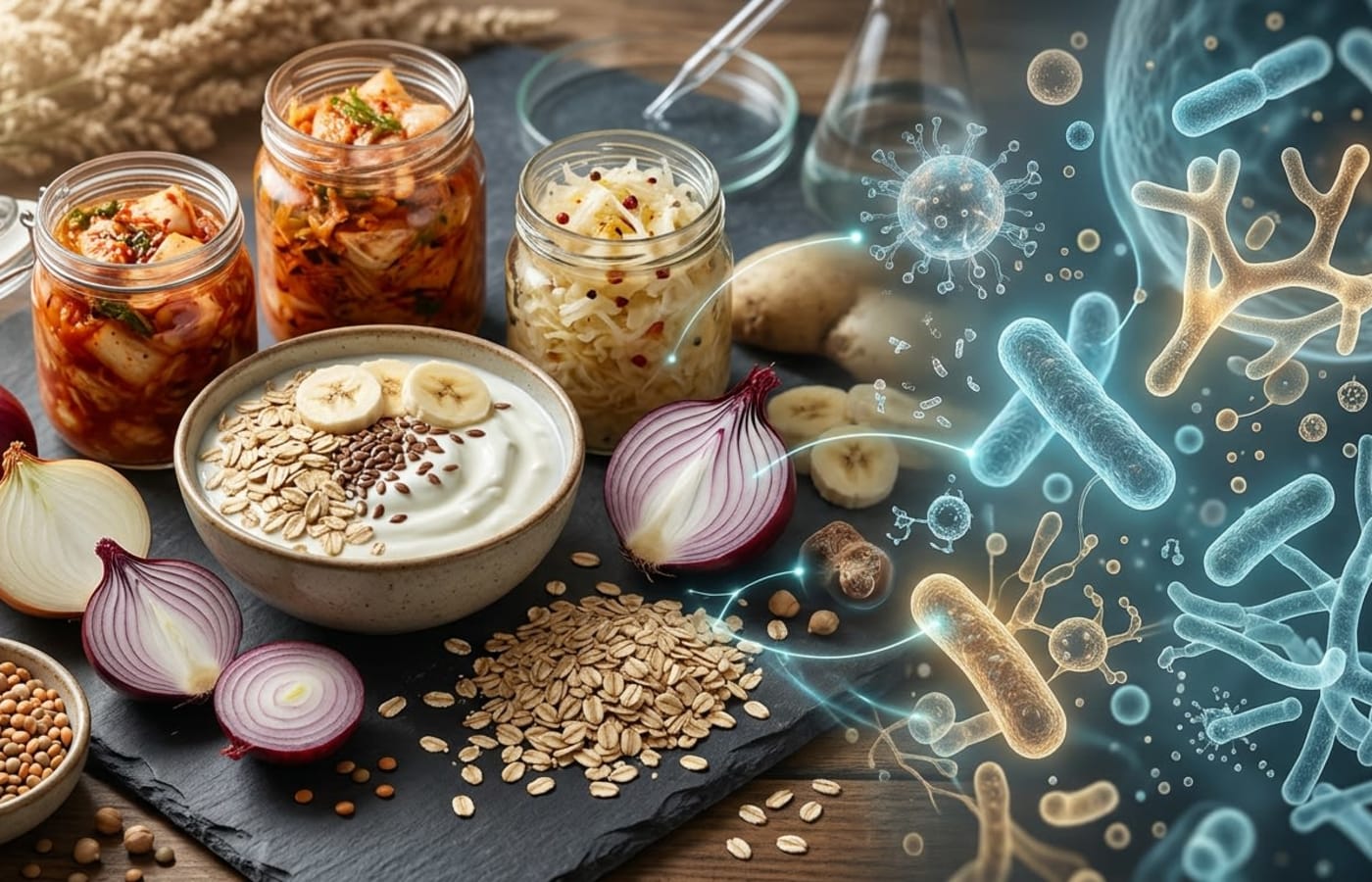
Postbiotics vs. Probiotics vs. Prebiotics: What's the Difference and Which Foods Contain Them?
Probiotics, prebiotics, and postbiotics are often discussed together, but they are not the same thing. One refers to beneficial live microorganisms, another to substances used by microorganisms, and the third to preparations containing inactivated microorganisms that have demonstrated health benefits. Understanding the differences can help you make better decisions about food, supplements, and gut health.
Table of Contents
Introduction: Three Similar Words, Three Different Ideas
Gut health has become one of the most discussed subjects in nutrition.
You may have seen yogurt advertised as probiotic, fiber supplements marketed as prebiotic, and newer products promoted as postbiotic formulas.
The names sound similar, and all three are connected to microorganisms. But they describe different things.
Probiotics are live microorganisms that provide a health benefit when administered in adequate amounts.
Prebiotics are substances selectively used by host microorganisms that provide a health benefit.
Postbiotics are preparations of inanimate microorganisms and/or their components that provide a health benefit.
These are not interchangeable marketing terms. Each has a scientific definition, and each requires evidence before a particular product can legitimately claim a specific benefit.
The distinction has become even more important as the gut microbiome field develops. In February 2026, an expert consensus statement published in Nature Reviews Gastroenterology & Hepatology proposed a clearer definition of gut health, emphasizing both normal gastrointestinal function and the person's experience of gut-related symptoms.
This newer framework is a useful reminder: gut health is not simply about having more bacteria, consuming more supplements, or changing one microbiome test result.
It is about how the gastrointestinal system functions and how that function affects everyday life.
1. Why Are People Talking About Postbiotics?
For many years, probiotic products dominated the commercial gut-health market.
Yogurts, fermented drinks, capsules, and powders were promoted for their live microorganisms.
Prebiotics then received more attention as researchers studied the substances that help particular microorganisms grow or function.
Postbiotics have become a newer area of interest because researchers are investigating whether preparations containing inactivated microorganisms or their components can also produce beneficial effects.
This creates three related areas of research:
Introducing selected live microorganisms.
Supporting the activity of microorganisms already present.
Using specific preparations made from inactivated microorganisms.
The science is promising in several areas, but the evidence is not equally strong for every product or health outcome.
A common mistake is to assume that because a product contains one of these ingredients, it automatically improves gut health. The evidence must relate to the actual microorganism or substance, the dose, the intended population, and the outcome being claimed.
2. What Are Probiotics?
Probiotics are live microorganisms that, when administered in adequate amounts, confer a health benefit on the host.
This definition was reinforced by an expert consensus panel convened by the International Scientific Association for Probiotics and Prebiotics (ISAPP), building on the FAO/WHO definition.
The important words are live, adequate amounts, and health benefit.
A product does not qualify as a probiotic simply because it contains bacteria.
How do probiotics work?
Different probiotic strains may influence the host through different mechanisms.
Depending on the strain and the evidence, these mechanisms may include:
Competing with other microorganisms for nutrients or attachment sites.
Producing substances that influence microbial growth.
Interacting with intestinal immune pathways.
Influencing the intestinal barrier.
Participating in metabolic processes.
These mechanisms should not be interpreted as proof that every probiotic product produces every effect.
The benefits of probiotics are often strain-specific. Two products containing different strains of the same bacterial species may not have the same evidence or effects.
Common probiotic microorganisms
Probiotic research includes members of several microbial groups, such as:
Lactobacillus species, including species now assigned to revised genera.
Bifidobacterium species.
Certain strains of Saccharomyces boulardii.
Other microorganisms with appropriate evidence for particular uses.
The name of the species alone is not enough to identify a proven probiotic. The strain and the evidence behind its use matter.
What are probiotics used for?
Some probiotic strains have been studied for specific digestive outcomes, including certain forms of antibiotic-associated diarrhea and other gastrointestinal symptoms.
However, the evidence varies by strain, population, dose, and condition.
A probiotic that has evidence for one specific outcome should not automatically be promoted as a treatment for constipation, bloating, immune disorders, or every other digestive complaint.
3. What Are Prebiotics?
Prebiotics are substances used by microorganisms in a way that provides a health benefit to the host.
The 2017 ISAPP consensus definition describes a prebiotic as a substrate that is selectively utilized by host microorganisms conferring a health benefit.
This means that not every fiber is automatically a prebiotic.
Many prebiotics are fibers or other carbohydrates, but the scientific definition requires more than simply being difficult to digest.
How do prebiotics work?
Humans cannot fully digest certain dietary carbohydrates.
Some of these substances reach the large intestine, where microorganisms can use them.
Microbial fermentation may produce compounds such as short-chain fatty acids.
These compounds participate in intestinal physiology and other metabolic processes.
The effects depend on the specific substrate, the microorganisms present, and the person's biology.
Common examples of prebiotic substances
Research has examined several types of prebiotic ingredients, including:
Inulin
Fructooligosaccharides (FOS)
Galactooligosaccharides (GOS)
Resistant starch
Certain other fermentable carbohydrates
Not all of these substances have identical effects.
Are all fibers prebiotics?
No.
This is an important distinction.
Dietary fiber is a broad nutritional category. Prebiotic is a more specific scientific term that requires evidence of microbial utilization and a health benefit.
Some fibers can have prebiotic effects, but the words fiber and prebiotic should not be used as synonyms.
An ingredient should not be called a proven prebiotic solely because it is fermentable.
4. What Are Postbiotics?
Postbiotics are preparations of inanimate microorganisms and/or their components that confer a health benefit on the host.
This is the definition established by the ISAPP expert consensus panel and published in Nature Reviews Gastroenterology & Hepatology in 2021.
The term may sound like it simply means the substances produced after bacteria consume food, but that is not the scientific definition.
A postbiotic preparation must contain inactivated microbial cells or their components, and a health benefit must be demonstrated.
How can inactivated microorganisms have an effect?
Inactivation means that microorganisms are no longer alive.
However, their cellular structures and components may still interact with the host.
Researchers are investigating how these preparations may influence:
Intestinal immune signaling.
Communication between microbial components and host cells.
Intestinal barrier-related processes.
Inflammatory pathways.
Other biological responses.
These are research areas, not guaranteed effects of every postbiotic product.
Are short-chain fatty acids postbiotics?
Not automatically.
Short-chain fatty acids such as acetate, propionate, and butyrate are microbial metabolites.
Although they are important products of microbial fermentation, the ISAPP consensus definition does not classify purified metabolites alone as postbiotics.
The definition requires a preparation containing inanimate microorganisms and/or their components that provides a demonstrated health benefit.
This distinction is particularly important when reading supplement advertisements.
Are all killed bacteria postbiotics?
No.
Simply killing a microorganism does not automatically create a proven postbiotic.
The preparation must meet the scientific criteria, including evidence of a health benefit in the intended host.
5. Probiotics vs. Prebiotics vs. Postbiotics: Key Differences
Feature | Probiotics | Prebiotics | Postbiotics |
|---|---|---|---|
What are they? | Live microorganisms | Substrates used by microorganisms | Preparations of inanimate microorganisms and/or components |
Must microorganisms be alive? | Yes | No live microorganism is required in the substrate itself | No |
Main scientific concept | Live microbes with demonstrated benefits | Microbial utilization with demonstrated benefits | Inactivated microbial preparations with demonstrated benefits |
Examples | Specific documented Lactobacillus or Bifidobacterium strains | Inulin, FOS, GOS, qualifying resistant starch preparations | Specific characterized inactivated microbial preparations |
Common delivery | Foods and supplements | Foods and supplements | Specially prepared foods or supplements |
Is a health benefit required by the definition? | Yes | Yes | Yes |
The simplest way to remember the difference:
Probiotics: selected live microorganisms.
Prebiotics: substances selected microorganisms can use beneficially.
Postbiotics: specific preparations of inactivated microorganisms or their components with demonstrated benefits.
6. How Do They Interact With the Gut Microbiome?
Your gut microbiome is the community of microorganisms living in the digestive tract.
It includes bacteria and other microbial groups that interact with the food you eat, your intestinal environment, and your immune system.
The microbiome is not a fixed collection of organisms. Its composition and activity can vary with age, diet, medications, illness, lifestyle, and other factors.
The role of dietary substrates
When certain fibers and other substrates reach the large intestine, microbes can use them.
This may change microbial activity and the substances produced during fermentation.
For example, some microbes ferment certain fibers into short-chain fatty acids.
The role of live microorganisms
A probiotic introduces a specific live microorganism in an adequate amount.
Some probiotics may act temporarily as they pass through the digestive tract. They do not necessarily establish permanent colonization.
Their potential effect depends on the strain and the intended use.
The role of inactivated microbial preparations
Postbiotics are not alive, but their components can still interact with host tissues.
The research examines whether these interactions can produce specific health outcomes.
Why one person's response may differ from another's
People do not have identical microbiomes.
The same dietary substrate may be used differently depending on the microorganisms present and other individual factors.
This helps explain why a food or supplement may produce different responses in different people.
It also explains why broad claims such as "this supplement restores your microbiome" are usually too simplistic.
7. Best Food Sources of Probiotics
Some foods contain live microorganisms, particularly when they are made through fermentation and the organisms remain alive in the final product.
However, fermented food and probiotic are not interchangeable scientific terms.
Yogurt with live cultures
Yogurt is made through microbial fermentation of milk.
Some products contain live cultures at the time of consumption.
Yogurt can also provide protein, calcium, and other nutrients.
Check the label for information about live cultures. A product containing live cultures is not automatically proven to provide every health benefit associated with a particular probiotic strain.
Kefir
Kefir is a fermented milk drink made using a community of microorganisms.
Its microbial composition can vary with the starter culture and production method.
It may contain a diverse mixture of bacteria and yeasts.
Fermented vegetables
Examples include traditionally fermented sauerkraut and kimchi.
Their microbial content depends on production, storage, and whether the food has been heat-treated or pasteurized.
Not every packaged fermented vegetable contains live microorganisms at the time it is eaten.
Other fermented foods
Some cheeses, fermented soy foods, and other traditionally fermented foods may contain live microorganisms.
But the presence of live microbes does not automatically qualify a food as a probiotic under the scientific definition.
8. Best Food Sources of Prebiotics
Prebiotic substances can occur naturally in many plant foods.
A varied plant-rich diet can provide different types of fermentable carbohydrates and fiber.
Garlic and onions
Garlic and onions contain fructans, including inulin-type compounds.
They are useful ingredients in many everyday meals.
Leeks and asparagus
These vegetables can contribute prebiotic carbohydrates as part of a varied diet.
Chicory root
Chicory root is a well-known source of inulin and is also used as an ingredient in some packaged foods.
Bananas
Bananas contain different types of carbohydrates depending on ripeness.
Less-ripe bananas contain more resistant starch than fully ripe bananas.
Oats and barley
Oats and barley contain beta-glucan, a soluble fiber with evidence for certain health outcomes.
Not every effect of beta-glucan should be described as a prebiotic effect; its other physiological properties also matter.
Beans, lentils, and chickpeas
Legumes provide fiber and fermentable carbohydrates.
They can contribute to a varied diet and support overall fiber intake.
Some people experience gas when increasing legumes quickly, so portion size and preparation matter.
Resistant starch
Resistant starch escapes digestion in the small intestine and can be fermented by microorganisms in the large intestine.
It can be found in foods such as legumes and some cooked-and-cooled starch-containing foods.
The amount varies with food type, preparation, cooling, and reheating.
9. Where Do Postbiotics Come From?
Postbiotics are not simply a food category like fruit or vegetables.
They are specific preparations created through controlled microbial production and inactivation processes.
Researchers and manufacturers may use microbial cultures, apply a defined inactivation method, and characterize the resulting preparation.
The final product must meet the relevant scientific criteria, including evidence of benefit and safety for its intended use.
Are fermented foods postbiotics?
Not automatically.
Fermented foods can contain live microorganisms and fermentation products, but this does not make them postbiotic preparations.
The ISAPP consensus statement on fermented foods distinguishes fermented foods from probiotics.
Similarly, the postbiotic definition requires a specific inactivated microbial preparation with a demonstrated health benefit.
Can heat-treated bacteria be postbiotics?
A heat-treated preparation may qualify if it meets the definition and the appropriate evidence requirements.
But heat treatment alone is not enough.
The preparation, microorganism, process, and demonstrated health benefit all matter.
10. What Does the Latest Research Actually Say?
This is where it is important to separate established scientific definitions from emerging health claims.
A. The 2026 consensus statement on gut health
In February 2026, Nature Reviews Gastroenterology & Hepatology published an ISAPP consensus statement proposing a definition of gut health centered on normal gastrointestinal function without active gastrointestinal disease and gut-related symptoms that affect quality of life.
The paper emphasizes that gut health should not be reduced to one microbiome test result.
It considers both objective gastrointestinal function and the person's subjective experience.
This is a useful development because commercial gut-health marketing often treats a single measurement or supplement as if it can establish overall digestive health.
The scientific picture is more complex.
B. The 2025 expert recommendations on prebiotics
A 2025 publication in Nature Reviews Gastroenterology & Hepatology discussed how compounds should be classified as prebiotics.
It reaffirmed the ISAPP definition and emphasized that researchers need evidence of selective microbial utilization and a health benefit.
The paper also discussed the importance of demonstrating a relationship between microbial changes and the health outcome.
This matters because a product should not be called a proven prebiotic merely because it changes the abundance of a particular bacterium in a laboratory experiment.
C. The 2021 postbiotic consensus statement
The ISAPP consensus panel defined postbiotics as preparations of inanimate microorganisms and/or their components that confer a health benefit on the host.
The paper clarified that purified metabolites alone do not meet this definition.
It also stressed that benefits should be demonstrated in the intended host.
This is a useful standard for evaluating commercial claims.
D. The evidence is not the same for every product
A scientific definition tells us what a substance must be.
It does not mean every product in that category has been proven to work for every outcome.
For example:
One probiotic strain may have evidence for a particular digestive outcome.
Another strain may have no comparable evidence.
A prebiotic ingredient may be studied for a specific microbial or metabolic response.
A postbiotic preparation may have evidence for one population but not another.
The product, dose, target group, and health outcome must all be considered.
11. Can You Combine Probiotics and Prebiotics?
Yes. The scientific term for a combination of live microorganisms and substrates selectively used by microorganisms that confers a health benefit is synbiotic.
The ISAPP consensus statement recognizes two categories.
Complementary synbiotics
These combine a probiotic and a prebiotic, with each component meeting its respective scientific criteria.
Synergistic synbiotics
These combine a live microorganism with a substrate that is selectively used by that co-administered microorganism, with the combination providing a health benefit.
The distinction is more technical than everyday food choices require, but it matters when evaluating supplements and research.
A product should not be called a scientifically established synbiotic simply because it contains a probiotic strain and some fiber.
The combination must meet the relevant criteria.
12. How to Choose a Probiotic or Postbiotic Supplement
The supplement market can be confusing.
Labels may use terms such as "microbiome support," "gut balance," "advanced probiotics," and "next-generation postbiotics."
These phrases do not tell you whether a product has strong clinical evidence.
Consider the following checklist.
For probiotics
Is the microorganism identified to strain level?
Is the amount stated clearly?
Is the amount guaranteed through the end of shelf life?
Is there human research supporting the claimed benefit?
Does the evidence apply to your intended use?
Are storage instructions clear?
Is the product manufactured with appropriate quality controls?
For prebiotics
Is the specific ingredient identified?
Is the amount per serving stated?
Is there evidence of microbial utilization?
Is there evidence for a relevant health benefit?
Is the dose appropriate for the intended use?
Is the ingredient likely to be tolerated?
For postbiotics
Does the label identify the preparation or microorganism?
Is the inactivation process described or characterized?
Is there evidence that the preparation meets the postbiotic definition?
Has a health benefit been demonstrated in the relevant population?
Is safety for the intended use addressed?
Who should seek medical advice first?
People with serious underlying illness, severe immune compromise, major gastrointestinal disease, or recent complex medical treatment should consult their healthcare professional before starting a microbial supplement.
Probiotic and postbiotic products are not automatically suitable for every person.
13. Common Myths About Gut Health
Myth 1: All fermented foods are probiotics
Reality: Fermented foods and probiotics are different categories. A fermented food does not have to demonstrate a health benefit to be classified as fermented, whereas a probiotic must meet specific criteria.
Myth 2: All fiber is prebiotic
Reality: Fiber is a broad category. A prebiotic requires evidence of microbial utilization and a health benefit.
Myth 3: Postbiotics are simply dead probiotics
Reality: A postbiotic must be a characterized preparation of inanimate microorganisms and/or their components that confers a health benefit. Simply killing bacteria does not establish this.
Myth 4: More bacteria always means better gut health
Reality: Microbial diversity and abundance are not simple scorecards. The function of the gut and the person's symptoms matter too.
Myth 5: Everyone needs a probiotic supplement
Reality: Many people can support overall digestive health through a varied diet, adequate fiber, regular meals, and appropriate medical care. Supplements are not universally required.
Myth 6: A microbiome test can tell you exactly which supplement you need
Reality: Microbiome testing is a developing field. Many commercial tests cannot reliably translate an individual's results into a validated personalized supplement prescription.
14. Frequently Asked Questions
What is the main difference between probiotics and prebiotics?
Probiotics are live microorganisms that provide a health benefit when taken in adequate amounts. Prebiotics are substances used by microorganisms in a way that provides a health benefit.
What is the difference between postbiotics and probiotics?
Probiotics are live microorganisms. Postbiotics are preparations containing inactivated microorganisms and/or their components that have demonstrated health benefits.
Are postbiotics better than probiotics?
There is no universal winner. They are different categories, and evidence depends on the specific preparation, intended health outcome, and population.
Are bananas prebiotic?
Bananas contain fermentable carbohydrates, including resistant starch in less-ripe fruit. Whether a specific ingredient qualifies as a prebiotic depends on the scientific evidence for microbial utilization and a health benefit.
Is yogurt a probiotic?
Yogurt may contain live cultures, but fermented foods and probiotics are not automatically interchangeable. A specific probiotic claim requires appropriate evidence.
Are onions and garlic prebiotics?
They contain fructans and other fermentable carbohydrates that can be used by intestinal microorganisms. They can contribute to a prebiotic-rich dietary pattern, although tolerance varies between individuals.
Are short-chain fatty acids postbiotics?
Not under the ISAPP consensus definition. Purified metabolites alone do not qualify as postbiotics.
Can probiotics cause bloating?
Some people experience gas or bloating after starting certain products. Effects vary by strain, dose, product, and individual. Persistent or severe symptoms should be assessed by a healthcare professional.
Can I take probiotics and prebiotics together?
Yes. Some products combine them and may be classified as synbiotics when they meet the relevant scientific criteria.
Do I need a postbiotic supplement?
There is no universal recommendation that everyone needs one. Product-specific evidence, health status, and intended use matter.
15. Final Takeaway: Understand the Ingredient Before Believing the Claim
Probiotics, prebiotics, and postbiotics are related, but they are not interchangeable.
Probiotics are selected live microorganisms. Prebiotics are substrates used by microorganisms in a way that provides a health benefit. Postbiotics are preparations of inanimate microorganisms and/or their components with demonstrated benefits.
A varied diet containing fruits, vegetables, legumes, whole grains, and appropriate fermented foods can provide a useful foundation for digestive health.
Supplements may have a role in specific circumstances, but the name on the label is not enough. The microorganism or ingredient, dose, evidence, safety, and intended outcome all matter.
The most important lesson is to look beyond marketing language and ask a simple question: Has this specific product been shown to provide the health benefit it claims?
References and Further Reading
Salminen S, Collado MC, Endo A, et al. The International Scientific Association of Probiotics and Prebiotics (ISAPP) consensus statement on the definition and scope of postbiotics. Nature Reviews Gastroenterology & Hepatology. 2021;18:649–667. DOI: 10.1038/s41575-021-00440-6.
Marco ML, Cunningham M, Bischoff SC, et al. The International Scientific Association of Probiotics and Prebiotics (ISAPP) consensus statement on the definition and scope of gut health. Nature Reviews Gastroenterology & Hepatology. 2026. DOI: 10.1038/s41575-026-01176-x.
Hutkins R, Walter J, Gibson GR, et al. Classifying compounds as prebiotics — scientific perspectives and recommendations. Nature Reviews Gastroenterology & Hepatology. 2025;22:54–70. DOI: 10.1038/s41575-024-00981-6.
Hill C, Guarner F, Reid G, et al. Expert consensus document: The International Scientific Association for Probiotics and Prebiotics consensus statement on the scope and appropriate use of the term probiotic. Nature Reviews Gastroenterology & Hepatology. 2014;11:506–514. DOI: 10.1038/nrgastro.2014.66.
Gibson GR, Hutkins R, Sanders ME, et al. The International Scientific Association for Probiotics and Prebiotics (ISAPP) consensus statement on the definition and scope of prebiotics. Nature Reviews Gastroenterology & Hepatology. 2017;14:491–502. DOI: 10.1038/nrgastro.2017.75.
Swanson KS, Gibson GR, Hutkins R, et al. The International Scientific Association for Probiotics and Prebiotics (ISAPP) consensus statement on the definition and scope of synbiotics. Nature Reviews Gastroenterology & Hepatology. 2020;17:687–701. DOI: 10.1038/s41575-020-0344-2.
Salminen S, Collado MC, Endo A, et al. The International Scientific Association of Probiotics and Prebiotics consensus statement on the definition and scope of postbiotics. Open-access full text: PubMed Central.
ISAPP. A roundup of the ISAPP consensus definitions: probiotics, prebiotics, synbiotics, postbiotics and fermented foods. Updated 2025. ISAPP resource.
Calculate your own numbers — free.
18 science-backed calculators covering everything in this article and more.