What Is a Calorie Deficit? (The Simple Truth)
A calorie deficit means your body is using more energy than you are consuming from food and drinks over a period of time. When energy intake stays below total energy expenditure, the body has to draw on stored energy, including body fat, to help meet its energy needs. Over time, this can result in weight loss.
The basic concept is simple. The difficult part is estimating how many calories your body actually uses, choosing a deficit that is appropriate for your circumstances, and maintaining that deficit consistently enough to produce measurable progress.
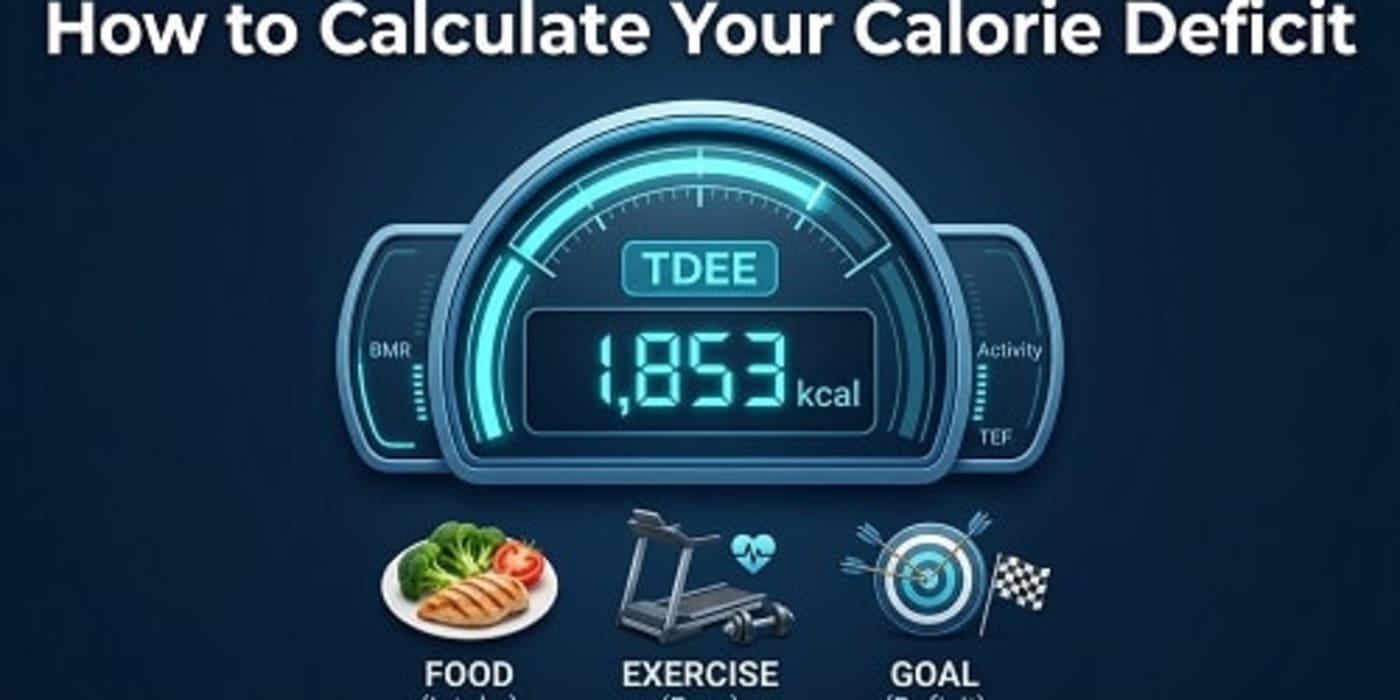
Quick answer: A calorie deficit occurs when your energy intake is lower than your total daily energy expenditure (TDEE). A simple planning equation is Calorie Deficit = TDEE − Calories Eaten. For example, if your estimated TDEE is 2,400 calories and you consistently eat about 1,900 calories, your planned deficit is approximately 500 calories per day. Your actual rate of weight loss may differ because energy expenditure changes as body weight, activity, appetite, and body composition change.
This distinction matters. A calorie deficit is not a promise that exactly 500 calories of body fat will disappear every day. Human metabolism is dynamic. Body weight affects energy expenditure, food intake can change spontaneously, physical activity can change, and water balance can temporarily hide changes in body fat.
That is why a useful calorie deficit calculator should do more than subtract an arbitrary number from your food intake. It should start with an estimate of your energy requirements, explain the assumptions behind that estimate, and give you a practical target that can be adjusted as your body changes.
Use the Calorie Deficit Calculator to estimate your daily calorie target, TDEE, deficit, and projected rate of weight loss.
Why Most Calorie Deficit Advice Fails You
Much of the calorie deficit advice online falls into one of three categories: overly simplistic, unnecessarily aggressive, or too generic to apply to a real person.
A good calorie target depends on your body size, age, sex, activity, current weight, goal, rate of weight loss, food intake, and how your body responds over time. Even a scientifically reasonable calculation is still an estimate, not a laboratory measurement of your metabolism.
1. Unrealistic deficits that set you up to fail
A larger deficit can produce faster initial weight loss, but bigger is not automatically better. Very aggressive restriction can make hunger, fatigue, poor training performance, dietary adherence, and nutrient adequacy harder to manage.
Some very-low-calorie approaches are used clinically for selected patients under medical supervision. That does not mean an unsupervised 800- or 1,000-calorie diet is appropriate for the general population.
For many adults, a moderate deficit is easier to sustain and allows enough calories for adequate protein, fiber, essential fats, micronutrients, and normal daily functioning.
2. Poor or missing macro guidance
Calories determine the energy balance that drives weight change, but food composition affects how easy it is to maintain that deficit and what happens to body composition while losing weight.
Protein can support muscle retention and satiety. Fiber-rich foods can improve fullness and help build a more nutrient-dense diet. Dietary fat supplies essential fatty acids and helps with absorption of fat-soluble vitamins. Carbohydrates can provide useful fuel for physical activity and training.
Two diets can contain the same number of calories but feel completely different in terms of hunger, energy, food volume, training performance, and nutritional quality.
3. Tools that give numbers with no explanation
A calculator that simply says "Eat 1,743 calories" without explaining where that number came from leaves an important question unanswered: Why 1,743?
A useful estimate should show the relationship between BMR, activity, TDEE, deficit size, and the resulting calorie target.
That is why this guide explains the calculation step by step instead of treating the calculator result as a magic number.
Calories In vs. Calories Out: What Actually Makes Up Your TDEE?
Your total daily energy expenditure, or TDEE, is the total amount of energy your body uses over an entire day. It is more useful to think of TDEE as a collection of several components rather than a single fixed metabolic number.
| Component | What It Means | Why It Matters |
|---|---|---|
| BMR / RMR | Energy required to support essential body functions at rest | Usually represents the largest component of daily expenditure |
| NEAT | Energy used for everyday movement outside formal exercise | Can change substantially without deliberate exercise |
| Exercise activity | Energy used during planned physical activity | Varies greatly between individuals and days |
| TEF | Energy used to digest, absorb, and process food | Changes with total intake and food composition |
These components are not completely independent. When you eat less and lose weight, your body may move less, weigh less, and require less energy to maintain itself. That is one reason a calorie target that worked at your starting weight may eventually stop producing the same rate of weight loss.
Step-by-Step: How to Calculate Your Calorie Deficit
Here is the calculation logic used by many calorie and TDEE estimation tools, including the approach behind our free calorie deficit calculator.
Step 1 — Calculate Your BMR
Basal metabolic rate (BMR) is an estimate of the energy your body requires to maintain essential physiological functions under resting conditions.
The Mifflin-St Jeor equation is widely used for estimating resting energy expenditure from body weight, height, age, and sex. Research comparing commonly used prediction equations has found Mifflin-St Jeor to be one of the more reliable general-purpose equations, although individual errors remain possible.
- Men: BMR = (10 × weight in kg) + (6.25 × height in cm) − (5 × age) + 5
- Women: BMR = (10 × weight in kg) + (6.25 × height in cm) − (5 × age) − 161
For example, a 30-year-old woman weighing 70 kg and measuring 165 cm would have an estimated BMR of approximately 1,420 calories per day.
That does not mean she should eat 1,420 calories. BMR is only one part of daily energy expenditure.
Step 2 — Estimate TDEE
Your Total Daily Energy Expenditure is higher than your BMR because you also move, exercise, digest food, and perform normal daily activities.
A common practical method is to multiply estimated BMR by an activity factor:
TDEE ≈ BMR × Activity Multiplier
This is convenient, but it should be treated as an estimate. A person's real TDEE can differ from the calculated number because activity patterns, body composition, movement, food intake, and metabolic adaptation vary.
Step 3 — Choose a Reasonable Deficit
Once you have an estimated TDEE, the next step is choosing how far below maintenance you want to eat.
There is no single deficit that is correct for every adult. A deficit should be large enough to create meaningful progress but small enough to support adherence, adequate nutrition, physical activity, and muscle retention.
Clinical guidance has historically used deficits such as 300–500 calories per day for many people and larger deficits for selected individuals with higher body weight under appropriate supervision. Modern weight-management approaches also emphasize that the body's response changes over time rather than following a perfectly linear calorie-to-weight equation.
Step 4 — Set Your Macros Within That Calorie Budget
Once your calorie target is established, distribute those calories among protein, carbohydrates, and fat.
Protein deserves particular attention during weight loss because preserving lean tissue becomes more important when energy intake is restricted.
After setting a suitable protein target and ensuring adequate dietary fat, the remaining calories can be allocated between carbohydrates and fat according to preference, health needs, and training requirements.
Worked Example
Illustrative example: 30-year-old woman, 70 kg, 165 cm, lightly active.
- Step 1 — BMR: approximately 1,420 kcal/day
- Step 2 — Estimated TDEE: 1,420 × 1.375 ≈ 1,953 kcal/day
- Step 3 — Planned deficit: −400 kcal/day
- Step 4 — Starting calorie target: approximately 1,553 kcal/day
This is an estimated starting point, not a guaranteed calorie requirement. Her real-world progress should be monitored over several weeks, because scale weight is affected by water, glycogen, food volume, menstrual-cycle changes, sodium intake, bowel contents, and other factors.
How to Choose the Right Activity Multiplier
Activity level is one of the largest sources of error in a TDEE calculation.
People frequently count their gym sessions while forgetting how much of the remaining day is spent sitting. Someone who trains for 45 minutes three times a week but spends most of the day seated may not have the same TDEE as someone who walks several hours throughout the day.
| Activity Level | Multiplier | Typical Description |
|---|---|---|
| Sedentary | × 1.2 | Mostly seated work with little structured exercise |
| Lightly Active | × 1.375 | Some exercise and/or regular daily walking |
| Moderately Active | × 1.55 | Regular exercise with substantial weekly movement |
| Very Active | × 1.725 | Frequent hard training and/or a physically active occupation |
| Extremely Active | × 1.9 | Very high training volume or heavy physical labor |
These multipliers are planning estimates, not physiological laws. If your predicted TDEE is consistently much higher than the energy intake that maintains your weight, your actual activity factor may be lower than the category you selected.
This is why real-world progress matters. Your body-weight trend over several weeks provides useful feedback that can help refine an initial estimate.
How Big Should Your Calorie Deficit Be?
The ideal deficit depends on your starting weight, body-fat level, health status, activity, training, dietary preferences, and how aggressively you want to pursue weight loss.
A moderate deficit is often easier to sustain than an aggressive one. The goal is not simply to make the number on the scale fall as quickly as possible. A successful weight-loss phase should also protect lean mass, support adequate nutrition, maintain physical function, and remain realistic enough to follow.
| Planned Deficit | Typical Use | Potential Advantage | Potential Challenge |
|---|---|---|---|
| 200–300 kcal/day | Slow, gradual weight loss | Often easier to sustain | Progress may be difficult to see week to week |
| 300–500 kcal/day | Common starting range | Balance between progress and adherence | Still requires consistent tracking and food choices |
| 500–750 kcal/day | More aggressive weight-loss approach | Potentially faster initial progress | Greater hunger, fatigue, and adherence challenges |
| 750–1,000+ kcal/day | Selected clinical situations | Faster weight loss may occur | Should generally involve professional guidance because nutritional and lean-mass risks increase |
Older clinical guidelines commonly describe a 500–1,000 kcal/day deficit as producing approximately 1–2 lb of weekly weight loss in appropriate populations, while also recognizing that weight loss slows as energy requirements fall. More recent guidance emphasizes gradual, sustainable weight management rather than treating the old 3,500-calorie rule as a precise prediction tool.
The CDC similarly describes gradual weight loss of about 1–2 pounds per week as more likely to be maintained than faster loss for many adults.
Why the 3,500-Calorie Rule Is Not a Perfect Weight-Loss Formula
You may have heard that a 3,500-calorie deficit equals exactly one pound of fat.
This can be useful as a rough historical approximation, but it is not a reliable long-term prediction equation.
As weight decreases, your body requires fewer calories to move and maintain itself. In addition, energy expenditure can adapt to changes in calorie intake and body composition. This means that the same daily deficit will not necessarily produce the same rate of weight loss forever.
The NIH Body Weight Planner was developed specifically because static calorie rules fail to capture these dynamic changes in body weight and energy expenditure.
In practical terms, think of a calorie deficit as a starting model that needs feedback, rather than a mathematical promise.
Calories vs. Macros — Why Both Matter
Calories determine the energy balance that drives weight change, but macronutrients influence satiety, food quality, training performance, and body composition.
A calorie deficit does not automatically guarantee that all of the weight lost will come from body fat. Some lean tissue can also be lost, particularly when the deficit is aggressive, protein intake is inadequate, or resistance training is absent.
Protein: The Most Important Macro to Prioritize
Protein provides amino acids needed to build and maintain body tissues. During calorie restriction, adequate protein intake combined with resistance training can help support preservation of lean mass.
There is no single protein number that is ideal for every person. Requirements can vary with body size, age, training status, body composition, and the size of the calorie deficit.
For active adults dieting to reduce body fat, a practical range often discussed in the literature is approximately 1.2–1.6 g of protein per kg of body weight per day, with higher intakes sometimes considered for resistance-trained individuals or people dieting aggressively. Protein recommendations should be individualized rather than treated as a universal minimum.
Research on resistance-trained adults suggests that protein intake around 1.6 g/kg/day is often sufficient for maximizing gains from resistance training under normal conditions, while energy restriction can increase the importance of adequate protein.
| Macro | Calories Per Gram | Primary Role | Practical Focus During a Deficit |
|---|---|---|---|
| Protein | 4 kcal/g | Muscle and tissue maintenance, satiety | Prioritize adequate intake |
| Fat | 9 kcal/g | Essential fatty acids, cell function, vitamin absorption | Avoid unnecessarily eliminating dietary fat |
| Carbohydrate | 4 kcal/g | Energy and exercise fuel | Adjust according to preference and activity |
After establishing a sensible protein target and adequate dietary fat, carbohydrates and fats can be adjusted according to personal preference and training demands.
Use the Macro Calculator to estimate a personalized protein, carbohydrate, and fat distribution within your calorie target.
Fiber, Food Volume, and Why Food Quality Matters During a Deficit
Weight loss ultimately depends on energy balance, but the foods you choose can make maintaining that balance substantially easier or harder.
Foods with high energy density can provide many calories in relatively small portions. Oils, sauces, nut butters, desserts, fried foods, sugary drinks, and processed snack foods can therefore make it easy to consume more energy than expected.
On the other hand, vegetables, fruit, legumes, lean proteins, whole grains, and other minimally processed foods can provide greater food volume and useful nutrients for fewer calories.
A useful calorie-deficit plate
- Protein: chicken, fish, eggs, Greek yogurt, cottage cheese, tofu, beans, lentils, or other protein-rich foods.
- Vegetables: use a variety of colors and textures for volume and micronutrients.
- Fruit: a convenient source of fiber, water, and micronutrients.
- Whole-food carbohydrates: potatoes, oats, rice, whole grains, beans, and other carbohydrate sources that fit your calorie target.
- Healthy fats: nuts, seeds, olive oil, avocado, and other sources in portions appropriate to your calorie budget.
The objective is not to eliminate enjoyable foods. A sustainable diet can include higher-calorie foods when portions are controlled and overall intake remains appropriate.
Real Examples: What Different Calorie Deficits Look Like
The following examples are illustrative calculations, not real patient case studies. They demonstrate how the same deficit can produce very different calorie targets depending on body size, age, sex, and activity.
Example 1 — Office Worker
Profile: 28-year-old woman, 68 kg, 162 cm, sedentary occupation.
- Estimated BMR: approximately 1,362 kcal/day
- Estimated TDEE using ×1.2: approximately 1,634 kcal/day
- Planned deficit: −300 kcal/day
- Starting calorie target: approximately 1,334 kcal/day
This example illustrates why a fixed "1,500-calorie diet" cannot be considered universally appropriate. Her estimated maintenance calories are relatively low compared with someone who is larger or significantly more active.
Example 2 — Gym-Goer
Profile: 35-year-old man, 88 kg, 178 cm, regularly trains several days per week.
- Estimated BMR: approximately 1,823 kcal/day
- Estimated TDEE using ×1.55: approximately 2,825 kcal/day
- Planned deficit: −400 kcal/day
- Starting calorie target: approximately 2,425 kcal/day
His calorie target is substantially higher than the first example because his estimated energy expenditure is higher. Cutting him to the same calorie target as the smaller sedentary person would create a much larger deficit.
Example 3 — Person Experiencing a Plateau
Profile: 42-year-old woman, 76 kg, 160 cm, regular daily walking.
- Estimated BMR: approximately 1,389 kcal/day
- Illustrative TDEE using ×1.375: approximately 1,910 kcal/day
- Current intake: approximately 1,800 kcal/day
- Estimated deficit: approximately 110 kcal/day
If her actual expenditure and intake were close to these estimates, her deficit would be relatively small. Rather than immediately assuming that her metabolism is "broken," the first step would be to verify food intake, activity, weight trends, and the assumptions used to estimate TDEE.
Why You Are Not Losing Weight in a Calorie Deficit
"But I am already eating less and nothing is happening."
This is one of the most common problems people encounter during weight loss. A scale plateau does not automatically mean that fat loss has stopped.
1. Your calorie intake is higher than you think
Dietary self-reporting is imperfect. Research comparing reported intake with objective measures such as doubly labeled water has repeatedly found under-reporting, but the size of the error varies substantially between individuals and studies.
Common sources include cooking oil, dressings, sauces, drinks, tasting food while cooking, snacks, weekend meals, restaurant portions, and inaccurate portion estimates.
2. Your activity level was overestimated
Selecting "very active" because you exercise several times per week can significantly inflate an estimated TDEE if the rest of your day is mostly sedentary.
Consider your complete day: walking, commuting, work, household activity, standing, exercise, and recreational movement.
3. Water retention is masking fat loss
Scale weight is not the same thing as body-fat mass.
Short-term changes can be caused by sodium intake, carbohydrate intake, glycogen storage, menstrual-cycle changes, bowel contents, inflammation from training, travel, stress, and changes in hydration.
A person can lose body fat while seeing little change on the scale for several days or even longer.
Instead of judging progress from one weigh-in, use consistent weigh-ins and evaluate the trend over several weeks.
4. Your TDEE has changed
As body weight decreases, the energy required to move and maintain the smaller body generally decreases as well.
This means a calorie intake that produced a 500-calorie estimated deficit at your starting weight may produce a smaller deficit later.
This is one reason the TDEE Calculator should be recalculated when your weight, activity, or routine changes substantially.
5. NEAT has decreased
Non-Exercise Activity Thermogenesis (NEAT) describes energy expenditure from everyday movement that is not formal exercise.
It includes walking around the house, standing, household chores, commuting, fidgeting, and other spontaneous movement.
During prolonged calorie restriction, some people unconsciously move less. They may sit more, walk less, or simply become less physically active outside their workouts.
This can reduce total daily energy expenditure without any conscious decision to "stop exercising."
6. Exercise calorie estimates are inaccurate
Fitness trackers, cardio machines, and exercise apps can provide useful activity estimates, but their calorie-burn numbers should not be treated as laboratory measurements.
If your TDEE calculation already accounts for your exercise activity, automatically eating back every "calorie burned" reported by a device can reduce or eliminate your intended deficit.
7. The plateau is too short to diagnose
A few days of unchanged scale weight is not enough to conclude that fat loss has stopped.
Look at the trend over several weeks rather than reacting to individual measurements.
Metabolic Adaptation: Does Your Metabolism Really Slow Down?
Yes, energy expenditure can decrease during weight loss — but the popular internet description of a "damaged metabolism" is much more dramatic than the scientific picture.
Some of the reduction is expected. A lighter body requires less energy to move and maintain than a heavier body.
There can also be an additional reduction in energy expenditure beyond what would be expected from changes in body size and composition. Researchers commonly refer to this phenomenon as adaptive thermogenesis or metabolic adaptation.
However, the magnitude is highly variable. A systematic review found substantial differences between studies and suggested that higher-quality studies often show small or non-significant adaptive effects.
What changes during weight loss?
- Resting energy expenditure can decrease as body mass and body composition change.
- Movement can decrease through changes in NEAT.
- Appetite can increase, making adherence harder.
- The body becomes lighter, reducing the energy cost of movement.
- Energy requirements at the new weight are lower than at the starting weight.
This combination helps explain why weight loss tends to slow as a diet continues.
What the "Biggest Loser" Study Actually Shows
One of the most widely discussed studies of metabolic adaptation followed participants from the television program The Biggest Loser.
In the 2016 follow-up, researchers found that resting metabolic rate remained lower than expected six years after the competition among the participants who were studied. The estimated metabolic adaptation at follow-up was approximately 499 kcal/day below the researchers' predicted value.
However, this study involved a very small group exposed to an unusually extreme weight-loss intervention. It should not be interpreted as evidence that every person who loses weight permanently develops a 500-calorie metabolic slowdown.
In fact, subsequent scientific discussion has highlighted methodological and interpretation issues surrounding the study.
The useful takeaway is not that your metabolism is "broken." It is that energy expenditure changes during and after substantial weight loss, and maintaining a lower body weight can require ongoing adjustments in food intake and physical activity.
NEAT — The Quiet Calorie Burn That Drops Without You Noticing
NEAT stands for Non-Exercise Activity Thermogenesis. It represents energy expenditure from everyday movement rather than formal workouts.
Imagine two people who both perform a 45-minute gym session. One spends the rest of the day walking, standing, doing household tasks, and moving around. The other spends most of the day sitting.
Their formal workouts are identical, but their total daily energy expenditure may be very different.
This is why weight-loss planning should not focus exclusively on gym sessions.
Practical ways to protect everyday movement
- Take short walking breaks during sedentary work.
- Walk for errands when practical.
- Use stairs when appropriate.
- Stand periodically instead of sitting continuously.
- Track daily steps if that helps you maintain consistency.
- Keep normal household and recreational activity during a diet.
There is no universal requirement to hit exactly 8,000 or 10,000 steps. The useful principle is to establish a sustainable activity level and avoid allowing everyday movement to disappear as calorie intake falls.
Exercise and the Calorie Deficit: Why Strength Training Matters
Exercise is not simply a way to "burn calories."
During weight loss, one of the major goals is to reduce body fat while preserving as much useful lean tissue as possible.
Resistance training provides a strong signal for maintaining muscle while dieting. A 2025 systematic review and meta-analysis found that adding resistance exercise to dietary weight loss helped protect fat-free mass and increased fat-mass loss compared with diet alone.
A 2026 systematic review and network meta-analysis similarly found that exercise during calorie restriction helped reduce fat-free-mass loss, with strength and mixed training showing particularly useful effects.
For general health, current CDC guidance recommends adults accumulate at least 150 minutes of moderate-intensity aerobic activity per week and perform muscle-strengthening activities on at least 2 days per week.
Your individual exercise plan should still reflect your fitness level, medical conditions, injuries, schedule, and goals.
Diet Breaks and Refeed Days — Do They Actually Help?
Diet breaks are periods during a weight-loss phase when a person temporarily increases food intake toward estimated maintenance rather than continuing the same calorie deficit every day.
They are sometimes marketed as a way to "reset" metabolism. That description is too strong.
The evidence is mixed. The MATADOR trial found greater weight loss and changes in energy expenditure with alternating periods of energy restriction and energy balance in a specific group of men with obesity.
However, a later systematic review of planned pauses found that intermittent dieting did not consistently produce superior weight loss compared with continuous energy restriction.
So why might a diet break still be useful?
- It can temporarily reduce the psychological pressure of continuous restriction.
- It can make a long diet feel more manageable.
- It may help some people practice maintenance eating.
- It provides an opportunity to reassess hunger, training, sleep, and adherence.
A diet break should therefore be viewed as a behavioral and dietary strategy, not a guaranteed metabolic reset.
How to Tell a Real Plateau From Normal Weight Fluctuation
A plateau means more than seeing the same number on the scale for a few mornings.
Because body weight fluctuates naturally, evaluate your trend rather than a single measurement.
| What You See | Possible Explanation | What to Do |
|---|---|---|
| Weight unchanged for 2–3 days | Normal water and food-volume variation | Continue and watch the trend |
| Weight jumps after a salty meal | Temporary water retention | Return to normal routine |
| Weight increases after hard training | Temporary fluid shifts and inflammation | Evaluate longer-term trend |
| Several weeks with no downward trend | Possible smaller-than-expected deficit, adherence issue, or adaptation | Audit intake and reassess TDEE/activity |
| Long-term plateau despite careful tracking | Multiple physiological and behavioral factors may be involved | Consider professional assessment |
Five Evidence-Based Steps to Break Through a Real Plateau
-
Audit your actual intake for 7–14 days.
Weigh calorie-dense foods such as oils, sauces, dressings, nuts, spreads, and snacks. Check drinks and restaurant portions. The objective is not perfection forever; it is to determine whether your estimated intake matches reality.
-
Recalculate your TDEE using your current weight.
Your energy requirements can change as your body becomes lighter. Recalculate rather than continuing to use the calorie target you received at the beginning of your diet.
-
Check your everyday movement.
Look beyond workouts. Compare your current step count and general activity with your earlier routine. If NEAT has fallen, restoring normal daily movement may help without requiring extreme additional cardio.
-
Prioritize protein and resistance training.
Adequate protein and strength training can help protect lean mass during calorie restriction. This matters because the goal should be improved body composition, not simply the lowest possible scale weight.
-
Reassess the size of your deficit.
If your intake, activity, and weight trend show that the original deficit has become very small, a modest adjustment may be appropriate. Avoid immediately jumping to an extreme restriction.
How Often Should You Recalculate Your Calorie Deficit?
There is no scientifically mandatory schedule such as "every exactly 4 weeks."
A better approach is to reassess when something meaningful changes:
- Your body weight has changed substantially.
- Your activity level changes.
- Your exercise routine changes.
- Your calorie intake changes.
- Your weight trend has stalled for several weeks.
- You reach a new weight-maintenance phase.
Use your calculator as a starting estimate, then compare it with your real-world trend.
Your TDEE Calculator can help you estimate your current maintenance calories, while the Calorie Deficit Calculator can help translate that estimate into a weight-loss target.
Common Calorie Deficit Myths Debunked
Myth: Eating as little as possible makes weight loss better
Reality: A larger deficit is not automatically a better deficit. Severe restriction can make hunger, fatigue, nutrient adequacy, training, and adherence more difficult. Some very-low-calorie diets are used medically, but that does not make them appropriate for unsupervised general use.
Myth: You must eat below 1,200 calories to lose weight
Reality: There is no universal calorie number that determines whether weight loss can occur. Your calorie requirement depends on your body and activity. A fixed 1,200-calorie prescription can be far too restrictive for some adults and may be unnecessary for others.
Myth: Carbohydrates automatically make you gain fat
Reality: Carbohydrates are not uniquely fattening. Body-fat gain occurs when energy intake chronically exceeds energy expenditure. Lower-carbohydrate diets can help some people reduce calorie intake, but carbohydrate restriction is not inherently required for fat loss.
Myth: Eating after 8 PM automatically stops fat loss
Reality: Meal timing can influence hunger, routine, and adherence, but a specific clock time does not override energy balance. A person can lose weight while eating dinner late if overall intake remains appropriate.
Myth: Exercise calories are exact
Reality: Exercise machines and wearable devices estimate energy expenditure. They can be useful for tracking activity trends but should not be treated as perfectly accurate measurements of calories burned.
Myth: A plateau means your metabolism is broken
Reality: Weight-loss plateaus can involve lower energy requirements, reduced activity, increased appetite, water fluctuations, adherence changes, and other factors. Metabolic adaptation is real, but it is only one piece of a much larger picture.
Myth: You can eat unlimited junk food if calories are low enough
Reality: Energy balance remains central to weight change, but diet quality affects protein intake, fiber, micronutrients, hunger, energy, digestive health, and long-term health. A sustainable calorie deficit should not be reduced to "eat anything as long as calories are low."
Calorie Deficit and Weight Loss: What Should You Actually Track?
Tracking more variables does not necessarily make weight loss better. The goal is to monitor the measurements that provide useful feedback without becoming overwhelmed.
| Metric | Why Track It? | How to Interpret It |
|---|---|---|
| Body weight | Shows overall trend | Use consistent measurements and focus on the trend |
| Calories | Shows approximate energy intake | Accuracy matters most during troubleshooting |
| Protein | Supports lean-mass preservation | Evaluate daily and weekly consistency |
| Steps / activity | Helps monitor NEAT and movement | Look for meaningful changes from your baseline |
| Waist measurement | Provides a body-composition-related trend | Measure consistently rather than daily |
| Strength/performance | Useful indicator during resistance training | Maintaining or improving performance can support the goal of preserving muscle |
When a Calorie Deficit May Need Professional Guidance
Calorie calculators are useful educational tools, but they cannot account for every medical or nutritional circumstance.
Talk with a qualified healthcare professional or registered dietitian if you are pregnant or breastfeeding, have a history of an eating disorder, have diabetes or another condition affected by food intake, take medications that influence weight or appetite, are underweight, are experiencing unexplained weight changes, or are considering a very-low-calorie diet.
Children and teenagers also require different approaches to nutrition and growth and should not use adult calorie-deficit recommendations without appropriate professional guidance.
Frequently Asked Questions
What is a healthy calorie deficit per day?
There is no single deficit that is healthy for every adult. A moderate deficit such as approximately 300–500 calories per day is a commonly used starting range for many people, while larger or smaller deficits may be appropriate depending on body size, health, goals, and professional guidance.
How many calories should I eat to lose weight?
Start by estimating your TDEE and then select a reasonable deficit. For example, someone with an estimated TDEE of 2,400 calories might begin around 1,900–2,100 calories depending on the desired rate of loss and individual circumstances. The appropriate target should be personalized rather than copied from someone else's diet.
Is 1,200 calories enough to lose weight?
It can produce weight loss in some people because it may create an energy deficit, but that does not mean 1,200 calories is an appropriate target for everyone. For many adults it may be unnecessarily restrictive and difficult to meet nutritional needs on. Calculate your estimated energy requirements instead of automatically choosing 1,200 calories.
How do I calculate my TDEE?
One common method is to estimate BMR using an equation such as Mifflin-St Jeor and then apply an activity factor. Because this is an estimate, your actual weight trend can provide useful feedback about whether the calculated TDEE is close to your real-world energy needs.
Why am I not losing weight even though I am in a calorie deficit?
First confirm that the deficit is real. Check food portions, oils, sauces, drinks, snacks, weekend intake, activity assumptions, and exercise-calorie estimates. Also consider water retention and the length of the plateau. If your current weight is lower than when you started, your energy requirements may also have decreased.
How long does it take to see results from a calorie deficit?
Scale weight can change within days, but short-term changes are heavily influenced by water and food contents. A more useful assessment is the multi-week trend. Gradual weight loss is generally easier to interpret and sustain than expecting dramatic changes every few days.
Should I eat back calories burned during exercise?
Not automatically. If your activity level was already included when estimating TDEE, eating back every exercise calorie reported by a wearable can effectively double-count activity. If you are highly active, train intensely, or have performance-related goals, a more individualized approach may be appropriate.
Does metabolic adaptation stop weight loss?
No. Metabolic adaptation can reduce energy expenditure and make continued weight loss more difficult, but it does not mean the body becomes incapable of losing weight. Energy requirements change as body weight and activity change, which is why weight-loss plans sometimes need to be reassessed.
Can I lose weight without counting calories?
Yes. Some people lose weight using portion control, structured meals, higher-protein diets, dietary patterns, food substitutions, or other approaches without formally counting calories. However, the underlying energy balance still matters. Calorie tracking is one method of making that energy balance more visible.
Is calorie counting accurate?
It is an estimation process. Food labels, databases, restaurant nutrition information, portion sizes, cooking methods, and human tracking errors all introduce uncertainty. The goal is not laboratory-level precision; it is obtaining a useful estimate that supports consistent decisions.
Can I lose fat and gain muscle at the same time?
Body recomposition is possible, particularly for beginners, people returning to training, and some individuals with higher body-fat levels. Resistance training, adequate protein, appropriate calorie intake, and progressive training can support the process. However, the rate of muscle gain during a calorie deficit is generally slower than during energy balance or a calorie surplus.
Calculate Your Calorie Deficit — Free
Use the free Calorie Deficit Calculator to estimate your TDEE, daily calorie target, projected rate of weight loss, and calorie deficit based on your personal information.
Then use the Macro Calculator to divide your calorie target into protein, carbohydrate, and fat targets.
If you want to understand the maintenance number behind the deficit, use the TDEE Calculator first.
Remember: calculator results are estimates. Your real-world weight trend, activity, hunger, performance, and ability to maintain the plan provide important feedback that should be considered alongside the initial calculation.
No signup required. Instant results. Your data stays private.
References & Research Sources
- National Institute of Diabetes and Digestive and Kidney Diseases (NIDDK). NIH Body Weight Planner and Research Behind the Body Weight Planner.
- Burrows, T. L. et al. (2019). Validity of Dietary Assessment Methods When Compared to the Method of Doubly Labeled Water: A Systematic Review in Adults.
- Franz, M. J. et al. Clinical guidelines on weight management and calorie restriction.
- Fothergill, E. et al. (2016). Persistent metabolic adaptation 6 years after "The Biggest Loser" competition. Obesity.
- Kuchnia, A. et al. (2016). Overstated metabolic adaptation after "The Biggest Loser" intervention. Obesity.
- Byrne, N. M. et al. (2017/2018). Intermittent energy restriction improves weight loss efficiency in obese men: the MATADOR study. International Journal of Obesity.
- Wren, G. M. et al. (2024). Effect of planned pauses versus continuous energy restriction on weight loss and attrition: a systematic review. Obesity.
- Morton, R. W. et al. (2018). A systematic review, meta-analysis and meta-regression of the effect of protein supplementation on resistance training-induced gains in muscle mass and strength in healthy adults. British Journal of Sports Medicine.
- Deller, M. et al. (2026). Effects of Calorie Restriction With and Without Strength, Endurance or Mixed Training on Fat-Free and Skeletal Muscle Mass in Overweight or Obese Individuals. Diabetes, Obesity and Metabolism.
- Ashtary-Larky, D. & Mohammadi, S. (2026). Weight Loss Plateau: Reasons, Challenges, and Solutions: A Narrative Review. Health Science Reports.
- Centers for Disease Control and Prevention (CDC). Steps for Losing Weight.
- Centers for Disease Control and Prevention (CDC). Adult Physical Activity Guidelines.
Medical disclaimer: This article is for educational purposes and is not a substitute for individualized medical or nutritional advice. Calorie and TDEE calculations are estimates and may not reflect an individual's measured energy expenditure. If you have a medical condition, take medication that affects weight or appetite, are pregnant or breastfeeding, have a history of an eating disorder, or are considering a very-low-calorie diet, consult an appropriately qualified healthcare professional.
Calculate your own numbers — free.
18 science-backed calculators covering everything in this article and more.