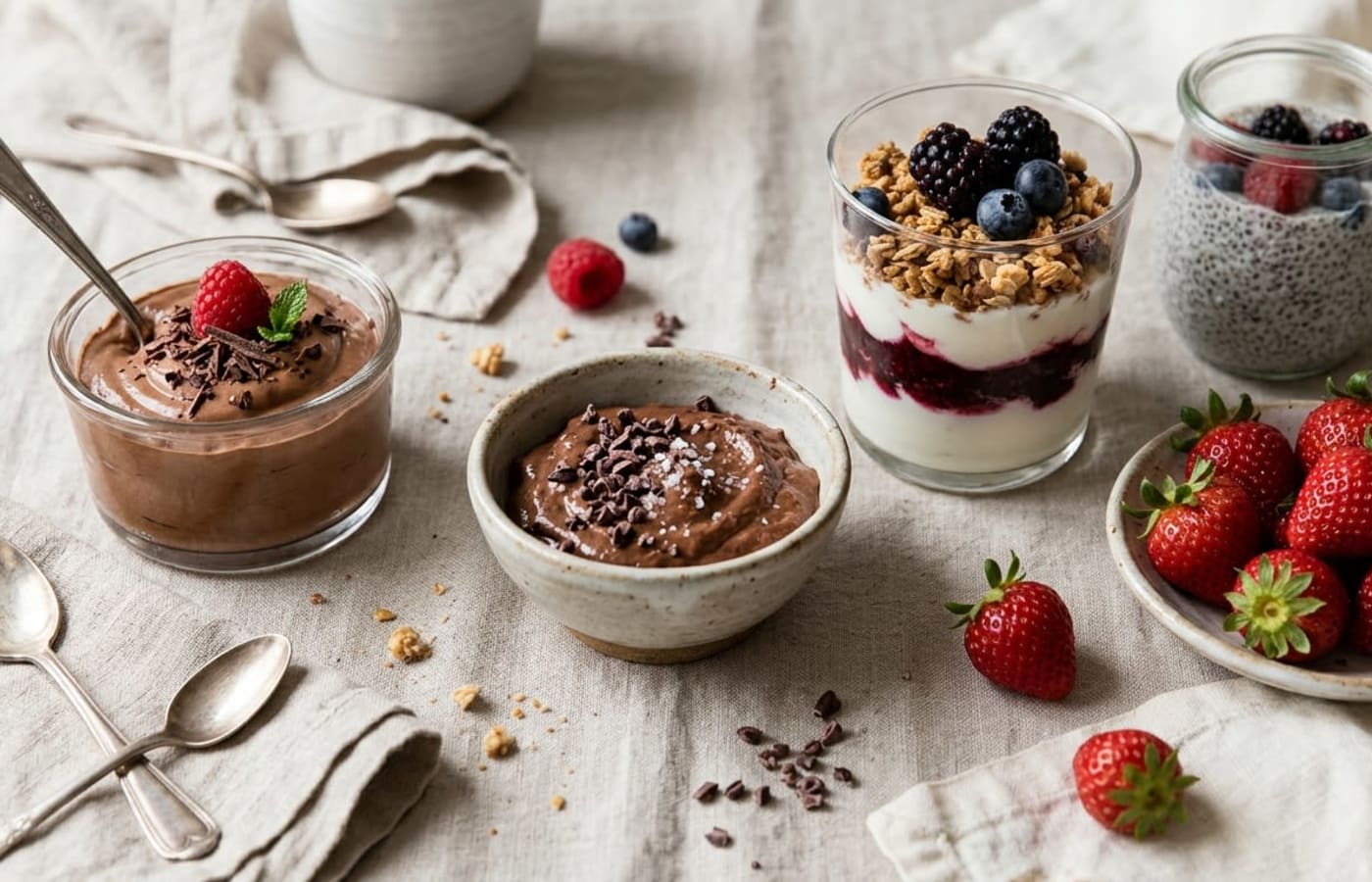
10 High-Protein Desserts Without Protein Powder: Delicious Ideas With Real-Food Ingredients
You do not need a scoop of protein powder to make a satisfying high-protein dessert. Greek yogurt, cottage cheese, milk, eggs, nuts, seeds, and naturally protein-rich ingredients can help turn everyday sweet treats into more balanced options.
Table of Contents
Introduction: Can Dessert and Protein Belong in the Same Meal Plan?
For a long time, people tended to think of protein foods and desserts as two separate categories.
Protein was associated with chicken breast, eggs, fish, shakes, and bodybuilding meals. Desserts were associated with sugar, butter, chocolate, cream, and foods eaten mainly for enjoyment.
But food choices do not have to fit into such strict categories.
A bowl of Greek yogurt with berries can be a dessert. Cottage cheese can become a chocolate mousse. Milk and eggs can form the base of a homemade pudding. Peanut butter, nuts, and seeds can add protein to a sweet snack.
This is one reason searches for high-protein desserts without protein powder have become an appealing content opportunity: people want practical ways to increase protein without relying on supplements or giving up familiar foods.
There is an important distinction, though. A dessert containing a little protein is not automatically a high-protein dessert. A spoonful of peanut butter or a small amount of milk may contribute protein, but the total amount depends on the full recipe and serving size.
This guide explains the ingredients that make the biggest difference, how to build a more balanced dessert, and ten practical recipes using ordinary foods.
1. Why High-Protein Desserts Are Trending
Protein has become a major focus in everyday nutrition.
People are increasingly interested in protein because it contributes to muscle maintenance, tissue repair, and many normal body functions. It is also relevant to people who exercise, age-related muscle preservation, and dietary patterns designed to support fullness.
At the same time, many people want foods that are enjoyable and realistic to eat regularly.
A high-protein dessert offers a convenient way to combine enjoyment with a nutrient that may otherwise be difficult to include consistently.
The appeal of food-first protein
Not everyone wants to buy protein powder, use sweetened supplements, or prepare complicated recipes.
Food-first ingredients can provide protein alongside other nutrients:
Greek yogurt provides protein and calcium.
Cottage cheese provides protein and calcium.
Milk provides protein, calcium, and other nutrients.
Eggs provide high-quality protein and several micronutrients.
Nuts and seeds provide protein, unsaturated fats, and fiber.
Soy foods provide plant protein.
The result can be a dessert that is more nutritionally substantial than a conventional sweet snack.
Why the trend should not become a protein obsession
More protein is not automatically better for every person.
Protein requirements depend on body weight, age, activity, health status, and individual goals. A dessert should not be treated as a replacement for a balanced diet.
For most people, the bigger goal is to meet their overall daily protein needs through a variety of foods, rather than forcing every meal and snack to contain a very high amount.
2. Can You Really Make a High-Protein Dessert Without Protein Powder?
Yes.
Protein powder is simply one concentrated ingredient. It is not essential for making a protein-rich recipe.
The most useful food-based ingredients are often dairy products, eggs, soy foods, nuts, and seeds.
However, the protein content varies considerably.
For example:
Regular yogurt generally contains less protein than strained Greek yogurt.
Cottage cheese can provide a substantial amount of protein, depending on the product.
Milk contributes protein, but a small splash will not transform a recipe into a high-protein meal.
Nuts and nut butters contain protein, but they are also energy-dense because they provide substantial fat.
Chia seeds contain protein and fiber, but they are not as concentrated a protein source as many dairy products.
The key is to build the recipe around a meaningful protein source instead of adding a token amount of protein-rich ingredients.
3. The Best Natural Protein Sources for Desserts
Greek yogurt
Greek yogurt is one of the most versatile ingredients for protein-focused desserts.
Straining removes some of the liquid whey, which concentrates the remaining protein relative to ordinary yogurt.
It can be used in:
Frozen yogurt bark
Cheesecake-style bowls
Chocolate yogurt mousse
Fruit parfaits
Creamy dessert dips
Check the nutrition label. Protein content varies by brand, style, and serving size.
Cottage cheese
Cottage cheese has attracted attention as a versatile high-protein ingredient.
It can be blended until smooth to create a creamy base for desserts.
A 2025 review in Critical Reviews in Food Science and Nutrition examined the nutritional characteristics and potential health effects of cottage cheese. It also emphasized an important limitation: despite its popularity, high-quality human randomized controlled trials directly evaluating many proposed health effects remain limited.
That means cottage cheese can be a convenient protein ingredient without needing to be promoted as a special metabolic or weight-loss food.
Milk
Milk provides complete protein, including whey and casein proteins.
It can be used in puddings, custards, chia desserts, and homemade frozen treats.
Eggs
Eggs provide high-quality protein and help create structure in baked desserts and custards.
Because raw or inadequately cooked eggs can carry food-safety risks, use properly cooked recipes and appropriate storage.
Nuts and nut butters
Almonds, peanuts, pistachios, and peanut butter can increase protein content and add texture.
They also contain considerable energy from fat. Portion size matters if calorie intake is part of your goal.
Soy foods
Silken tofu is a useful plant-based dessert ingredient. When blended, it creates a smooth texture and can work well in chocolate mousse.
Soy foods provide plant protein, making them useful for people who avoid dairy.
Seeds
Chia seeds, hemp seeds, and pumpkin seeds can contribute protein, fiber, and fats.
They are best used as supporting ingredients rather than the only protein source in a dessert.
4. Does Protein in Dessert Actually Matter?
It can matter as part of the overall diet, but the benefits should not be exaggerated.
Protein supports muscle maintenance
Dietary protein supplies amino acids needed to build and maintain body tissues.
When combined with appropriate resistance exercise, adequate protein intake supports muscle adaptation and recovery.
A dessert does not have a unique muscle-building effect. It simply contributes to the day's total protein intake.
Protein can contribute to fullness
Protein can influence appetite and satiety through several mechanisms, including digestive processes and gut-derived signaling.
However, fullness is affected by more than protein alone. Energy content, food texture, volume, fiber, and individual preferences also matter.
Protein does not cancel out sugar or calories
A dessert can be high in protein and still contain substantial added sugar, saturated fat, or calories.
For example, a large chocolate cheesecake made with cottage cheese may provide protein, but it can still be energy-dense.
A more useful approach is to evaluate the entire nutritional profile rather than judging food by one number.
5. Ten High-Protein Desserts Without Protein Powder
The following recipes use ordinary ingredients. Nutrition values are estimates and can vary with brands, ingredient sizes, sweeteners, and serving portions. They should be recalculated using the exact ingredients before publication as fixed macro values.
Recipe 1: Chocolate Greek Yogurt Mousse
Why it works: Greek yogurt provides the main protein source, while cocoa adds chocolate flavor without requiring a large amount of chocolate.
Ingredients
200 g plain Greek yogurt
1 tablespoon unsweetened cocoa powder
1–2 teaspoons honey or a sweetener of choice
A small splash of vanilla extract
A few dark chocolate shavings, optional
Method
Add the Greek yogurt and cocoa powder to a bowl.
Mix until smooth and evenly colored.
Add vanilla and sweeten to taste.
Refrigerate for 20–30 minutes.
Finish with a small amount of dark chocolate if desired.
Nutrition note: The protein comes primarily from the yogurt. The exact amount depends on the product's label. Choosing plain yogurt gives you better control over added sugar.
Recipe 2: Blended Cottage Cheese Chocolate Mousse
Ingredients
200 g cottage cheese
1 tablespoon unsweetened cocoa powder
1 teaspoon honey or sweetener
½ teaspoon vanilla extract
A pinch of salt
Method
Place all ingredients in a blender.
Blend until completely smooth.
Scrape down the sides and blend again if necessary.
Chill for at least 30 minutes.
Serve with berries or a small amount of chopped nuts.
Why it works: Blending changes the texture of cottage cheese, making it resemble a creamy mousse.
Nutrition note: Cottage cheese varies in protein and sodium content. Check the package rather than assuming all brands are equivalent.
Recipe 3: Greek Yogurt Berry Cheesecake Bowl
Ingredients
200 g plain Greek yogurt
½ cup strawberries or mixed berries
2 tablespoons crushed whole-grain oats
1 teaspoon honey
A few drops of vanilla
1 tablespoon chopped almonds, optional
Method
Mix yogurt, vanilla, and honey.
Add berries.
Sprinkle oats over the top.
Finish with chopped almonds.
Chill briefly for a thicker texture.
Why it works: This recipe combines dairy protein with fruit and some fiber from oats and berries.
Recipe 4: Peanut Butter Banana Yogurt Cups
Ingredients
150–200 g Greek yogurt
½ medium banana
1 tablespoon peanut butter
Cinnamon
A few crushed peanuts
Method
Mash the banana.
Stir it into the yogurt.
Add cinnamon.
Swirl in peanut butter.
Finish with crushed peanuts and refrigerate.
Nutrition note: Peanut butter adds some protein, but it is also energy-dense. Measure the portion instead of pouring freely.
Recipe 5: High-Protein Chia Pudding
Ingredients
150 ml milk
100 g plain Greek yogurt
2 tablespoons chia seeds
½ teaspoon vanilla
Berries for topping
Method
Whisk the milk, yogurt, and vanilla.
Stir in chia seeds.
Wait five minutes and stir again to reduce clumping.
Refrigerate for at least four hours or overnight.
Add berries before serving.
Why it works: Milk and Greek yogurt provide the main protein, while chia seeds contribute fiber and help create a thick texture.
Important: Chia seeds absorb liquid. Allow the pudding to hydrate fully rather than eating large quantities of dry seeds.
Recipe 6: Baked Egg Custard
Ingredients
2 eggs
200 ml milk
½ teaspoon vanilla
Cinnamon
Sweetener to taste
Method
Whisk eggs and milk until combined.
Add vanilla and cinnamon.
Pour into heat-safe ramekins.
Place the ramekins in a larger baking dish with hot water.
Bake at approximately 160°C until the custard is set.
Cool safely and refrigerate.
Why it works: Eggs and milk provide the protein.
Food safety: Cook the custard thoroughly and refrigerate leftovers promptly.
Recipe 7: Silken Tofu Chocolate Pudding
Ingredients
200 g silken tofu
1 tablespoon unsweetened cocoa
1–2 teaspoons maple syrup or another sweetener
½ teaspoon vanilla
A pinch of salt
Method
Drain excess liquid from the tofu.
Blend all ingredients until silky.
Taste and adjust sweetness.
Chill for at least 30 minutes.
Serve with berries.
Why it works: Silken tofu creates a creamy plant-based dessert and contributes soy protein.
Recipe 8: Frozen Greek Yogurt Berry Bark
Ingredients
250 g Greek yogurt
½ cup berries
1 tablespoon chopped pistachios
1 teaspoon honey, optional
Method
Spread yogurt on a parchment-lined tray.
Scatter berries and pistachios across the surface.
Drizzle lightly with honey if desired.
Freeze until firm.
Break into pieces and serve.
Nutrition note: This is a frozen snack, not a conventional ice cream replacement in terms of texture. Its nutritional value depends on the yogurt and toppings.
Recipe 9: Peanut Butter Oat Yogurt Bites
Ingredients
100 g Greek yogurt
40 g oats
1 tablespoon peanut butter
Cinnamon
A few chopped peanuts
Method
Mix the yogurt, oats, peanut butter, and cinnamon.
Refrigerate until the mixture becomes firmer.
Shape into small bites.
Add chopped peanuts.
Keep refrigerated and consume within a suitable food-storage period.
Why it works: Yogurt provides the main protein, while oats and peanuts add texture and additional nutrients.
Recipe 10: Strawberry Milk Pudding
Ingredients
250 ml milk
100 g Greek yogurt
½ cup mashed strawberries
A small amount of gelatin or a suitable vegetarian setting agent
Vanilla
Sweetener to taste
Method
Prepare the setting agent according to its package instructions.
Warm the milk gently; do not boil unnecessarily.
Mix in the prepared setting agent.
Allow the mixture to cool until warm rather than hot.
Stir in yogurt and strawberry puree.
Pour into serving cups and refrigerate until set.
Why it works: Milk and yogurt provide the protein, while strawberries provide flavor and fruit content.
Food note: The setting agent changes the texture, not the protein content significantly. Check the label if you need a vegetarian or vegan version.
6. How to Make Desserts Higher in Protein
You do not have to follow a special recipe every time.
A few simple ingredient substitutions can increase protein in familiar desserts.
Instead of relying mainly on | Consider adding or using | Why |
|---|---|---|
Regular yogurt | Plain Greek yogurt | Often more protein per serving |
Cream-heavy mousse | Blended cottage cheese or Greek yogurt | Can increase protein and change the fat profile |
Water-based pudding | Milk or soy milk | Adds protein |
Fruit-only snack | Yogurt with fruit | Adds dairy protein |
A small amount of nuts alone | Yogurt plus a measured nut topping | Makes the main protein source more substantial |
Traditional custard mix | Eggs and milk | Provides protein from whole foods |
The best substitution depends on the recipe. Greek yogurt may work well in a cold mousse but may behave differently in a baked recipe.
7. Protein, Calories, Sugar, and Portion Size
A common mistake is assuming that a high-protein dessert must also be low-calorie or low-sugar.
These are separate nutritional characteristics.
Consider three examples:
A Greek yogurt bowl with berries may provide protein, fruit, and relatively modest energy depending on the portion.
A cottage cheese chocolate mousse may provide substantial protein but can become energy-dense with large amounts of nut butter or chocolate.
A dessert made with milk, eggs, cream, and sugar can contain protein while also being high in saturated fat and added sugar.
When evaluating a recipe, look at:
Protein per serving.
Total calories per serving.
Added sugar.
Saturated fat.
Fiber, where relevant.
Serving size.
For a dessert to be genuinely useful, it should fit the person's overall eating pattern rather than simply maximize one nutrient.
8. Common Mistakes When Making High-Protein Desserts
Mistake 1: Assuming all yogurt has the same protein content
Regular, Greek, Icelandic-style, and plant-based yogurts can differ substantially.
Always check the nutrition label.
Mistake 2: Adding too much peanut butter
Peanut butter provides protein, but it is also rich in fat and calories.
A measured tablespoon can add flavor without making the dessert excessively energy-dense.
Mistake 3: Treating collagen as a complete substitute for dietary protein
Collagen peptides have a different amino acid profile from many complete dietary protein sources and are particularly low in some essential amino acids.
A recipe should not automatically be described as equivalent to a dairy-, egg-, or soy-based protein dessert simply because collagen has been added.
Mistake 4: Forgetting portion size
A recipe may contain 40 grams of protein in the entire bowl but only 10 grams in each of four servings.
Always calculate nutrition per serving, not per full batch.
Mistake 5: Using misleading labels
Terms such as "guilt-free," "fat-burning," or "metabolism-boosting" do not describe reliable nutritional outcomes.
A more credible recipe article tells readers what the food contains and what it does not promise.
9. How to Choose a Better High-Protein Dessert
Use this simple checklist:
Does the recipe have a meaningful protein source?
Is the serving size realistic?
Is the protein value calculated from actual ingredients?
Does the recipe contain a reasonable amount of added sugar?
Does it suit your dietary requirements?
Is it enjoyable enough to make again?
You do not need to make every dessert low-fat, low-carb, low-calorie, and high-protein at the same time.
A balanced approach leaves room for enjoyment.
10. Frequently Asked Questions
What is the best high-protein dessert without protein powder?
Greek yogurt mousse and blended cottage cheese mousse are practical options because their main ingredients already contain substantial protein.
Can I get 20 grams of protein from a dessert without protein powder?
Yes. Depending on the product and serving size, a dessert made with a substantial amount of Greek yogurt or cottage cheese may provide around 20 grams or more. Calculate the actual recipe rather than assuming a fixed value.
Is cottage cheese good for making desserts?
Yes. Blending cottage cheese creates a smooth texture suitable for chocolate mousse, cheesecake-style bowls, and pudding. Its protein content varies by brand.
Is Greek yogurt better than regular yogurt for protein?
Greek yogurt usually contains more protein per serving because it is strained. However, products vary, so compare labels.
Are high-protein desserts good for weight loss?
They can fit into a weight-management plan, especially when they replace less satisfying alternatives. But weight loss depends on long-term energy balance, not one particular dessert.
Can I eat high-protein desserts every day?
A dessert can be part of an everyday eating pattern if it fits your nutritional needs. Variety and overall diet quality remain important.
Are high-protein desserts suitable for vegetarians?
Many are. Greek yogurt, cottage cheese, milk, eggs, soy milk, and tofu can all be used depending on the person's dietary preferences.
Are these desserts suitable for people with diabetes?
Not automatically. Their carbohydrate, sugar, and total energy content still matter. People managing diabetes should consider the complete recipe and their individual care plan.
11. Final Takeaway: Protein Powder Is Optional
High-protein desserts do not need complicated ingredients or expensive supplements.
Greek yogurt, cottage cheese, milk, eggs, tofu, nuts, and seeds can all help create sweet foods that contribute to daily protein intake.
The most useful recipe is not necessarily the one with the highest protein number. It is the one that tastes good, uses ingredients you enjoy, provides a meaningful nutritional contribution, and fits your overall eating pattern.
Dessert can be enjoyable and nutritionally useful at the same time.
References and Further Reading
Farsi DN, et al. Cottage cheese, a relatively underexplored cultured dairy product with potential health benefits? Critical Reviews in Food Science and Nutrition. 2025;65(32):7953–7963. DOI: 10.1080/10408398.2025.2487682.
Savaiano DA, Hutkins RW. Yogurt, cultured fermented milk, and health: a systematic review. Nutrition Reviews. 2021;79(5):599–614. DOI: 10.1093/nutrit/nuaa013.
Jäger R, et al. International Society of Sports Nutrition Position Stand: protein and exercise. Journal of the International Society of Sports Nutrition. 2017;14:20. DOI: 10.1186/s12970-017-0177-8.
National Academies of Sciences, Engineering, and Medicine. Dietary Reference Intakes for Energy, Carbohydrate, Fiber, Fat, Fatty Acids, Cholesterol, Protein, and Amino Acids. 2005.
USDA FoodData Central. Food composition database. https://fdc.nal.usda.gov/.
Calculate your own numbers — free.
18 science-backed calculators covering everything in this article and more.