In this guide
Your smartwatch tells you the spin class burned 620 calories. That number feels precise — a real, specific measurement your device tracked in real time. It's also, according to a growing and remarkably consistent body of research spanning nearly a decade, very likely wrong — not by a rounding error, but frequently by hundreds of calories in either direction.
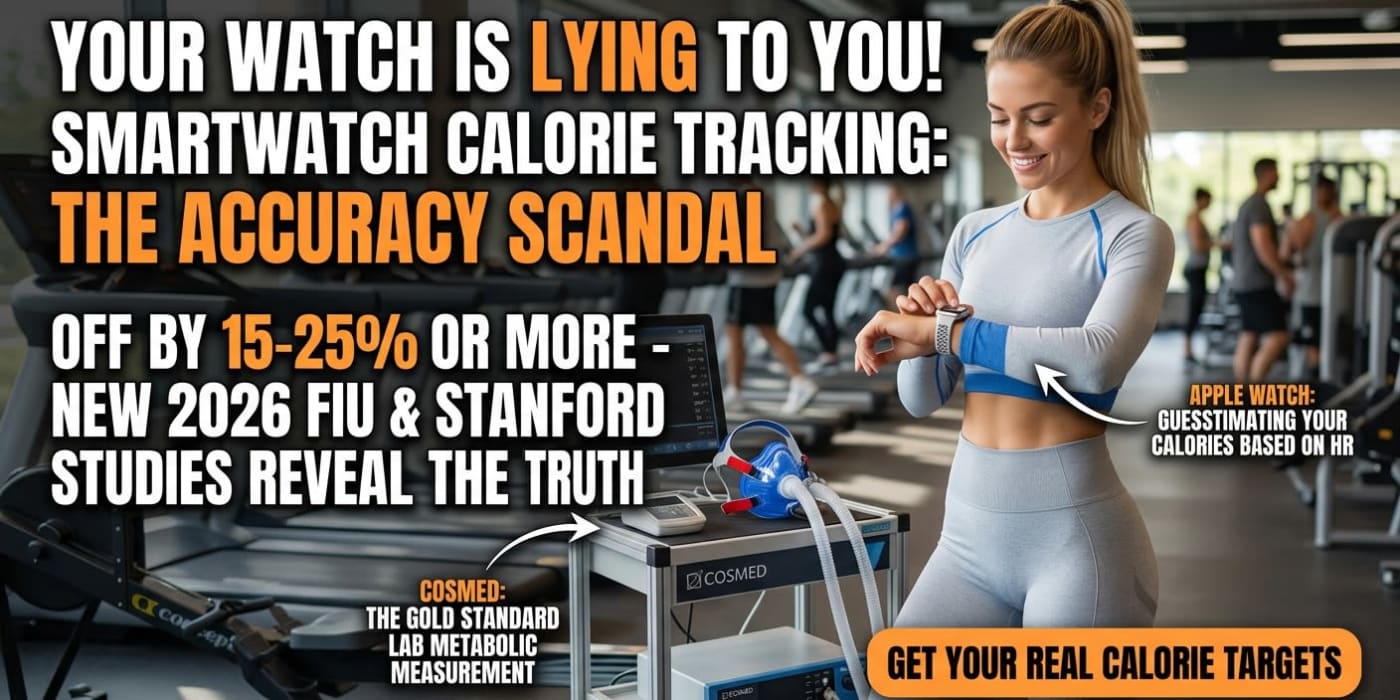
A 2026 study comparing the Apple Watch Series 8, Fitbit Sense 2, Samsung Galaxy Watch 5, and Garmin Forerunner 955 against a gold-standard COSMED K5 metabolic analyzer found typical calorie-burn errors in the 15-25% range, with some devices performing considerably worse — and accuracy worsening as body fat percentage increased. This builds directly on a landmark 2017 Stanford study that found wearable calorie estimates off by an average of 27%, with the worst-performing device off by 93%.
This guide covers what's actually going wrong inside these devices, which perform relatively better, and — most importantly — what to actually rely on when setting your real calorie targets.
The 2026 Study That Measured Your Smartwatch Against the Gold Standard
Researchers at Florida International University tested four of the most popular current wearables against a COSMED K5 — the type of clinical-grade metabolic analyzer used in research labs to directly measure oxygen consumption and, from that, actual calorie expenditure. Apple Watch performed as the most accurate of the group tested. Garmin and Samsung overestimated calorie burn the most. Fitbit's results were genuinely difficult to even assess — the device occasionally reported implausibly low readings, including a single calorie for an entire workout, and sometimes failed to generate a reading at all, forcing researchers to exclude much of that device's data from the final analysis entirely.
The Stanford Study This Builds On
This isn't a new or isolated finding — it replicates and extends a well-established research pattern. In 2017, Stanford University researchers tested seven popular wrist-worn devices (including the Apple Watch, Fitbit Surge, Microsoft Band, and others) against the same type of gold-standard metabolic measurement. Heart rate tracking performed impressively — six of seven devices measured within 5% of the reference standard. Calorie burn estimation told a completely different story: even the most accurate device averaged a 27% error, and the least accurate device was off by 93% — meaning a workout the device reported as 500 calories may have actually burned closer to 260, or as much as 965.
Why Wearables Get Calorie Burn Wrong — The Actual Mechanism
The core problem is structural, not a simple bug that better software eventually fixes: most consumer wearables estimate calorie burn primarily from heart rate, using population-average equations that assume a given heart rate corresponds to a given metabolic rate. This assumption breaks down for several well-documented reasons:
- Heart rate responds to things unrelated to calorie burn — stress, caffeine, heat, and dehydration all elevate heart rate without a proportional increase in actual energy expenditure
- Resistance training decouples heart rate from calorie burn specifically — heart rate spikes during a heavy lift don't correlate with calorie expenditure the way they do during steady-state cardio, which is why strength-training estimates are often particularly unreliable
- Body composition affects accuracy — the 2026 FIU study specifically found error worsening as body fat percentage increased, since the underlying algorithms weren't calibrated evenly across body types
- Optical sensors are physically limited by skin tone, tattoos, and how snugly the device fits the wrist — all factors that can degrade the underlying heart rate signal the calorie estimate depends on
Which Devices Perform Relatively Best — And Worst
| Device | General Accuracy Pattern (across studies) |
|---|---|
| Apple Watch | Generally the most accurate of current mainstream wearables, though still meaningfully imprecise |
| Garmin | Tends toward significant overestimation in recent comparative testing |
| Samsung Galaxy Watch | Similarly prone to overestimation in recent testing |
| Fitbit | Inconsistent — occasionally implausible readings; historically among the more variable performers |
The practical takeaway isn't "buy an Apple Watch and trust the number" — even the best-performing device in these comparisons still carries meaningful error. It's that relative device ranking matters less than understanding that none of them should be treated as a precise absolute measurement.
Why the Error Changes Depending on What You're Doing
A 2015 review covering 22 published studies on consumer activity trackers found error rates varying considerably by activity type — walking estimates off by roughly 31% on average, cycling estimates off by around 52%. More recent comparative testing echoes this pattern: steady-state cardio tends to produce the smallest errors (roughly 10-20%), walking can run 26-61% off, and cycling can approach 52% error. Swimming remains particularly unreliable across most devices, and resistance training — for the heart-rate-decoupling reasons above — is among the least trustworthy categories of all.
The "Eating Back Your Calories" Trap This Creates
This inaccuracy isn't a harmless quirk — it directly undermines a common weight-management strategy. A 2024 Mayo Clinic study compared wearable TDEE estimates from Apple Watch, Garmin, and Fitbit against doubly-labeled water measurement (the gold standard for tracking real-world energy expenditure) over 14-day periods, finding an average overestimation of 18% across devices. For someone with an actual TDEE of 2,200 calories, an 18% overestimate means their watch reports roughly 2,600 — a 400-calorie gap. If that person adjusts their eating based on the inflated number — a common practice sometimes called "eating back" exercise calories — they end up in a consistent calorie surplus without realising it, directly undermining a fat-loss goal they believe they're actively pursuing.
What to Use Instead for Your Actual Calorie Targets
Wearable calorie data has genuine value as a relative measure — comparing whether Tuesday's session was more intense than Monday's, or tracking a consistency trend over time. It's considerably less reliable as an absolute number for setting nutrition targets. For that purpose, validated population equations consistently outperform wearable estimates:
- Use the TDEE calculator, based on the Mifflin-St Jeor equation, for your baseline daily calorie needs including a chosen activity level — this doesn't depend on device-specific algorithmic guesswork.
- Use the calories burned calculator for individual sessions, which relies on validated MET (Metabolic Equivalent of Task) values from the ACSM Compendium of Physical Activities rather than heart-rate-based estimation.
- Treat your wearable's number as a rough trend indicator, not a precise input for daily calorie math.
Frequently Asked Questions
Which fitness tracker is most accurate for calorie burn?
Recent comparative testing generally finds Apple Watch performing relatively better than Garmin, Samsung, and Fitbit for calorie-burn estimation specifically, though all devices still carry meaningful error — typically 15-25% or higher depending on activity type — and none should be treated as a precise absolute measurement.
Why does my smartwatch overestimate calories burned?
Most wearables estimate calorie burn primarily from heart rate using population-average algorithms, which don't account for factors like stress, caffeine, body composition, or activities (like resistance training) where heart rate doesn't correlate well with actual energy expenditure.
Should I eat back the calories my fitness tracker says I burned?
This is generally not advisable given documented overestimation rates averaging around 18% across major devices in controlled comparison against gold-standard measurement. Consistently eating back inflated calorie estimates can create an unrecognised calorie surplus that undermines fat-loss goals.
Why is my calorie burn especially inaccurate during weightlifting?
Resistance training causes heart rate spikes that don't correlate proportionally with actual calorie expenditure the way steady-state cardio does, which is a documented, specific weakness in heart-rate-based calorie estimation algorithms used by most consumer wearables.
What should I use instead of my fitness tracker for calorie targets?
Validated population equations — like the Mifflin-St Jeor formula used in a TDEE calculator for daily needs, or MET-based calculations for individual activity sessions — consistently outperform wearable heart-rate-based estimates for setting actual nutrition targets.
Does body fat percentage affect how accurate my tracker is?
Yes — a 2026 study specifically found wearable calorie-estimation accuracy worsening as body fat percentage increased, meaning the same device may be less reliable for some users than others based on body composition alone.
References & Sources
- Florida International University (2026). Your smartwatch is lying to you about how many calories you burned in your last workout.
- Shcherbina, A. et al. (2017). Accuracy in wrist-worn, sensor-based measurements of heart rate and energy expenditure in a diverse cohort. Journal of Personalized Medicine, 7(2), 3.
- Evenson, K. R. et al. (2015). Systematic review of the validity and reliability of consumer-wearable activity trackers. International Journal of Behavioral Nutrition and Physical Activity, 12, 159.
- Mayo Clinic (2024). Comparative validation of consumer wearable TDEE estimates against doubly-labeled water.
- MacrosMeasure (2025). Free TDEE Calculator.
- MacrosMeasure (2025). Free Calories Burned Calculator.
Calculate your own numbers — free.
18 science-backed calculators covering everything in this article and more.