In this guide
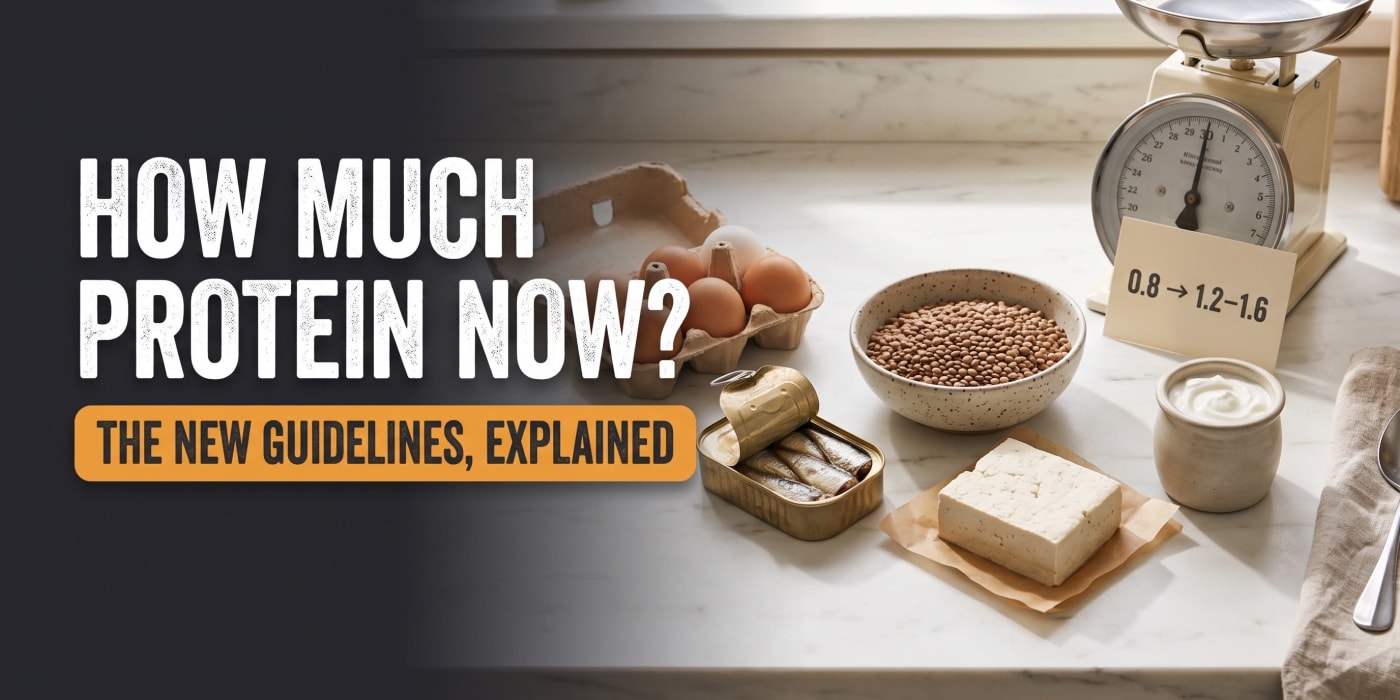
If your feed has been shouting "protein-maxxing" at you this year, you're not imagining it. Protein has become the most marketed nutrient in the supermarket, and in January 2026 it got an official boost: the 2025–2030 Dietary Guidelines for Americans put a protein range of 1.2 to 1.6 grams per kilogram of body weight a day front and centre, well above the long-standing minimum of 0.8 g/kg.
Most of the debate since has been shouted from two corners. One says "finally, the science caught up". The other says "this is a marketing gift dressed up as policy". The reality is less dramatic and more useful, and it has been sharpened in recent weeks by a critical perspective in The Journal of Nutrition and a headline-grabbing review of protein restriction and ageing. We read the coverage, the expert reactions and the evidence behind both sides to give you a version you can actually act on.
The short version: the new 1.2–1.6 g/kg range sits within what sports-nutrition and ageing researchers have argued for years, and it's well supported for older adults, people in a calorie deficit, people on weight-loss medication and people who lift. But the evidence behind it is mostly short-to-mid-term weight-management trials (30 trials, 2,042 people, over 80% animal protein), and a group of experts argues that's too narrow for a one-size-fits-all rule. For many healthy adults who already eat reasonably, "eat more protein" isn't the main thing to fix.
What Actually Changed in January
The 2025–2030 Dietary Guidelines for Americans were released in January 2026. They tell people to "prioritise protein foods at every meal" and give a protein target of 1.2–1.6 g/kg of body weight per day. That's up from the Recommended Dietary Allowance (RDA) of 0.8 g/kg, a figure that had stood for decades. For a 70 kg adult, it moves the number from about 56 g a day to roughly 84–112 g.
The guidelines also shifted tone on where protein comes from. The previous advisory committee had recommended listing beans, peas and lentils first, followed by nuts, seeds and soya, then seafood, then meat, poultry and eggs. The new guidance more broadly emphasises "nutrient-dense" protein foods at every meal, including animal sources. Both pieces have drawn argument.
The Guideline and Its Critique at a Glance
| Item | Details |
|---|---|
| The guideline | 2025–2030 Dietary Guidelines for Americans (January 2026): 1.2–1.6 g/kg/day; "prioritise protein foods at every meal" |
| The old benchmark | RDA 0.8 g/kg/day (UK reference nutrient intake 0.75 g/kg/day) |
| Evidence cited for the target | A review of 30 randomised trials with 2,042 participants, focused mainly on body weight, fat mass and lean mass; over 80% of protein in those trials came from animal foods |
| The critique | A Journal of Nutrition perspective led by Stefan Pasiakos (Pennington Biomedical Research Center) with experts in protein metabolism, clinical nutrition, epidemiology and policy; covered by NutraIngredients on 25 August 2026 |
| Main criticisms | Too reliant on weight-loss trials; limited attention to heart disease, type 2 diabetes, kidney disease, cancer and bone health; affordability and cultural fit; protein source underweighted |
| The "restriction" review | A Cell Press Blue review of 350 animal and human studies on protein restriction and ageing (August 2026), widely covered under headlines about eating less protein |
| Market backdrop | Products with at least 10 g of protein reached about $23.6 billion in US sales in the year to 9 August 2026; whey prices up roughly fivefold since 2023 |
RDA Versus Target: The Part Everyone Mixes Up
The RDA was never designed to be an optimal intake. It's the amount that keeps most healthy adults in nitrogen balance, in other words not losing body protein. Stuart Phillips, a McMaster University protein researcher quoted in Consumer Reports, put it this way: the RDA is a minimum to maintain whole-body protein balance, and the new range reflects where evidence on muscle protein synthesis, resistance training, ageing and energy restriction has been pointing for years.
That framing matters because it removes a false drama. The shift from 0.8 to 1.2–1.6 isn't a discovery that everyone was deficient. It's a change in what the official target is for. Teresa Fung of Simmons University and Harvard noted that 1.2–1.6 sits within the range many scientists already used, so in practice it isn't a huge change. And other dietitians have pointed out that many adults already eat close to, or inside, the new range, so telling the public they need "more" can create a deficiency worry that isn't there.
The Evidence Behind 1.2–1.6 g/kg
It's worth being fair to the higher range, because there's real science behind it in specific situations.
- Calorie restriction. A systematic review and meta-analysis by Hudson and colleagues found that intake at roughly the RDA may be enough to maintain lean mass in a steady state, but intake around 1.3 g/kg reduced lean-mass loss during energy restriction.
- Older adults. In a US cohort of adults aged 70–79, those eating about 1.1 g/kg lost roughly 40% less lean body mass over three years than those eating about 0.8 g/kg (Houston et al., 2008). That's why the PROT-AGE expert group recommends at least 1.0–1.2 g/kg for healthy older adults.
- Resistance training. Meta-analyses of protein supplementation with lifting show added gains in lean mass and strength, with benefits levelling off around 1.6 g/kg for most people.
- Per-meal triggers. Studies of muscle protein synthesis find that roughly 0.3 g/kg per meal, or about 25–35 g for most adults, is enough to fully trigger the muscle-building response, which supports "protein at every meal".
In short: for muscle, ageing and dieting, the upper half of the range isn't controversial. We unpack the mechanics in our guides to protein sources for muscle gain and building muscle naturally.
What the Critics Say (and What They Don't)
The Journal of Nutrition perspective isn't an attack on protein. It's an attack on the leap from "weight-loss trials" to "universal recommendation". Its authors argue that evidence from weight-loss studies isn't broad enough to justify a single protein recommendation for every American across the whole lifespan. Their specific concerns:
- A narrow evidence base. The review behind the target focused largely on body weight, fat mass and lean mass, and didn't comparably examine heart disease, type 2 diabetes, kidney disease, cancer or bone health, the outcomes that normally shape population policy.
- Source imbalance. Over 80% of protein in the supporting trials came from animal foods, which makes it hard to generalise to plant-based and mixed diets.
- Affordability and fit. Animal protein carries a cost premium. The authors worry that low-income households and older adults may struggle to afford it, and that cultural food practices aren't well reflected.
- The "magic bullet" problem. Lead author Stefan Pasiakos stressed that adding protein doesn't automatically make a product, or a person, healthier, and that raising protein without thinking about calories, saturated fat, food quality, exercise or underlying health could have consequences the supporting studies never measured.
Notice what they don't say: they don't say higher protein is harmful for healthy people, and they explicitly agree it's beneficial in some circumstances. Their point is "not everyone, not always, not at any cost".
The "Less Protein, Longer Life" Headlines, in Perspective
In August, a review in Cell Press Blue analysed 350 animal and human studies on protein restriction and ageing, and Time ran it under the question of whether eating less protein could help you age better. The review argued that protein restriction improves metabolic health and lifespan across many organisms, and that restricting specific amino acids, particularly methionine, isoleucine and valine, reproduces many of the benefits.
How seriously should you take it? Carefully, and without whiplash. The evidence there is dominated by animal and cellular work. Observational human data are mixed: NHANES analyses have linked higher protein intake with higher mortality and diabetes risk, and a UK twin study found a positive association between protein intake and sarcopenia in older twins. But such links are riddled with confounding. People who are ill, frail or dieting change what they eat, and those associations can run backwards. Even the article that summarised the review noted that potential benefits of protein restriction haven't been established in clinical trials across relevant human groups.
The most defensible position is boringly moderate: protein needs are real and rise with age, training and dieting, and "more is always better" isn't supported either. We also covered the main safety question in our protein intake calculator guidance: for healthy adults without kidney disease, current evidence doesn't show harm from intakes inside the 1.2–1.6 range.
Who Genuinely Benefits From More Protein
| Group | Why more protein helps | Sensible target |
|---|---|---|
| Adults over 60–65 | Anabolic resistance means muscle needs more protein to respond | 1.0–1.2 g/kg at minimum (PROT-AGE); 1.2–1.6 g/kg if active or dieting |
| People in a calorie deficit | Higher protein reduces lean-mass loss during weight loss and supports fullness | 1.2–1.6 g/kg (higher end if lean or training) |
| People using GLP-1 medication | Reduced appetite makes it easy to under-eat protein while losing weight quickly | 1.2–1.6 g/kg, protein first at each meal |
| Lifters and athletes | Supports muscle repair and growth | 1.4–2.0 g/kg depending on goals |
| Vegans and some vegetarians | Lower digestibility and leucine content of many plant proteins | Roughly 10–20% above omnivore targets |
| People recovering from illness or surgery | Higher repair demands | Individual advice from a dietitian |
Who Probably Doesn't Need to Change Anything
A healthy, moderately active adult who already eats eggs, dairy, fish, meat or beans and tofu across the day is often near or within the new range without trying. For that person, the better questions are about distribution (is most of it at dinner?), quality (is it coming with fibre and unsaturated fat?) and everything else (sleep, activity, vegetables). Doubling down on protein shakes isn't the usual missing piece.
There are also people who should be cautious. Those with advanced chronic kidney disease (stages 4–5) are normally advised to restrict protein under medical supervision. People with early kidney disease, a strong family history of kidney problems, or other chronic illnesses should get individual advice rather than following a population range.
How to Work Out Your Number If You Have a Higher BMI
Applying 1.2–1.6 g/kg to total body weight can overshoot if you carry a lot of body fat. A Stanford nutrition scientist quoted in coverage suggested people with a BMI over 30 use an "adjusted body weight" instead, because lean mass is what the protein is mostly supporting.
A commonly used formula: adjusted body weight = ideal body weight + 0.25 × (actual weight − ideal weight). Different clinicians use slightly different factors, so treat it as a starting estimate.
Worked example: a man who is 175 cm and 100 kg has an ideal body weight of roughly 70 kg. Adjusted weight = 70 + 0.25 × (100 − 70) = 77.5 kg. At 1.2–1.6 g/kg, his range is about 93–124 g of protein a day, compared with 120–160 g if he used his full 100 kg.
You can find your ideal weight with our ideal weight calculator and your own personalised range with the protein intake calculator. If you're cutting calories, check your maintenance with the TDEE calculator and set a moderate deficit using the calorie deficit calculator, so protein targets remain realistic.
Protein on a Budget
Affordability is a legitimate part of this debate, and it's one of the practical areas where food choices matter more than headlines. Protein doesn't have to come from supplements or premium cuts. These are among the cheaper sources per gram in most markets (prices vary by country and season):
| Food (approximate serving) | Protein (g, approx.) |
|---|---|
| Lentils, 1 cup cooked | 18 |
| Chickpeas, 1 cup cooked | 14 |
| Black beans, 1 cup cooked | 15 |
| Eggs, 2 large | 12 |
| Cottage cheese, 1 cup | 25 |
| Plain Greek yoghurt, 170 g pot | 15–17 |
| Canned tuna or sardines, 100 g | 22–26 |
| Chicken thigh, 100 g cooked | 24–26 |
| Milk or soya milk, 250 ml | 7–8 |
| Peanut butter, 2 tablespoons | 7–8 |
| Firm tofu, 125 g | 12–15 |
Whey protein is a useful convenience, but its price has climbed about fivefold since 2023 as demand outpaced production, so whole foods are often the better value. Combining beans or lentils with grains and eggs or dairy over the day easily gets most people to 90–110 g at modest cost.
Source and Quality: It Isn't Only About the Grams
One thing the new guideline's critics are right to underline is that what comes with the protein matters. A grilled fish fillet with vegetables, a bowl of lentil soup and a processed meat sandwich might each deliver 25 g of protein, but they come bundled with very different fibre, fat, sodium and micronutrient packages.
Observational research generally associates plant-forward and fish-rich protein patterns with better long-term outcomes than diets heavy in processed red meat, though those studies can't prove cause. And as the 2023 work on branched-chain amino acids showed, individual amino acids can have distinct and sometimes opposing effects, so "protein" isn't a single uniform nutrient. A practical rule is to hit your target mostly from minimally processed foods, mix animal and plant sources if you eat both, and treat powders as a tool, not the foundation.
The Bottom Line
The new 1.2–1.6 g/kg range is best read as a sensible target for people with a reason to eat more protein: older adults, dieters, people on weight-loss drugs, and people who lift. It's less convincing as a mandate for every healthy adult, partly because the evidence behind it is narrower than the headlines suggest and partly because most people already eat near it.
If you take one action, work out your own number, not the national one. Use the calculators, spread protein across meals at about 25–35 g each, favour whole foods, and make sure the rest of the plate, fibre, healthy fats and vegetables, isn't crowded out. And if someone tells you protein is either a miracle or a poison, you can safely assume they haven't read the studies.
Frequently Asked Questions
What is the new protein recommendation in the US dietary guidelines?
The 2025–2030 Dietary Guidelines for Americans, released in January 2026, give a protein target of 1.2–1.6 g per kg of body weight per day and advise prioritising protein foods at every meal. That's above the RDA of 0.8 g/kg, which remains the minimum to prevent deficiency.
Is 0.8 g/kg still the RDA?
Yes. The RDA is a minimum intake that maintains protein balance in most healthy adults. The new guideline range is a dietary target, not a replacement for that definition.
Do I need more protein than I'm eating now?
Not necessarily. Many healthy adults already eat close to or within 1.2–1.6 g/kg. People most likely to benefit from more are those over 60–65, people dieting, people using GLP-1 medication and people who do resistance training.
Why are some experts criticising the new target?
A Journal of Nutrition perspective argued that the evidence leaned too heavily on short-to-mid-term weight-management trials, paid limited attention to chronic disease outcomes, and relied on mostly animal-sourced protein, so it may be too narrow for a universal recommendation. They also raised cost and equity concerns.
Does eating less protein help you live longer?
A 2026 review of 350 animal and human studies suggested protein restriction, especially of certain amino acids, may support healthy ageing in animals. Human clinical benefits haven't been demonstrated, and higher protein is helpful for older adults' muscle, so it isn't a reason to cut protein.
How much protein should I eat if I'm overweight?
Many clinicians use an adjusted body weight rather than total weight. A common formula is ideal weight plus 25% of the excess. Applying 1.2–1.6 g/kg to that adjusted figure gives a more realistic range. Confirm with a dietitian.
Is the 1.2–1.6 g/kg range safe for kidneys?
For healthy adults without kidney disease, current evidence doesn't show kidney harm at these intakes. People with advanced chronic kidney disease are usually advised to restrict protein, and those with early kidney disease should get individual advice.
What's the cheapest way to hit my protein target?
Beans, lentils, eggs, dairy, canned fish, tofu and chicken thighs are generally affordable. Whey has become more expensive since 2023, so whole foods are often better value.
How should I spread protein through the day?
Aim for roughly 25–35 g at each main meal, about 0.3 g/kg, rather than loading it all at dinner. That supports the muscle-building response and makes it easier to reach your total.
References & Sources
- US Department of Health and Human Services and US Department of Agriculture (2026). Dietary Guidelines for Americans, 2025–2030.
- NutraIngredients (25 August 2026). The overproteinification of everything? Protein push in new dietary guidelines raises evidence and access questions (reporting a perspective by Pasiakos, S. M. et al. in The Journal of Nutrition, 2026).
- Cell Press Blue (2026). Review of dietary protein restriction and ageing (350 animal and human studies), doi:10.1016/j.cpblue.2026.100079; Time coverage, August 2026.
- Consumer Reports (2026). How much protein do you really need? (expert comments from S. Phillips and T. Fung); Stanford Medicine (March 2026). How much protein should we really be eating?
- Hudson, J. L. et al. (2020). Protein intake greater than the RDA differentially influences whole-body lean mass responses to purposeful catabolic and anabolic stressors: a systematic review and meta-analysis. Advances in Nutrition, 11(3), 548–558.
- Houston, D. K. et al. (2008). Dietary protein intake is associated with lean mass change in older, community-dwelling adults: the Health, Aging, and Body Composition (Health ABC) Study. American Journal of Clinical Nutrition, 87(1), 150–155.
- Bauer, J. et al. (2013). Evidence-based recommendations for optimal dietary protein intake in older people: a position paper from the PROT-AGE Study Group. Journal of the American Medical Directors Association, 14(8), 542–559.
- Morton, R. W. et al. (2018). A systematic review, meta-analysis and meta-regression of the effect of protein supplementation on resistance training-induced gains in muscle mass and strength. British Journal of Sports Medicine, 52(6), 376–384.
- MacrosMeasure (2026). Free Protein Intake Calculator.
- MacrosMeasure (2026). Free Ideal Weight Calculator.
Calculate your own numbers — free.
18 science-backed calculators covering everything in this article and more.