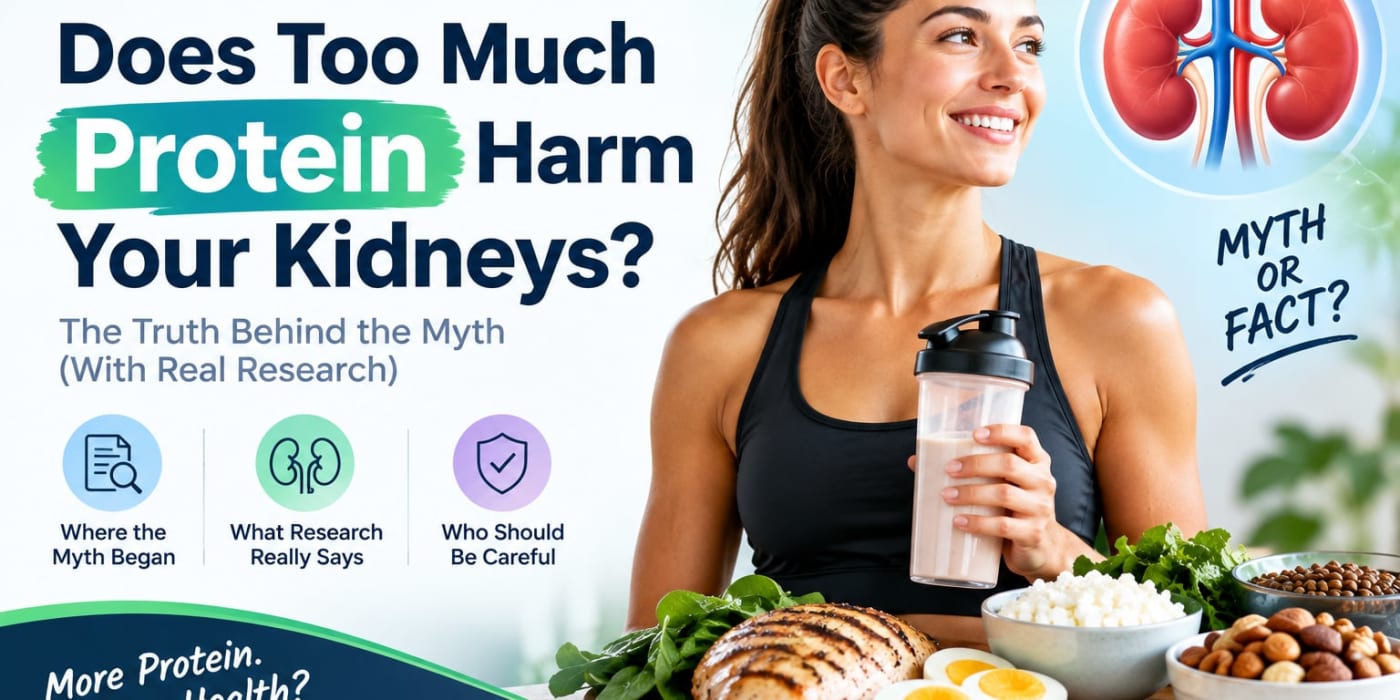
In this guide
The warning that's followed every high-protein dieter for decades
Hyperfiltration — the mechanism behind the fear, explained correctly
The decade-long gold-standard study that settled the question
"Too much protein will destroy your kidneys" is one of the most durable pieces of nutrition advice in modern fitness culture — repeated by well-meaning doctors, echoed across gym locker rooms, and cited without much scrutiny for decades. It's also, according to the highest-quality long-term evidence available, simply not supported for the population it's most often aimed at: healthy adults without existing kidney disease.
A 2026 study using iohexol clearance — the gold-standard method for directly measuring kidney function — followed 1,324 middle-aged and older adults without chronic kidney disease for a median of 10 years. Participants consuming ≥1.4g of protein per kilogram of body weight daily showed no faster decline in measured kidney function, no greater risk of accelerated function loss, and no higher likelihood of developing chronic kidney disease compared to those eating less protein.
This guide traces where the fear came from, what the best current evidence actually shows, and the one legitimate exception worth knowing about.
The Warning That's Followed Every High-Protein Dieter for Decades
Anyone who has increased their protein intake for muscle gain or fat loss has likely heard some version of this warning — from a well-meaning relative, an outdated textbook, or occasionally a doctor working from decades-old assumptions rather than current evidence. The claim has persisted long enough to feel like settled medical fact, even though the research specifically addressing healthy populations has told a consistently different story for years.
Where the Myth Actually Began
The concern originates from legitimate clinical observations in people who already have kidney disease — where protein restriction genuinely is part of standard treatment, since damaged kidneys struggle to clear protein metabolism byproducts efficiently. The error was in generalising a treatment principle for existing kidney disease onto healthy kidneys with entirely normal filtering capacity — a leap the underlying research was never designed to support.
Hyperfiltration — The Mechanism Behind the Fear, Explained Correctly
Higher protein intake does cause a measurable, real physiological change: an increase in glomerular filtration rate (GFR), called hyperfiltration, as the kidneys ramp up filtering to clear the additional urea and metabolic byproducts protein digestion produces. For decades, this was interpreted as evidence of kidney "strain" or damage in progress.
A comprehensive review published in the Journal of Nutrition and Metabolism concluded that this hyperfiltration response is a normal, adaptive physiological mechanism — not evidence of harm. Kidneys are designed to scale their filtration rate to metabolic demand; a higher rate in response to more protein intake is functionally similar to your heart rate rising during exercise — an appropriate response to increased demand, not a sign the organ is being damaged.
The Decade-Long Gold-Standard Study That Settled the Question
Most earlier research relied on estimated GFR (calculated from blood markers), which introduces some imprecision. The 2026 study referenced above used iohexol clearance instead — a direct, gold-standard measurement of actual kidney filtration — across 1,324 adults tracked for a median of 10 years. This design specifically addressed the main methodological weakness in earlier protein-and-kidney research, and it found no evidence that habitual higher protein intake accelerated kidney function decline in people without pre-existing kidney disease.
This finding is consistent with the earlier landmark Framingham Offspring Study, which similarly found no association between protein intake — even exceeding 100g per day — and kidney function decline in healthy adults with normal blood pressure and blood sugar. A 2016 McMaster University-led systematic review analysing 28 papers spanning 1975-2016 across more than 1,300 participants, including healthy people and those with obesity, type 2 diabetes, or hypertension (but not diagnosed kidney disease), reached the same conclusion: no evidence linking high-protein diets to kidney disease in this population.
The Finding Nobody Expected — Protein and Reduced Mortality
Beyond simply failing to find harm, more recent research has found the opposite direction of effect. A large cohort study following more than 8,500 older adults for up to 10 years found that in adults without kidney disease, every 0.2g/kg increase in daily protein intake was associated with a 15% reduction in premature death risk. Even more striking: among people with early-stage chronic kidney disease (stages 1-3, not advanced disease), those consuming 1.4g/kg of protein daily — nearly double the standard 0.8g/kg recommendation — had a 27% lower mortality risk over the decade of follow-up compared to those eating the lower standard amount.
The One Genuine Caveat — Genetic Kidney Risk
The research isn't entirely uniform, and one nuance is worth taking seriously. A study examining genetic risk for reduced kidney function in 5,717 generally healthy adults found that while genetic risk was consistently associated with lower kidney function overall, higher protein and phosphorus intake showed a stronger negative association with kidney function specifically in people with a greater genetic predisposition to chronic kidney disease. This suggests genetics may meaningfully influence individual susceptibility to protein's effects on kidney health — an emerging, still-developing area of research rather than a reason for general population-wide concern.
Who Should Actually Be Careful With Protein Intake
| Population | Recommendation |
|---|---|
| Healthy adults, no kidney disease | No evidence-based ceiling from kidney-safety concerns specifically; 1.2-1.6g/kg is well-supported and possibly protective |
| Early-stage CKD (stages 1-3) | Research suggests higher protein may still be beneficial for mortality, but individual guidance from a physician is essential given the more mixed evidence in this group |
| Advanced CKD (stages 4-5) | Protein restriction remains standard, evidence-based clinical practice — this population was excluded from the studies described above and should follow individualised medical guidance |
| Strong family history of kidney disease | Discuss with a physician given the emerging genetic-susceptibility research; standard population guidance may not fully apply |
For the vast majority of people reading this — healthy adults without diagnosed kidney disease — the evidence-based protein target is 1.2-1.6g/kg of body weight daily, with some research suggesting the upper end of this range and beyond may carry longevity benefits rather than risk. Use the protein intake calculator to find your specific target.
Frequently Asked Questions
Does eating too much protein damage healthy kidneys?
The best current evidence, including a 2026 decade-long study using gold-standard direct kidney function measurement, finds no association between higher habitual protein intake and kidney function decline in adults without pre-existing kidney disease.
Is 100g+ of protein a day too much?
No — multiple large studies, including the Framingham Offspring Study, found no kidney function decline associated with protein intake exceeding 100g daily in healthy adults with normal blood pressure and blood sugar. This amount fits comfortably within evidence-based recommendations for many active adults.
What is hyperfiltration and is it harmful?
Hyperfiltration is an increase in kidney filtration rate in response to higher protein intake. Current evidence characterises this as a normal, adaptive physiological response to increased metabolic demand, not evidence of kidney damage in progress.
Should people with chronic kidney disease avoid high protein?
For advanced CKD (stages 4-5), protein restriction remains standard clinical practice and this population should follow individualised medical guidance. Interestingly, some research in earlier-stage CKD (stages 1-3) found higher protein intake associated with lower mortality risk, though this remains an area requiring physician-guided, individualised decisions rather than generic advice.
Does genetics affect how protein impacts kidney health?
Emerging research suggests people with a greater genetic predisposition to chronic kidney disease may show a stronger negative association between higher protein intake and kidney function than the general population — an area of ongoing research rather than a settled recommendation to reduce protein pre-emptively without other risk factors.
What protein intake is actually recommended for healthy adults?
Most evidence-based guidance places the target at 1.2-1.6g per kilogram of body weight daily for healthy, active adults, with some research suggesting benefits at the higher end of this range or beyond, rather than kidney-safety concerns limiting intake in this population.
References & Sources
- Devries, M. C. et al. (2018). Changes in kidney function do not differ between healthy adults consuming higher- compared with lower- or normal-protein diets: a systematic review and meta-analysis. Journal of Nutrition, 148(11), 1760–1775.
- 2026 iohexol-clearance cohort study. Ten-year measured GFR outcomes and habitual protein intake in adults without chronic kidney disease.
- Carballo-Casla, A. et al. (2024). Protein intake and mortality in older adults with chronic kidney disease: a multicohort population-based study. Innovation in Aging, 8(Suppl 1).
- Levey, A. S. et al. (2016). Dietary protein and the kidneys: what have we learned from the Framingham Offspring Study? Journal of Renal Nutrition.
- CHRIS Study genetic risk cohort (2026). Interaction between polygenic kidney-function risk and dietary protein/phosphorus intake.
- MacrosMeasure (2025). Free Protein Intake Calculator.
Calculate your own numbers — free.
18 science-backed calculators covering everything in this article and more.