In this guide
If you've started intermittent fasting and noticed your period arriving late, becoming lighter, or disappearing altogether, you're not imagining a connection that isn't there — and you're also not necessarily looking at permanent damage. This is a genuinely nuanced area of research, sitting somewhere between the alarmist warnings circulating on wellness blogs and the dismissive "it's totally fine, just try harder" advice found in most generic fasting content.
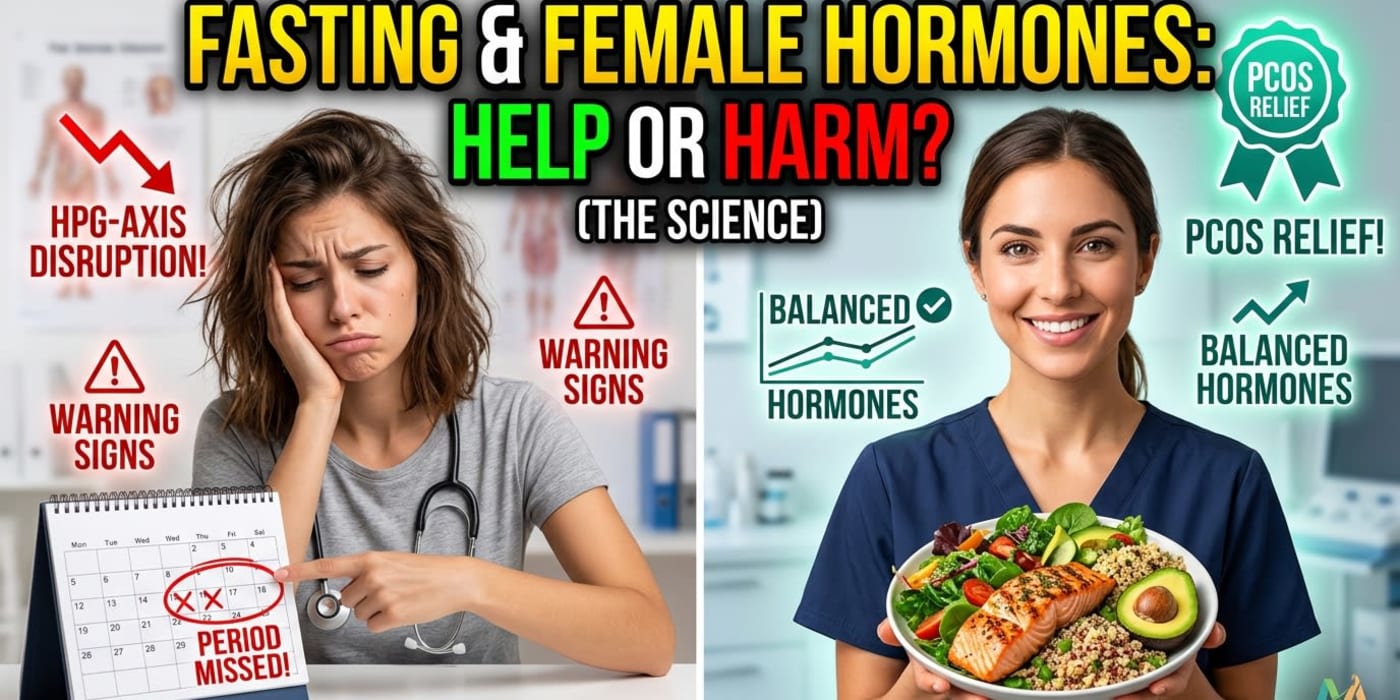
Fasting can suppress the hypothalamic-pituitary-gonadal (HPG) axis — the hormonal signalling pathway that regulates ovulation and the menstrual cycle — particularly under more restrictive protocols, in younger or leaner women, or when combined with other stressors like inadequate sleep or high training volume. For women managing PCOS specifically, research suggests intermittent fasting may actually improve hormonal markers. These aren't contradictory findings — they reflect two genuinely different populations responding to the same intervention in different ways.
This guide covers where the fear originated, what human research actually shows, and how to tell whether your body is adapting normally or genuinely struggling.
Where the Fasting-Hurts-Fertility Fear Actually Started
Much of the popular concern about intermittent fasting and female hormones traces back to a single, frequently misapplied rodent study. Researchers had young female rats undergo 24-hour water fasting every other day for 12 weeks. By the end, the rats showed increased estradiol, decreased luteinizing hormone (LH), and disrupted estrous cyclicity (the rodent equivalent of a menstrual cycle).
The detail almost universally omitted when this study is cited: the rats were three months old — developmentally equivalent to roughly a 9-year-old human. This was a study of fasting effects in developmentally immature animals under an unusually aggressive protocol (complete water-only fasting every other day), not a study of adult women practising standard time-restricted eating.
This doesn't mean the underlying concern is baseless — it means the specific evidence most commonly cited to support it doesn't actually generalise to how most adult women practise intermittent fasting today.
The HPG Axis — Why Women's Hormones Respond Differently to Fasting Than Men's
Men's reproductive hormone production is comparatively less tightly coupled to moment-to-moment energy availability than women's. Female reproductive hormone production is strongly linked to perceived metabolic sufficiency — from an evolutionary standpoint, the body is designed to confirm adequate energy availability before supporting ovulation and potential pregnancy. When fasting is prolonged, overly aggressive, or layered onto existing stress (poor sleep, high training volume, an already-restrictive diet), the body can interpret the pattern as food scarcity rather than a deliberate health intervention — prompting the HPG axis to downregulate reproductive signalling as a protective response.
What Actual Human Studies Show
Human trial data — as opposed to rodent studies — presents a more measured picture than the more alarmist online content suggests. A review of human trials on intermittent fasting and reproductive hormones found that in most studies of cycling women, fasting did not significantly change LH or FSH levels, and estradiol remained largely unaffected in several trials as well. Where effects have been observed, they tend to occur with more restrictive protocols, or in specific subgroups — younger women and those with lower starting body fat appear more susceptible to menstrual cycle disruption than the general population of women trying moderate time-restricted eating.
A separate systematic review specifically addressing IF and menstrual regularity found that while IF shows genuine promise for hormonal benefit in some contexts (detailed below), potential risks — including amenorrhea (absent periods), anovulation, and delayed sexual maturation in younger populations — are real when fasting conflicts with a woman's biological rhythms without adjustment, particularly around circadian alignment and overall nutritional adequacy.
The PCOS Exception — Where Fasting May Genuinely Help
This is the part of the research that complicates a simple "fasting is risky for women" narrative. Multiple studies specifically in women with PCOS — a condition frequently involving elevated androgens and insulin resistance — have found intermittent fasting associated with reduced circulating androgen levels and improved insulin sensitivity, without negatively affecting LH, FSH, or estradiol in these trials. A 2025 systematic review and meta-analysis on IF in women with PCOS concluded it represents a promising strategy for improving weight, metabolic, hormonal, and inflammatory profiles in this specific population — though the review also noted the evidence base remains preliminary and needs more robust confirmation.
Some research has also found intermittent fasting associated with increased sex hormone binding globulin (SHBG), linked to improved insulin sensitivity independent of overall sex hormone levels — a mechanism that may partly explain the PCOS-specific benefit. If you're managing PCOS and considering fasting, our dedicated PCOS and weight loss guide covers the broader insulin-resistance context this fits into.
Warning Signs Your Body Is Telling You Something
- Missed or significantly irregular periods that weren't a pattern before starting fasting
- Unusual fatigue that doesn't improve with adjusting fasting timing or adequate sleep
- New sleep disturbances or mood changes, particularly concentrated in the second half of your cycle — one study in Appetite found women practising IF reported more mood swings and sleep disturbance than men on the same protocol
- Difficulty conceiving if you're actively trying, since steady ovulation requires sufficient and consistent energy availability
- Signs of low bone density risk over time — research in the Journal of Bone and Mineral Research has linked hypothalamic amenorrhea (missed periods from energy restriction) to decreased bone mineral density
None of these symptoms mean fasting is inherently dangerous for all women — they mean your current protocol may be too aggressive for your current life circumstances, and adjusting rather than pushing through is the evidence-informed response.
Adjusting Fasting to Your Cycle Instead of Ignoring It
| Cycle Phase | Fasting Adjustment |
|---|---|
| Follicular phase (post-period to ovulation) | Generally the best-tolerated window for a longer fasting protocol, given rising estrogen and typically higher energy |
| Luteal phase (post-ovulation to period) | Consider shortening the fasting window or easing restriction, given naturally rising metabolic rate and appetite covered in our cycle-syncing macros guide |
| Any phase, if symptoms appear | Shorten the fasting window, prioritise sleep and stress reduction, and reassess before continuing an aggressive protocol |
Who Should Avoid Intermittent Fasting Entirely
Certain groups of women should approach intermittent fasting with particular caution or avoid it outright: anyone pregnant or breastfeeding, anyone actively trying to conceive without a specific clinical reason to fast, anyone with a history of an eating disorder, anyone who is underweight, and anyone already experiencing menstrual irregularity from another cause that hasn't been evaluated. This is a genuinely individual decision best made with a healthcare provider familiar with your specific reproductive health history.
Frequently Asked Questions
Will intermittent fasting stop my period?
For most women practising moderate protocols like 16:8, human research generally doesn't show significant disruption to reproductive hormones. More restrictive protocols, combined with low body fat, high stress, or inadequate sleep, carry higher risk of menstrual irregularity — this is an individual risk profile, not a universal outcome.
Is the rat study showing fasting harms female hormones relevant to adult women?
The most frequently cited rat study used very young rats (developmentally equivalent to roughly 9 human years old) under an aggressive 24-hour water-only fasting protocol every other day. This doesn't directly translate to adult women practising standard time-restricted eating protocols.
Does intermittent fasting help or hurt PCOS?
Multiple studies specifically in women with PCOS found intermittent fasting associated with reduced androgen levels and improved insulin sensitivity, without adverse effects on LH, FSH, or estradiol in these trials — though researchers note the evidence base is still described as preliminary and needs further confirmation.
What are the warning signs I should stop or adjust my fasting protocol?
Missed or significantly irregular periods, persistent fatigue unrelieved by better sleep, new mood or sleep disturbances (particularly in the second half of your cycle), and difficulty conceiving if you're trying are all signals worth taking seriously and discussing with a healthcare provider.
Should I fast differently depending on where I am in my cycle?
Some women find shortening the fasting window during the luteal phase (the week or two before a period) more comfortable, aligning with the naturally rising metabolic rate and appetite during this phase, while the follicular phase tends to be the better-tolerated window for longer fasting.
Is 16:8 safer for women than 5:2 or OMAD?
Generally, less restrictive protocols carry lower risk of the HPG-axis disruption associated with more aggressive energy restriction, making 16:8 a more conservative starting point for women concerned about hormonal effects than 5:2's more restrictive fasting days or OMAD's extreme single-meal structure.
References & Sources
- Kumar, S. & Kaur, G. (2013). Intermittent fasting dietary restriction regimen negatively influences reproduction in young rats. PLOS ONE, 8(1), e52416.
- Cienfuegos, S. et al. (2022). Effect of intermittent fasting on reproductive hormone levels in females and males: a review of human trials. Nutrients, 14(11), 2343.
- Waly, N. et al. (2025). The analysis study effect of intermittent fasting on female reproductive hormones and menstrual cycle: a comprehensive systematic review. International Medical Journal.
- Systematic review and meta-analysis (2026). Effect of intermittent fasting on anthropometric measurements, metabolic profile, and hormones in women with PCOS.
- Al-Rawi, N. et al. (2020). Effect of diurnal intermittent fasting during Ramadan on ghrelin, leptin, melatonin, and cortisol levels. PLOS ONE, 15(8), e0237922.
- MacrosMeasure (2026). PCOS and Weight Loss: Why It's Harder and What Actually Works.
- MacrosMeasure (2026). Macros for Women: Cycle Syncing Guide.
Calculate your own numbers — free.
18 science-backed calculators covering everything in this article and more.