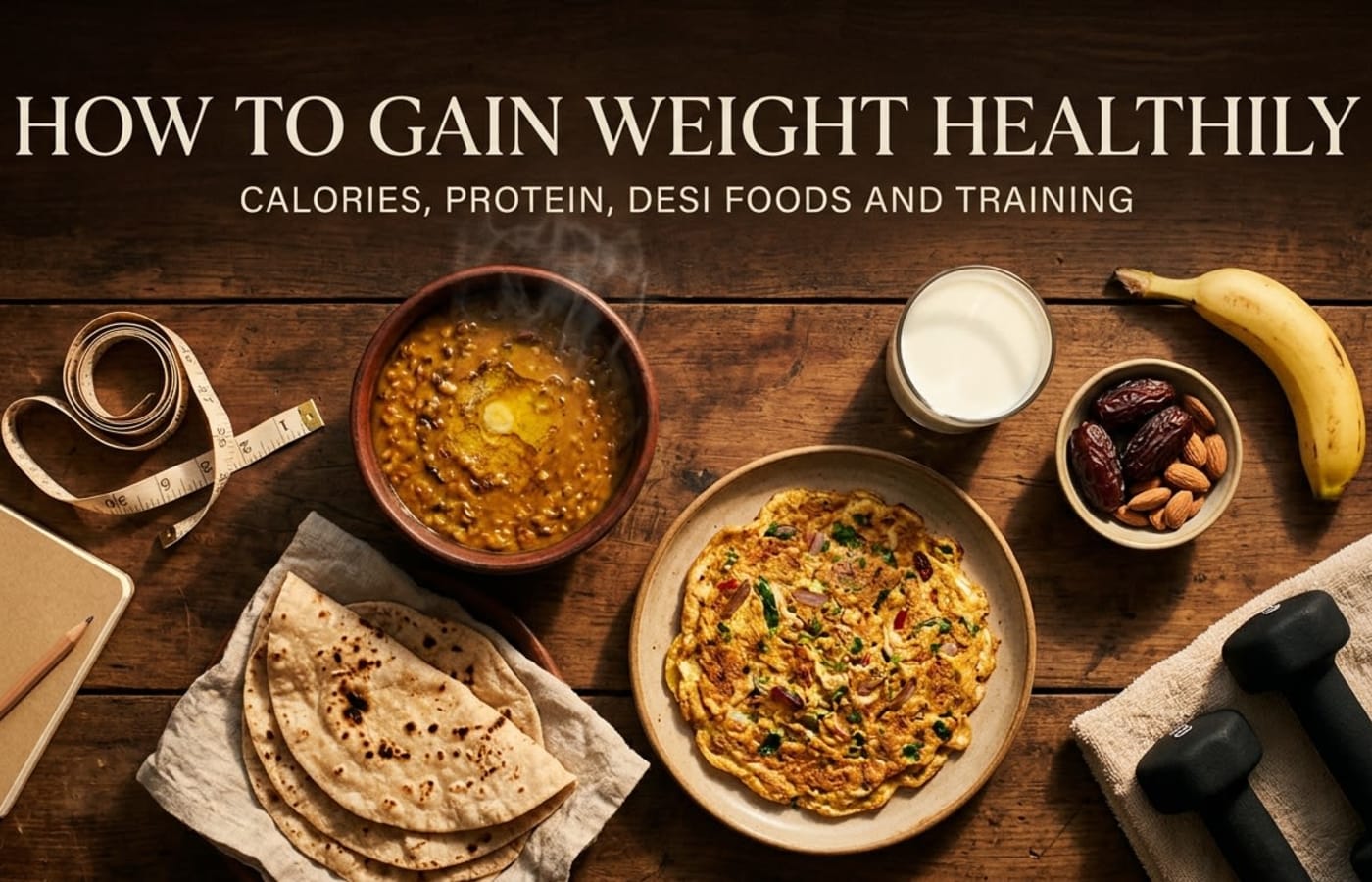
In this guide
Weight-loss advice is everywhere. Advice for people who want to gain weight is mostly a shrug: "just eat more." If you've ever tried, you know how unhelpful that is. You eat a bigger lunch and feel stuffed until dinner. You force down an extra snack and your weight doesn't budge. Meanwhile, a friend who "eats everything" seems to put on weight just by looking at a biscuit.
The frustration is real, and so is the science behind it. Studies that deliberately overfed volunteers found that identical extra calories led to wildly different weight gain from one person to the next, with the differences driven partly by genetics and partly by how much the body quietly ramps up fidgeting and movement. At the same time, how you gain matters more than how fast. The same surplus can build muscle or settle as belly fat, depending on your protein, your training and, for many South Asians, where your body tends to store fat.
We went through the overfeeding trials, the protein and body-composition studies, the global data on underweight and the clinical guidance on unintended weight loss, then turned them into a practical plan with calorie targets, protein numbers, desi-friendly foods and a training outline. It's written for underweight adults, "hard gainers" and anyone rebuilding after illness. If you're losing weight without trying, start with the medical section below.
The short version: to gain weight healthily, eat about 300–500 calories a day above maintenance, aim for roughly 0.25–0.5 kg (0.5–1 lb) a week, get 1.6–2.2 g of protein per kg of body weight, and lift weights two to four times a week. In a metabolic-ward trial, people who overate by about 950 calories a day gained similar fat (roughly 3–4 kg) whatever their protein intake, but only those eating normal or high protein built about 3 kg of lean mass. Gains vary a lot between people: in a classic twin study, the same extra calories produced 4.3 to 13.3 kg of weight gain. If your weight loss is unintentional, or your BMI is below about 16, see a doctor before changing your diet.
This article is general information, not medical advice. Unintentional weight loss, a BMI below 18.5 with symptoms, or any history of an eating disorder deserve a proper medical assessment.
Who This Guide Is For (and When to See a Doctor First)
This guide is for you if any of these fit:
- Your BMI is below 18.5 and you're otherwise well, and you've been that way for years.
- You're a "hard gainer" with a normal BMI who wants more size or muscle.
- You're rebuilding weight after a stretch of illness, surgery or a stressful period.
- You want to gain weight healthily for sport or strength.
Please speak to a doctor before trying to eat your way out of it if:
- You've lost weight without trying. Clinical malnutrition criteria (the GLIM consensus) flag unintentional loss of more than about 5% of body weight within six months, or more than 10% beyond six months, as a warning sign. Causes range from an overactive thyroid, diabetes and coeliac disease to inflammatory bowel disease, chronic infections such as tuberculosis, depression and cancer.
- You have symptoms: persistent diarrhoea, fever or night sweats, abdominal pain, difficulty swallowing, extreme tiredness, a cough that won't clear, or an unexplained rise in thirst.
- Your BMI is below about 16, or you've eaten very little for more than about ten days. Restarting food too fast can cause refeeding syndrome, a dangerous shift in blood salts (potassium, phosphate, magnesium) that's recognised in clinical guidelines such as NICE's. Severe underweight needs medically supervised refeeding.
- You have a history of, or suspect, an eating disorder (including avoidant/restrictive food intake disorder), or you struggle to eat because of anxiety or fear.
- You've stopped having periods, or you're a teenager who isn't growing as expected.
Underweight in Numbers: BMI Bands and Why It Matters
| BMI (kg/m²) | WHO grade | What to do |
|---|---|---|
| Below 16.0 | Severe thinness | See a doctor; supervised refeeding |
| 16.0–16.9 | Moderate thinness | Medical check recommended; gradual gain |
| 17.0–18.4 | Mild thinness | Check for causes; use the plan below |
| 18.5–22.9 | Healthy range (the Asian upper limit is 22.9) | Gain only for performance or muscle goals |
You can calculate yours with our BMI calculator, and see the weight range for your height with the ideal weight calculator.
Underweight isn't a harmless "lean" state. Large pooled analyses, such as the Global BMI Mortality Collaboration (The Lancet, 2016), find a J-shaped curve, with lower risk around a BMI of 20–25 and higher risk below that in healthy never-smokers. Being persistently underweight is linked with lower bone density, a higher risk of infections, anaemia, menstrual problems and fertility difficulties, and poorer recovery from illness or surgery.
It's also common in South Asia. In the NCD Risk Factor Collaboration's 2024 analysis in The Lancet, which pooled 3,663 population studies, adult underweight fell worldwide between 1990 and 2022 (from 14.5% to 7.0% in women), but in 2022 age-standardised prevalence in places such as India and Bangladesh remained among the highest in the world, ranging from about 11% to 26%. The authors noted that countries like India and Pakistan carry both thinness and obesity at the same time. So underweight and obesity concerns can sit in the same family, or even the same person at different life stages.
| Height | Weight at BMI 17 | Weight at BMI 18.5 | Weight at BMI 20 | Weight at BMI 22.9 |
|---|---|---|---|---|
| 155 cm (5′1″) | 40.8 kg | 44.4 kg | 48.1 kg | 55.0 kg |
| 160 cm (5′3″) | 43.5 kg | 47.4 kg | 51.2 kg | 58.6 kg |
| 165 cm (5′5″) | 46.3 kg | 50.4 kg | 54.5 kg | 62.3 kg |
| 170 cm (5′7″) | 49.1 kg | 53.5 kg | 57.8 kg | 66.2 kg |
| 175 cm (5′9″) | 52.1 kg | 56.7 kg | 61.3 kg | 70.1 kg |
| 180 cm (5′11″) | 55.1 kg | 59.9 kg | 64.8 kg | 74.2 kg |
For example, a 170 cm adult at BMI 17 weighs about 49 kg, and reaching BMI 18.5 means gaining roughly 4.4 kg.
Why Some People Can't Gain Weight
"Fast metabolism" is the usual explanation, and it's mostly wrong. Resting metabolism is largely determined by body size and composition, and the leftover person-to-person variation is modest. The real reasons are subtler, and two classic overfeeding experiments show them clearly.
| Experiment | What was done | What it showed |
|---|---|---|
| Bouchard and colleagues (New England Journal of Medicine, 1990) | 12 pairs of young identical twin men were overfed by 1,000 kcal a day, six days a week, for 84 days (about 84,000 extra calories each) | Average gain was 8.1 kg, but individuals ranged from 4.3 to 13.3 kg. There was about three times more variation between twin pairs than within pairs, pointing to a strong genetic influence |
| Levine and colleagues (Science, 1999) | 16 volunteers were overfed by 1,000 kcal a day for eight weeks | Fat gain varied about ten-fold between people. The difference was explained by changes in non-exercise activity thermogenesis (NEAT), which rose by anywhere from −98 to +692 kcal a day. Some people unconsciously fidgeted, stood and moved their way out of the surplus |
Notice something else in the twin study. Eighty-four thousand extra calories would predict about 10.9 kg of gain by the old 7,700-kcal-per-kilogram rule, but the average was 8.1 kg, roughly a quarter less. Some of the extra energy is burned off (digesting more food, moving more, a bigger body to run). We cover the same effect in the opposite direction in our article on how to set your daily calories.
Other everyday contributors for hard gainers:
- A small appetite or early fullness. Large, high-fibre, bulky meals fill you up before you've eaten many calories.
- A highly active day. Manual work, long commutes, sport and fidgeting can add several hundred calories to your expenditure.
- Under-eating without noticing. People who say they "eat loads" often log well under what they think. A week of honest tracking is eye-opening, as we explain in our guide to eating the wrong number of calories.
- Medical and psychological causes (see the first section).
How Many Calories to Gain Weight: The Maths
- Find your maintenance calories. Use the TDEE calculator. Remember that, for South and East Asian adults, standard equations can overestimate resting energy by roughly 7–11%. When you're trying to gain, that error is less harmful than when you're cutting, but it's a reason to treat the result as a starting point.
- Add a surplus. A common range is +300 to +500 kcal a day. Hard gainers sometimes need +500 to +700.
- Eat that amount consistently for two weeks, weigh yourself regularly and adjust.
| Step | Woman, 28 y, 50 kg, 160 cm, lightly active | Man, 25 y, 55 kg, 172 cm, lightly active |
|---|---|---|
| BMR (Mifflin–St Jeor) | 10×50 + 6.25×160 − 5×28 − 161 = 1,199 | 10×55 + 6.25×172 − 5×25 + 5 = 1,505 |
| Maintenance (× 1.375) | about 1,650 | about 2,070 |
| Target with +400 / +500 kcal | about 2,050 | about 2,570 |
| Realistic expected gain | About 0.25–0.4 kg a week | About 0.3–0.5 kg a week |
The simple arithmetic says 500 extra calories a day is 3,500 a week, which is about 0.45 kg of tissue. In practice, as the twin data show, early gain can be slower than the maths suggests, then speed up as appetite and body size catch up. That's why a weekly average, not a single weigh-in, should drive your adjustments. You can also use the calorie calculator to set a surplus directly.
How Fast Should You Gain?
| Weekly gain | What it usually means |
|---|---|
| Under 0.1 kg | Surplus too small, or intake lower than you think; add 200–300 kcal |
| 0.25–0.5 kg (0.5–1 lb) | A sensible target for most underweight adults and hard gainers |
| 0.5–0.7 kg | Fine early on or in recovery from illness, with medical guidance if recent weight loss was large |
| Above 0.7 kg for several weeks | Likely more fat gain than necessary; trim 100–200 kcal unless a clinician advises otherwise |
| Total gain wanted | Timeline at 0.25 kg/week | Timeline at 0.5 kg/week |
|---|---|---|
| 3 kg | About 12 weeks | About 6 weeks |
| 5 kg | About 20 weeks | About 10 weeks |
| 10 kg | About 40 weeks | About 20 weeks |
The weekly ranges here are common coaching and dietetic practice rather than trial-defined limits. If you've had a major illness or have a very low BMI, your healthcare team will set a pace.
Muscle or Fat? What Decides Where the Weight Goes
This is where the best evidence helps. In the PROOF trial (Bray and colleagues, JAMA, 2012), 25 healthy adults lived in a metabolic unit and were overfed by about 950 calories a day, roughly 40% above maintenance, for eight weeks. The only thing that differed was the protein content of the diet: 5%, 15% or 25% of calories.
| Diet protein | Average weight gain | Lean body mass change | Fat gain |
|---|---|---|---|
| 5% (about 0.7 g/kg, low) | 3.2 kg | About −0.7 kg (a small loss) | About 3–4 kg |
| 15% (about 1.8 g/kg, normal) | 6.1 kg | About +2.9 kg | About 3–4 kg |
| 25% (about 3.0 g/kg, high) | 6.5 kg | About +3.2 kg | About 3–4 kg |
Three lessons. First, fat gain was similar in every group: calories, not protein, determined how much fat people stored (the difference wasn't statistically significant). Second, only the normal- and high-protein groups gained lean mass, and the low-protein group actually lost a little. Third, these volunteers weren't training, so lean-mass gains came from protein alone in a sedentary body. Add resistance training and the share going to muscle should improve further, particularly in beginners, who can gain a surprising amount of muscle quickly (see our article on newbie gains).
So the formula is simple: surplus calories + enough protein + progressive resistance training. Take away the protein or the training and most of the surplus is stored as fat.
A Note for South Asian Adults: Protect Your Waist
This matters more than most weight-gain guides admit. South and East Asian adults tend to carry more body fat, and more of it around the organs, at the same BMI, and develop type 2 diabetes at lower BMIs (the reasons are covered in our guide to BMI for South Asians). That means a thin person can gain weight in an unhealthy way if the gain is mostly belly fat from sugary drinks, fried snacks and sweets.
- Prefer protein-rich, minimally processed calories: milk, yoghurt, eggs, lentils, chickpeas, paneer, fish, chicken, nuts, ghee in moderation, whole-grain rotis and rice.
- Limit liquid sugar and deep-fried snacks as the main calorie source: sweet drinks, packaged juices, samosas and pakoras every day.
- Watch the waist. Aim to keep your waist-to-height ratio under 0.5 (or waist under about 90 cm for men and 80 cm for women) as you gain. If your waist rises quickly while your strength doesn't, rebalance toward protein and training.
- Lift. Gaining muscle changes where weight goes and improves insulin sensitivity.
Macros for Weight Gain
| Nutrient | Target | Why |
|---|---|---|
| Protein | 1.6–2.2 g per kg (use the protein intake calculator) | Supports lean-mass gain; benefits for muscle plateau at roughly 1.6 g/kg in meta-analyses |
| Fat | 25–35% of calories | Energy-dense and easy to add (see the macro calculator) |
| Carbohydrate | The remainder, about 4–7 g/kg | Fuels training and fills the surplus |
| Fibre | Aim for adequate, not excessive (about 25–30 g) | Very high fibre can cause early fullness |
| Step | Woman, 50 kg, target 2,050 kcal | Man, 55 kg, target 2,570 kcal |
|---|---|---|
| Protein | 1.6 g/kg = 80 g (320 kcal) | 1.8 g/kg = 99 g (396 kcal) |
| Fat (30%) | 615 kcal = 68 g | 771 kcal = 86 g |
| Carbohydrate (remainder) | 1,115 kcal = 279 g | 1,403 kcal = 351 g |
Our guides to calories for building muscle and the lean-bulk plan go deeper on surplus size and macro splits.
High-Calorie Foods That Work (Including Desi Favourites)
The principle is energy density: more calories per bite. Approximate values per typical serving (they vary by brand and recipe):
| Food (approx. serving) | Calories | Protein | Why it helps |
|---|---|---|---|
| Ghee, 1 tablespoon (14 g) | 125 | 0 g | Easy to add to dal, rice or roti |
| Whole milk, 250 ml | 150 | 8 g | Liquid calories with protein |
| Almonds, 28 g (a small handful) | 164 | 6 g | Healthy fats and protein |
| Peanut butter, 2 tablespoons | 190 | 7 g | Dense; spreads on roti or bread |
| Medjool dates, 3 | 200 | 1 g | Sweet, portable carbohydrate |
| Banana, medium | 105 | 1 g | Easy to blend into shakes |
| Egg, 1 large | 72 | 6 g | Cheap, complete protein |
| Paneer, 100 g (full-fat) | 265–300 | 18–20 g | Protein and fat in one |
| Cooked lentils (dal), 1 cup | 230 | 18 g | Protein and carbohydrate; add ghee tadka for +125 |
| Cooked white rice, 1 cup | 205 | 4 g | Reliable carbohydrate base |
| Roti or chapati, 1 medium | 110–120 | 3–4 g | Add a teaspoon of ghee for +40 |
| Avocado, half | 120 | 1.5 g | Healthy fats |
| Olive or other oil, 1 tablespoon | 119 | 0 g | Easiest calories to add to cooking |
| Whole-milk yoghurt (dahi), 200 g | 120 | 7 g | Protein and probiotics |
Easy "plus 500" additions
- 2 tablespoons of peanut butter on bread plus a banana: about +300 calories.
- A glass of whole milk with 3 dates: about +350.
- A tablespoon of ghee over dal and another over roti: about +175.
- A handful of almonds or cashews twice a day: about +330.
- An extra egg or two at breakfast: about +150.
Choose two or three that suit your taste and routine, so the surplus becomes automatic.
Eating Tricks for a Small Appetite
- Eat 5–6 times a day. Three meals plus two or three snacks is easier than three huge meals.
- Drink calories. Milk, smoothies, lassi without excess sugar and homemade shakes are less filling than the same calories in solid food.
- Don't drink lots of water before meals. Sip with meals and drink more between them.
- Eat the energy-dense part first. Start with the protein and starch, then the salad.
- Fortify instead of adding more food. Stir milk powder into milk, add grated cheese or paneer to dishes, add nut butter to porridge and ghee to dal. Dietitians often call this "food first" fortification.
- Set alarms. If you don't feel hungry, eat by the clock.
- Make food enjoyable. Flavour, variety and eating with others raise intake.
- Go easy on very high-fibre bulk (large raw salads, lots of bran) if you fill up quickly, while still getting adequate fibre overall.
A Sample Day: About 2,950 Calories
An illustrative day for a larger or more active person, roughly 65–70 kg, aiming for a +500 surplus. Scale portions down for a lower target. Approximate values.
| Time | Meal | Approx. calories | Approx. protein |
|---|---|---|---|
| 7:30 | 2-egg cheese omelette, 2 rotis with a teaspoon of ghee each, a glass of whole milk | 755 | 35 g |
| 10:30 | A banana and a handful of almonds (28 g) | 270 | 7 g |
| 13:00 | 1 cup rice, 1 cup dal with a ghee tadka, chicken curry (120 g), yoghurt (150 g) | 880 | 52 g |
| 16:30 | 2 slices wholegrain bread with 2 tablespoons peanut butter, a glass of milk | 500 | 23 g |
| 20:00 | 2 rotis, paneer or fish curry (120 g), vegetables cooked in a little oil | 560 | 30 g |
| Total | about 2,965 | about 147 g |
Trim the chicken or paneer and drop the evening milk if protein feels high for your weight, or add a milk-and-dates snack if you need more calories. Use the recipe nutrition calculator to check your own versions of these dishes, since cooking oil and ghee vary a lot between homes.
A Homemade Weight-Gain Shake With Real Numbers
Commercial "mass gainers" are often 1,000–1,250 calories of mostly maltodextrin and sugar per serving. A homemade version costs less and gives you control.
| Ingredient | Amount | Calories | Protein | Fat | Carbs |
|---|---|---|---|---|---|
| Whole milk | 400 ml | 240 | 12.8 g | 13 g | 19.6 g |
| Banana | 1 large | 105 | 1.3 g | 0.4 g | 27 g |
| Peanut butter | 2 tablespoons | 190 | 7 g | 16 g | 7 g |
| Rolled oats | 40 g | 152 | 5.3 g | 2.6 g | 27 g |
| Whey or milk protein powder (optional) | 1 scoop (30 g) | 120 | 24 g | 2 g | 3 g |
| Total with protein powder | about 810 | about 50 g | about 34 g | about 84 g | |
| Total without protein powder | about 690 | about 26 g | about 32 g | about 81 g |
Blend and drink between meals, or as a snack, not instead of one. Figures are approximate and the macros won't multiply out exactly because of fibre and rounding.
Training That Turns Calories Into Muscle
Without resistance training, a surplus is more likely to become fat. A simple, beginner-friendly plan:
| Day | Session (full body) | Sets × reps |
|---|---|---|
| Day 1, 2 and 3 (e.g. Mon/Wed/Fri) | Squat or leg press | 3 × 8–12 |
| Push-up or bench press | 3 × 8–12 | |
| Row (dumbbell, cable or band) | 3 × 8–12 | |
| Overhead press | 2–3 × 8–12 | |
| Hip hinge (Romanian deadlift or hip thrust) | 3 × 8–12 | |
| Core (plank or carry) | 2 × 30–45 s |
- Progressive overload. Add a rep or a little weight each week. Take sets within about 1–3 reps of failure.
- Rest 2–3 minutes between heavy sets, and don't overdo cardio, which burns calories you're trying to add.
- Sleep 7–9 hours, since muscle is built during recovery.
- Track strength. Estimate progress with the one rep max calculator.
For the full programming picture, see our natural muscle-building guide and the protein foods in our protein sources guide. If you have an injury or health condition, check with a clinician or qualified coach before starting.
Tracking: What to Measure and How to Adjust
- Weigh yourself 3–7 mornings a week under the same conditions (after the toilet, before food) and use the weekly average.
- Measure your waist weekly at the same point (midway between the lowest rib and the hip bone). Estimate body fat every few weeks with the body fat calculator and our Navy-method guide.
- Log your main lifts. Rising strength means the weight is going somewhere useful.
- Take monthly photos in the same light.
| After 2–3 weeks… | Do this |
|---|---|
| Weekly average hasn't moved | Add 200–300 kcal a day and check your logging honesty |
| Gaining 0.25–0.5 kg a week, strength rising | Keep going |
| Gaining above 0.7 kg a week, waist rising fast | Trim 100–200 kcal, favour protein, keep lifting |
| Gaining slowly but feeling full all the time | Switch to smaller, more frequent meals and more liquid calories |
| Unexplained symptoms or losing weight again | See a doctor |
Common Mistakes
- Relying on junk food. It adds calories, but you'll get less protein, more fat around the waist and fewer micronutrients.
- Skipping strength training. Without it, more of the surplus is stored as fat.
- Eating big and rarely. Two huge meals are harder than six moderate ones.
- Not weighing food or tracking. "I eat a lot" isn't data.
- Expecting instant results. The first two weeks are often slow, partly because appetite and activity adjust.
- Using unregulated "weight gain" pills, steroids or appetite stimulants without medical supervision. Some carry real risks.
- Ignoring medical causes when weight loss is recent or unexplained.
- Chasing a number, not health. Aim for strength, energy, good blood tests and a waist under half your height.
The Bottom Line
Gaining weight healthily is less about eating more and more about eating on purpose: a steady surplus of 300–500 calories, a protein target of 1.6–2.2 g per kg and lifting weights so the gain becomes muscle. Some people gain slower than others for reasons that aren't their fault, from genetics to the way their bodies unconsciously burn off extra calories, so track the trend and adjust.
If you're South Asian, guard your waist as you gain. If your weight loss is unexplained, or you're severely underweight, get medical help first. And if you do it right, a few kilograms of well-fed, trained body will show up in your energy, your bone and immune health and your strength, not just the scale.
Frequently Asked Questions
How many calories do I need to eat to gain weight?
Maintenance plus about 300–500 calories a day for most people, and 500–700 for hard gainers. Find maintenance with a TDEE calculator, eat the surplus for two weeks and adjust to your weekly average weight.
How fast can I safely gain weight?
A common target is 0.25–0.5 kg (0.5–1 lb) a week. Faster gain mostly adds fat, unless you're recovering from illness under medical guidance.
Why can't I gain weight even though I eat a lot?
Often because you're eating less than you think, or because your body burns off more through everyday movement. In overfeeding studies, the same extra calories produced anywhere from 4.3 to 13.3 kg of gain in different people, and fat gain varied about ten-fold with changes in non-exercise movement.
What is the best way to gain weight for skinny people?
Eat a steady calorie surplus, include 1.6–2.2 g of protein per kg, eat 5–6 times a day, use liquid calories and lift weights 2–4 times a week.
What foods help you gain weight healthily?
Whole milk, yoghurt, eggs, paneer, lentils, nuts and nut butters, dates, bananas, rice, rotis with ghee, fish, chicken and olive oil. Prefer protein-rich, minimally processed foods over sugary drinks and deep-fried snacks.
Is a BMI under 18.5 unhealthy?
It can be. Large analyses find higher mortality risk at low BMI, and underweight is linked with weaker bones, more infections and menstrual and fertility problems. If it's recent, unexplained or comes with symptoms, see a doctor.
Should South Asians gain weight differently?
The principles are the same, but waist control matters more. South Asian adults tend to store more fat around the organs and develop diabetes at lower BMI, so favour protein-rich foods and strength training and keep your waist under half your height.
Do mass gainer shakes work?
They provide calories, but many are mostly sugar and maltodextrin. A homemade shake with milk, banana, peanut butter and oats gives about 700–800 calories and costs far less.
How long does it take to gain 5 kg?
Roughly 10–20 weeks at 0.25–0.5 kg a week.
When should I see a doctor about weight loss or being underweight?
If you've lost more than about 5% of your weight in six months without trying, have symptoms such as persistent diarrhoea, fever or severe tiredness, have a BMI below about 16, or have a history of an eating disorder.
References & Sources
- Bray, G. A. et al. (2012). Effect of dietary protein content on weight gain, energy expenditure, and body composition during overeating: a randomized controlled trial. JAMA, 307(1), 47–55.
- Bouchard, C. et al. (1990). The response to long-term overfeeding in identical twins. New England Journal of Medicine, 322(21), 1477–1482.
- Levine, J. A., Eberhardt, N. L. & Jensen, M. D. (1999). Role of nonexercise activity thermogenesis in resistance to fat gain in humans. Science, 283(5399), 212–214.
- NCD Risk Factor Collaboration (2024). Worldwide trends in underweight and obesity from 1990 to 2022: a pooled analysis of 3663 population-representative studies with 222 million children, adolescents, and adults. The Lancet, 403(10431), 1027–1050.
- Global BMI Mortality Collaboration (2016). Body-mass index and all-cause mortality: individual-participant-data meta-analysis of 239 prospective studies in four continents. The Lancet, 388(10046), 776–786.
- Cederholm, T. et al. (2019). GLIM criteria for the diagnosis of malnutrition: a consensus report from the global clinical nutrition community. Clinical Nutrition, 38(1), 1–9.
- National Institute for Health and Care Excellence. Nutrition support for adults: oral nutrition support, enteral tube feeding and parenteral nutrition (CG32): refeeding risk criteria.
- Morton, R. W. et al. (2018). A systematic review, meta-analysis and meta-regression of the effect of protein supplementation on resistance training-induced gains in muscle mass and strength in healthy adults. British Journal of Sports Medicine, 52(6), 376–384.
- Mifflin, M. D. et al. (1990). A new predictive equation for resting energy expenditure in healthy individuals. American Journal of Clinical Nutrition, 51(2), 241–247.
- Henry, C. J. K. (2005). Basal metabolic rate studies in humans: measurement and development of new equations. Public Health Nutrition, 8(7A), 1133–1152.
- World Health Organization. Body mass index classification (adult thinness grades); WHO Expert Consultation (2004), The Lancet, 363(9403), 157–163.
- US Department of Agriculture. FoodData Central (nutrient values for foods used in the examples).
- MacrosMeasure (2026). Free TDEE Calculator.
- MacrosMeasure (2026). Free Protein Intake Calculator.
Calculate your own numbers — free.
18 science-backed calculators covering everything in this article and more.