In this guide
Most people who track their food quite carefully still have a completely untracked category: what they drink. A coffee here, a couple of beers there, a glass of wine with dinner, a "healthy" smoothie — none of it feels like "eating," so it rarely gets logged the way a meal does. But liquid calories add up exactly the same way solid ones do, and for a lot of people, they represent the single largest gap between their tracked calories and their actual total intake.
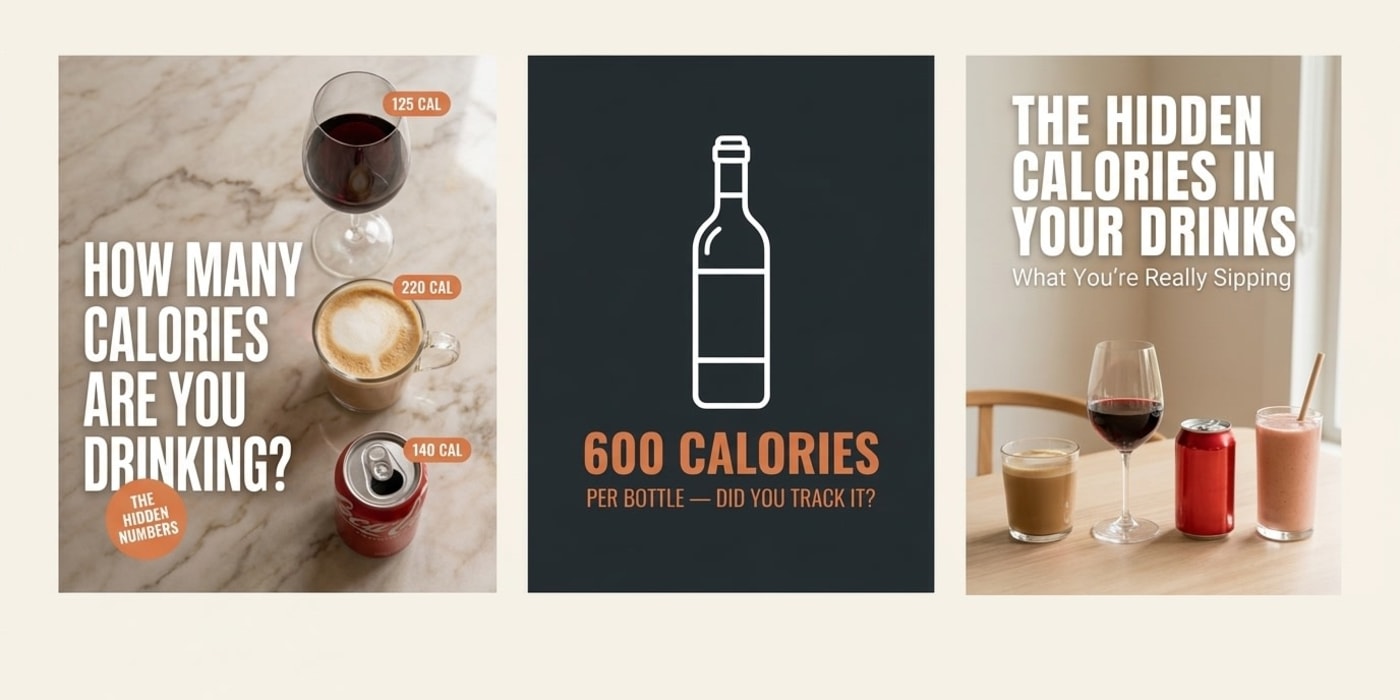
A single 750ml bottle of wine contains roughly 600 calories. A large sugary coffee drink can carry 400–500 calories — more than many people budget for an entire meal. Two beers a few nights a week adds up to 1,000+ calories weekly that rarely get written down anywhere.
This isn't about eliminating drinks you enjoy — it's about seeing the real number, so it can be a deliberate choice rather than an invisible one. Use the calorie calculator to see your daily target, then read on to see exactly where your drinks fit into it.
The Calorie Blind Spot Almost Nobody Tracks
Research on self-reported food logging consistently shows that beverages are among the most under-tracked categories, even among people who are otherwise diligent about logging meals. Part of this is psychological — drinking doesn't trigger the same "I am eating" awareness that sitting down to a plate of food does. Part of it is practical — a drink consumed across a two-hour dinner or a night out doesn't have a clear single "logging moment" the way a meal does.
Why Liquid Calories Behave Differently in the Body
Beyond simply being easy to forget, liquid calories are metabolically different from solid food in a way that matters for appetite regulation. Liquids generally produce a much weaker satiety response than solid food containing the same number of calories — meaning a 300-calorie drink doesn't fill you up nearly as much as a 300-calorie meal would, making it easier to consume on top of your usual intake rather than in place of it.
Calories in Alcohol — The Full Breakdown
Pure alcohol (ethanol) contains 7 calories per gram — nearly as calorie-dense as fat (9 kcal/g) and considerably more than protein or carbohydrates (both 4 kcal/g). Unlike those other macronutrients, alcohol calories provide no nutritional value — no protein, no fibre, no micronutrients — which is why they're often described as "empty calories."
| Drink | Typical Serving | Approx. Calories |
|---|---|---|
| Beer (regular) | 355ml (12 oz) | 150 kcal |
| Beer (light) | 355ml (12 oz) | 100 kcal |
| Wine (red or white) | 150ml (5 oz) | 120–125 kcal |
| Wine (full bottle) | 750ml | ~600 kcal |
| Spirits (vodka, whisky, gin — neat) | 45ml (1.5 oz) | 95–100 kcal |
| Cocktail (margarita, mojito) | 1 standard glass | 250–400 kcal |
| Piña colada | 1 standard glass | 400–500 kcal |
The mixer is often where the real damage happens — a spirit alone might be under 100 calories, but combined with regular soda, juice, or a cream-based mixer, that number can double or triple. Ordering the same spirit with a zero-calorie mixer, or opting for wine or a light beer over a cocktail, are among the highest-leverage swaps for anyone tracking intake without wanting to fully cut alcohol out.
The Hidden Metabolic Cost of Alcohol Beyond Its Calories
Alcohol's impact on weight goes beyond the calories in the glass. The liver prioritises metabolising alcohol over other fuel sources when it's present in the bloodstream, which means fat oxidation is measurably suppressed while alcohol is being processed. This doesn't make alcohol calories "count more" in a simple mathematical sense, but it does mean that fat burning is effectively paused for several hours after drinking — which matters more the more frequently it happens.
Alcohol also reliably increases appetite and reduces inhibition around food choices, which is a major reason a night of drinking is so often accompanied by eating meaningfully more than usual — an effect that compounds on top of the drink calories themselves.
Coffee and Tea — Where the Calories Actually Come From
Black coffee and plain tea are essentially calorie-free — the issue is almost never the coffee itself, but what's added to it. A basic breakdown of common coffee-shop additions:
| Drink | Typical Size | Approx. Calories |
|---|---|---|
| Black coffee or plain tea | Any size | 0–5 kcal |
| Coffee with milk (dairy) | Medium | 20–40 kcal |
| Latte (whole milk) | Medium (12 oz) | 150–180 kcal |
| Flavoured latte with syrup | Large (16 oz) | 250–350 kcal |
| Frozen blended coffee drink | Large | 400–500 kcal |
A daily large flavoured latte habit alone can quietly represent 2,000+ calories a week — roughly equivalent to an entire extra day of eating — without ever feeling like "food" in the way a snack or meal does.
Soft Drinks, Juice, and "Healthy" Bottled Beverages
Regular soda contains roughly 140–150 calories per 355ml can, almost entirely from added sugar. Fruit juice is often assumed to be a healthier alternative, but a typical glass of orange juice carries a similar calorie load to soda while providing far less satiety than eating the whole fruit would — fibre is removed in juicing, which is a large part of what makes whole fruit filling.
Many bottled "healthy" beverages — smoothies, protein shakes marketed for indulgence, sweetened cold brews, kombucha with added sugar — can carry 200–350 calories per bottle despite health-oriented branding and labelling. Checking the actual nutrition label rather than the front-of-package marketing is the only reliable way to know what a given bottled drink actually contains.
What a Week of "Normal" Drinking Actually Adds Up To
A realistic moderate week:
Daily flavoured latte (300 kcal × 5 weekdays) = 1,500 kcal
Two glasses of wine, 3 evenings (250 kcal × 3) = 750 kcal
One soft drink most days (140 kcal × 5) = 700 kcal
Weekly liquid total: ~2,950 kcal — nearly a full extra day of eating, entirely untracked
This isn't a scare number designed to make anyone feel guilty about coffee or wine — it's simply the arithmetic most people never actually run. Seeing it laid out is often the single fastest way to close a stubborn calorie-tracking gap without changing a single meal.
Practical Fixes That Don't Require Giving Anything Up
- Log drinks the moment you order them, the same way you would a meal — waiting until later is when they get forgotten.
- Swap one sweetened drink a day for a zero-calorie alternative — sparkling water, black coffee, or unsweetened tea — without eliminating the rest.
- Choose wine or a light beer over a cocktail when drinking socially; the calorie difference per drink is often 150–250 calories.
- Order coffee-shop drinks smaller and less sweetened — a medium with half the syrup keeps the ritual while cutting the calorie load meaningfully.
- Eat the whole fruit instead of drinking the juice — same or fewer calories, plus the fibre that actually makes you feel full.
Frequently Asked Questions
How many calories are in a glass of wine?
A standard 150ml (5 oz) glass of wine contains approximately 120–125 calories, regardless of whether it's red or white — the calorie content comes primarily from the alcohol itself rather than sugar content for most dry wines.
Does alcohol stop fat loss?
Not automatically, but it does temporarily suppress fat oxidation while the liver prioritises metabolising alcohol, and it commonly increases food intake through appetite stimulation and reduced inhibition. Frequent drinking makes a calorie deficit noticeably harder to maintain even if the drink calories themselves are accounted for.
Is fruit juice healthier than soda?
Nutritionally, fruit juice offers some vitamins that soda doesn't, but calorically the two are often very similar, and juice lacks the fibre that makes whole fruit filling. Whole fruit is generally the better choice over juice for both nutrition and satiety.
How many calories are in a black coffee?
Black coffee contains essentially zero calories — typically under 5 per cup. Nearly all coffee-related calories come from milk, cream, sugar, and syrup additions rather than the coffee itself.
What's the lowest-calorie alcoholic drink?
Spirits served neat or with a zero-calorie mixer (soda water, diet tonic) and light beer are typically the lowest-calorie options, generally landing under 100–130 calories per serving — considerably less than sweetened cocktails or full-sugar mixed drinks.
Do liquid calories count the same as food calories for weight loss?
Yes, in terms of the raw calorie math, but liquids tend to be less filling per calorie than solid food, which makes it easier to consume them in addition to your usual meals rather than genuinely in place of them — this is why they're worth tracking with particular care.
References & Sources
- Mourao, D. M. et al. (2007). Effects of food form on appetite and energy intake in lean and obese young adults. International Journal of Obesity, 31(11), 1688–1695.
- Suter, P. M. (2005). Is alcohol consumption a risk factor for weight gain and obesity? Critical Reviews in Clinical Laboratory Sciences, 42(3), 197–227.
- Yeomans, M. R. (2010). Alcohol, appetite and energy balance. Physiology & Behavior, 100(1), 82–89.
- US Department of Agriculture (2025). FoodData Central — beverage nutrient data.
- MacrosMeasure (2025). Free Calorie Calculator.
Calculate your own numbers — free.
18 science-backed calculators covering everything in this article and more.