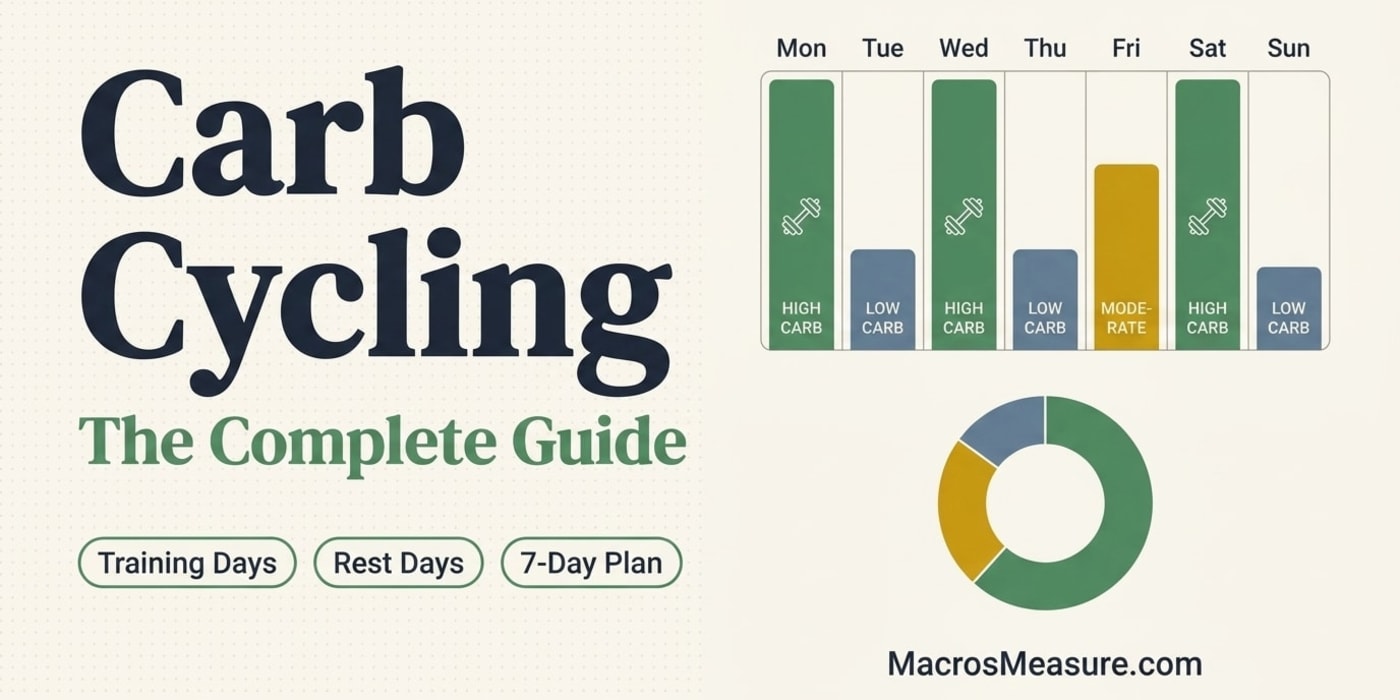
What is carb cycling — and what is it not
Carb cycling is one of the most searched and most misunderstood nutrition strategies in the English-speaking world. At its simplest, it means varying your carbohydrate intake across the week based on your daily energy demands — eating more carbohydrates on training days when your body needs them, and fewer on rest days when demand is lower. The logic is sound. The execution is often where people go wrong.
This guide explains the science clearly, defines each day type with exact numbers, addresses the specific considerations for women, and provides a ready-to-use 7-day plan with full macro targets you can adapt to your own calorie needs.
27K
monthly global searches for "carb cycling" — one of the most searched nutrition strategies
3–4×
more carbs on high days versus low days in a typical plan
≈400g
glycogen stored in muscles — depleted by ~60–90 min of hard training
0%
extra equipment required — carb cycling is a dietary strategy, not a supplement protocol
1. What Is Carb Cycling — and What It Is Not
Carb cycling is a structured approach to carbohydrate periodisation — deliberately varying carbohydrate intake across different days based on training load. On days you train hard, carbohydrates are higher to fuel performance and replenish glycogen. On rest days or low-intensity days, carbohydrates are reduced because demand is lower and the hormonal environment is less conducive to carbohydrate storage.
It is not a zero-carb diet. It is not a keto protocol. It is not "eating whatever you want on high days." It is a structured macro strategy that keeps total weekly calorie balance intact while redistributing macronutrients to better align with daily physiological demands.
❌ Common Misconception
"Carb cycling means eating unlimited carbs on training days and starving on rest days."
✅ What It Actually Means
Carb cycling redistributes carbohydrates within a fixed weekly calorie budget. High days are higher in carbs but not unlimited — protein stays constant and fats are reduced to compensate. Weekly calories remain aligned with your goal.
How carb cycling differs from standard macro tracking
Standard macro tracking gives you one fixed set of daily targets — the same protein, carbs, and fat every day regardless of whether you trained or rested. Carb cycling introduces planned variation, recognising that a rest day and a hard leg session day have fundamentally different energy and substrate demands. The weekly average calories and macros can be identical between someone tracking static macros and someone carb cycling — the difference is in the distribution.
This redistribution serves two purposes: it can improve training performance by ensuring carbohydrates are available when most needed, and it can improve body composition by reducing carbohydrate storage pressure on low-demand days.
2. The Science: Glycogen, Fat Oxidation, and Why Day-Type Matters
To understand why carb cycling has a rational physiological basis, you need to understand what carbohydrates actually do in the context of exercise and recovery.
Muscle glycogen — your primary training fuel
When you consume carbohydrates, they are broken down to glucose and either used immediately for energy or stored as glycogen — a branched polymer of glucose — in the liver (~100g capacity) and skeletal muscle (~400g capacity, varying with muscle mass and training status). Muscle glycogen is the dominant substrate for moderate-to-high-intensity exercise: activities above approximately 65–70% VO₂max rely predominantly on glycogen, not fat.
A 2015 review by Dr. Louise Burke and colleagues published in the European Journal of Sport Science confirmed that glycogen availability significantly affects training performance — sessions initiated with depleted glycogen produce lower power output, earlier fatigue, and compromised technical execution. Replenishing glycogen after training is therefore a genuine performance priority on days preceding or following hard sessions.
Fat oxidation on low carb days
When carbohydrate availability is reduced — as on rest days or low-intensity training days — the body increases its reliance on fat oxidation for energy. Research by Acheson et al. (1988) demonstrated that fat oxidation is suppressed when carbohydrate intake and insulin levels are high, and elevated when they are low. Rest days, with lower glycogen demand and no need for rapid substrate availability, are therefore an appropriate time to reduce carbohydrate intake and allow fat oxidation to be the dominant fuel pathway.
"Carbohydrate periodisation — strategic manipulation of carbohydrate availability in training — allows athletes to optimise substrate use across different training sessions while preserving high-intensity performance capacity."
— Impey et al. (2018). Sports Medicine
Insulin — the distribution hormone
Insulin is released in response to carbohydrate intake and drives glucose into cells for storage or use. On training days, elevated insulin post-workout serves an important anabolic function: it drives glucose into muscle cells for glycogen resynthesis and facilitates amino acid uptake for muscle protein synthesis. On rest days, the same insulin response contributes primarily to fat storage (lipogenesis) rather than muscle glycogen replenishment, since glycogen stores are already adequate. This mechanistic difference provides the physiological rationale for varying carbohydrate intake by day type.
3. High, Moderate, and Low Carb Days — Defined Precisely
A functional carb cycling plan uses three day types. The exact gram targets vary by individual (calculated in Section 5), but the structural principles are consistent.
High Carb Day
Training Days (Hard Sessions)
3–4g carbs/kg body weight
Used before and after the most demanding training sessions — heavy compound lifts, intense cardio, or sport-specific training. Glycogen replenishment and training performance are the priority. Fat intake is reduced to compensate calorically. Protein remains constant.
Moderate Carb Day
Moderate Training Days
2–2.5g carbs/kg body weight
Light training sessions, active recovery, or the day before a planned hard session. Maintains adequate glycogen without the full high-day allocation. A practical bridge between high and low days for people training 4–5 days per week.
Low Carb Day
Rest Days / Very Light Activity
0.5–1g carbs/kg body weight
Complete rest or very low-intensity activity (walking, gentle yoga). Glycogen demand is minimal. Fat intake is increased to compensate calorically. Promotes fat oxidation and insulin sensitivity. Protein remains identical to all other days.
📌 The golden rule of carb cycling
Protein never changes. Carb cycling modulates carbohydrates and dietary fat — protein stays constant across all day types at your daily target (1.6–2.2g/kg). This ensures muscle protein synthesis is never compromised by the carbohydrate restriction on low days. The macronutrient that shifts to compensate for lower carbs is fat — not protein.
Day Type | Carbs (g/kg) | Protein (g/kg) | Fat | Calories vs TDEE |
|---|---|---|---|---|
High Carb | 3.0–4.0 | 1.8–2.2 (unchanged) | Low (0.5–0.7g/kg) | TDEE or slight surplus |
Moderate Carb | 2.0–2.5 | 1.8–2.2 (unchanged) | Moderate (0.8–1.0g/kg) | Near TDEE |
Low Carb | 0.5–1.0 | 1.8–2.2 (unchanged) | Higher (1.0–1.3g/kg) | Below TDEE |
4. Who Carb Cycling Works Best For — and Who Should Skip It
🏋️Intermediate–Advanced Trainees
People training 3–5 days per week with genuine variation in session intensity benefit most — the day-type structure mirrors their actual training variation.
🔄 Body Recomposition Goals
Simultaneously losing fat and gaining muscle — carb cycling supports training performance while creating fat-loss conditions on rest days, facilitating both goals.
📉 Fat Loss Plateaus
People who have stalled on a standard deficit sometimes respond well to carb cycling because the variation prevents metabolic adaptation and maintains training quality.
🚫 Beginners — Not Recommended
Beginners gain more from establishing consistent habits, total calorie awareness, and basic protein targets than from carb cycling complexity. Nail the fundamentals first.
🏃 Endurance Athletes
The research on "train-low, compete-high" periodised carbohydrate strategies is well-established for endurance athletes. Carb cycling fits naturally into this model.
⚠️History of Disordered Eating
Any approach that labels certain days as "restricted" or creates food guilt cycles is inappropriate for individuals with a history of disordered eating. Consult a registered dietitian first.
5. How to Set Up Your Carb Cycling Plan — Step by Step
The following method works for anyone with a calculated TDEE. If you haven't calculated yours yet, use our free TDEE calculator first — it's the starting point for every calculation below.
Step 1 — Calculate Your Weekly Calorie Budget
Fat Loss goal: TDEE × 7 days × 0.85 (15% weekly deficit)
Maintenance goal: TDEE × 7 days
Muscle gain goal: TDEE × 7 days × 1.10 (10% weekly surplus)
This weekly budget is then distributed unevenly across day types — not equally
Step 2 — Set Protein (Constant Across All Days)
Protein target = body weight (kg) × 2.0g/kg
Example (75kg person): 75 × 2.0 = 150g protein/day = 600 kcal from protein
This never changes — protein is identical on high, moderate, and low days
Step 3 — Assign Day Types to Your Week
High carb: your 2–3 hardest training days
Moderate carb: lighter training days or pre-hard-session days
Low carb: rest days and very light activity days
Typical split for someone training 4 days: 2 high + 1 moderate + 4 low
Step 4 — Set Carbs by Day Type (75kg example)
High day: 75 × 3.5g = 263g carbs = 1,050 kcal
Moderate day: 75 × 2.0g = 150g carbs = 600 kcal
Low day: 75 × 0.7g = 53g carbs = 210 kcal
Step 5 — Fill Remaining Calories with Fat
High day remaining: Daily target − protein kcal − carb kcal = fat kcal → ÷ 9 = fat grams
Low day remaining: Same formula — fat will be much higher on low days
Minimum fat floor: Never go below 0.5g/kg body weight on any day
Fat is the flexible macro that rises and falls inversely with carbohydrates
✅ Worked Example — 75kg person, fat loss goal, 4 training days/week
TDEE: 2,200 kcal/day · Weekly budget at 15% deficit: 2,200 × 7 × 0.85 = 13,090 kcal
High days (×2): ~2,400 kcal each — 150g protein (600 kcal), 263g carbs (1,050 kcal), 83g fat (750 kcal)
Moderate days (×1): ~2,100 kcal — 150g protein (600 kcal), 150g carbs (600 kcal), 100g fat (900 kcal)
Low days (×4): ~1,600 kcal each — 150g protein (600 kcal), 53g carbs (210 kcal), 88g fat (790 kcal)
Weekly total: (2,400×2) + 2,100 + (1,600×4) = 4,800 + 2,100 + 6,400 = 13,300 kcal ≈ target ✓
🔥 TDEE Calculator →Calculate your daily calorie burn — the foundation of any carb cycling plan
🥗 Macro Calculator →Get your baseline macro targets before setting up your cycling structure
6. Carb Cycling for Women — Specific Considerations
Carb cycling for women follows the same structural principles as for men, but several physiological and hormonal factors deserve specific attention.
The menstrual cycle and carbohydrate metabolism
Research demonstrates that carbohydrate metabolism varies across the menstrual cycle in women. During the follicular phase (days 1–14), oestrogen is relatively high and the body tends to rely more on carbohydrate oxidation — making this phase well-suited to higher-carb training days. During the luteal phase (days 15–28), progesterone rises and the body shifts toward greater fat oxidation and has modestly elevated total energy expenditure (~100–300 kcal/day). Some women report better performance and recovery with slightly higher total calorie intake during the luteal phase.
A 2019 review by McNulty et al. in the British Journal of Sports Medicine found that aerobic performance was significantly better during the follicular phase — consistent with higher carbohydrate availability and oestrogen-driven glycogen-sparing. This has practical carb cycling implications: scheduling high-carb training days during the follicular phase may optimise both performance and body composition outcomes.
Fat minimum — non-negotiable for women
Women should never reduce dietary fat below approximately 20% of total calories or below 0.5–0.6g/kg body weight on even the lowest-carb days. Fat supports oestrogen production, reproductive hormone health, and the absorption of fat-soluble vitamins. The hormonal consequences of very low fat intake — irregular cycles, reduced bone density, disrupted sleep — are well-documented and occur independent of calorie intake. On low carb days, fat needs to compensate calorically; this keeps the fat minimum naturally well-met in a correctly structured plan.
Calorie targets for women
Because women generally have lower lean body mass and thus lower TDEE than men at the same body weight, the absolute gram targets for all macros will be lower. The ratios and day-type structure are identical — only the absolute numbers change. A 60kg woman will have very different gram targets than a 90kg man but the same proportional carb cycling architecture.
⚠️ Carb cycling and women's health — an important caveat
Women with irregular menstrual cycles, a history of hypothalamic amenorrhoea, or currently experiencing hormonal disruption should approach any restrictive carbohydrate strategy cautiously and ideally under the guidance of a registered dietitian or sports medicine physician. The low-carb days in this plan are not severe, but any dietary restriction that creates significant caloric deficit in women with underlying hormonal vulnerability warrants clinical supervision.
7. 7-Day Carb Cycling Meal Plan — Full Macro Targets
The following plan is built for a 75kg moderately active person targeting fat loss, training 3 days per week. Adjust all gram targets proportionally for your own body weight using the formulas in Section 5. All meals are illustrative — substitute freely while hitting the daily macro targets shown.
Monday — Leg Day / Heavy Training
2,400 kcal · 150g protein · 263g carbs · 83g fat
HIGH CARB
Breakfast3 whole eggs + 80g oats with banana and honey — ~55g carbs, 28g protein, 18g fat
Lunch150g chicken breast + 150g cooked basmati rice + salad with olive oil — ~55g carbs, 42g protein, 12g fat
Pre-workout1 medium banana + 25g whey in water — ~30g carbs, 25g protein, 2g fat
Post-workout30g whey + 200g white potato (baked) — ~40g carbs, 28g protein, 3g fat
Dinner150g salmon + 80g cooked quinoa + steamed broccoli — ~28g carbs, 40g protein, 18g fat
Pre-sleep200g cottage cheese — ~8g carbs, 22g protein, 9g fat
Tuesday — Rest Day
1,600 kcal · 150g protein · 53g carbs · 88g fat
LOW CARB
Breakfast3 whole eggs scrambled + 2 rashers bacon + spinach — ~4g carbs, 32g protein, 28g fat
LunchLarge salad: 150g tuna, avocado, cucumber, tomato, olive oil dressing — ~10g carbs, 38g protein, 26g fat
Snack30g almonds + 2 boiled eggs — ~6g carbs, 18g protein, 24g fat
Dinner150g lean beef mince stir-fry with courgette, peppers, no rice — ~12g carbs, 42g protein, 18g fat
Pre-sleep200g full-fat Greek yoghurt — ~9g carbs, 17g protein, 10g fat
Wednesday — Upper Body / Push Day
2,400 kcal · 150g protein · 263g carbs · 83g fat
HIGH CARB
BreakfastGreek yoghurt bowl: 200g yoghurt + 60g granola + 100g berries — ~62g carbs, 20g protein, 12g fat
LunchTurkey wrap: 120g turkey breast, whole wheat tortilla, hummus, salad — ~48g carbs, 38g protein, 14g fat
Pre-workout1 apple + 25g whey — ~25g carbs, 25g protein, 1g fat
Post-workout30g whey + 150g sweet potato (baked) — ~35g carbs, 28g protein, 2g fat
Dinner150g chicken thigh + 120g cooked brown rice + roasted vegetables — ~38g carbs, 38g protein, 18g fat
Pre-sleep200g cottage cheese + 1 tbsp nut butter — ~10g carbs, 22g protein, 10g fat
Thursday — Rest Day
1,600 kcal · 150g protein · 53g carbs · 88g fat
LOW CARB
BreakfastOmelette: 3 eggs, 40g feta, spinach, mushrooms — ~4g carbs, 30g protein, 22g fat
Lunch150g salmon fillet + large green salad, olive oil, no grains — ~8g carbs, 38g protein, 28g fat
Snack30g mixed nuts + 1 boiled egg — ~6g carbs, 12g protein, 20g fat
Dinner150g lean beef steak + roasted courgette and broccoli, butter — ~12g carbs, 44g protein, 22g fat
Pre-sleep200g cottage cheese — ~8g carbs, 22g protein, 9g fat
Friday — Moderate Training (Pull Day)
2,100 kcal · 150g protein · 150g carbs · 100g fat
MODERATE CARB
Breakfast2 eggs + 40g oats + 1 tbsp peanut butter — ~28g carbs, 22g protein, 20g fat
LunchChicken and rice bowl: 140g chicken, 100g cooked rice, roasted veg — ~35g carbs, 38g protein, 12g fat
Snack1 apple + 30g almonds — ~22g carbs, 6g protein, 16g fat
Dinner150g cod loin + 100g sweet potato + green beans — ~24g carbs, 40g protein, 8g fat
Pre-sleep200g Greek yoghurt + 30g walnuts — ~12g carbs, 20g protein, 22g fat
Saturday — Rest Day
1,600 kcal · 150g protein · 53g carbs · 88g fat
LOW CARB
BreakfastSmoked salmon (100g) + 2 poached eggs + avocado — ~4g carbs, 36g protein, 28g fat
LunchBig Greek salad: 150g chicken, olives, feta, cucumber, olive oil — ~10g carbs, 42g protein, 26g fat
Snack25g dark chocolate (85%+) + 15g almonds — ~12g carbs, 4g protein, 16g fat
Dinner150g prawn stir-fry with courgette noodles, sesame oil, ginger — ~10g carbs, 36g protein, 18g fat
Pre-sleep200g cottage cheese — ~8g carbs, 22g protein, 9g fat
Sunday — Active Recovery (Walk / Yoga)
1,700 kcal · 150g protein · 60g carbs · 92g fat
LOW CARB
Breakfast3 eggs + 1 slice sourdough + avocado — ~18g carbs, 26g protein, 24g fat
Lunch150g tinned tuna + leafy greens, olive oil, lemon, 50g chickpeas — ~14g carbs, 44g protein, 18g fat
Snack2 boiled eggs + 20g cashews — ~6g carbs, 16g protein, 18g fat
Dinner150g turkey mince + cauliflower rice + broccoli + olive oil — ~10g carbs, 42g protein, 18g fat
Pre-sleep200g cottage cheese + 1 tsp honey — ~12g carbs, 22g protein, 9g fat
💡 Weekly totals check
This 7-day plan totals approximately 13,200 kcal for the week — a moderate deficit for a 75kg person with a TDEE of ~2,200 kcal/day (maintenance = 15,400 kcal/week). The deficit is achieved primarily through the 4 low-carb days, while performance on training days remains well-supported by the 2 high-carb and 1 moderate-carb day.
8. Common Carb Cycling Mistakes — and How to Avoid Them
Mistake | Why It Happens | The Fix |
|---|---|---|
Dropping protein on low carb days | Trying to reduce overall calories by cutting everything | Protein stays constant at 1.8–2.2g/kg every single day — only carbs and fats cycle |
Making low days too low | Thinking restriction = faster results | Keep fat minimum at ≥0.5g/kg; never go below 1,200–1,400 kcal regardless of plan |
Assigning high days to rest days as a "treat" | Emotional eating patterns overriding the structure | High days are training fuel, not rewards — assign them strictly to hardest training days |
Not tracking on low days because "it's just protein and fat" | Underestimating caloric density of fat | Fat has 9 kcal/g — 100g of fat is 900 kcal. Low days require the same tracking discipline as high days |
Changing day types reactively instead of planning ahead | Poor week planning | Set your training week in advance — assign day types Sunday for the following Monday–Sunday |
Frequently Asked Questions
What is carb cycling and does it work?
Carb cycling is a dietary strategy that varies carbohydrate intake based on daily training demands — higher on hard training days, lower on rest days. It works by aligning carbohydrate availability with actual physiological need: fuelling performance when glycogen demand is high and promoting fat oxidation when it is low. Research by Burke et al. and Impey et al. supports periodised carbohydrate approaches for athletes and active individuals. It is not a magic strategy but a practical way to optimise weekly nutrition without changing overall calorie targets.
How many carbs on a high day vs a low day?
For most active adults: high day = 3–4g carbs per kg body weight; moderate day = 2–2.5g/kg; low day = 0.5–1g/kg. For a 75kg person that translates to roughly 225–300g on high days and 38–75g on low days. Exact targets depend on your TDEE, training intensity, and goal. Calculate your personalised TDEE at our TDEE calculator first.
Is carb cycling good for weight loss?
Carb cycling can support weight loss when it creates an overall weekly calorie deficit. The primary advantage over a standard deficit is that it preserves training quality on high days — meaning you maintain the muscle-preserving stimulus of hard training while still losing fat across the week. For people who train inconsistently or who are complete beginners, a simpler consistent daily deficit is equally effective and easier to sustain.
What do I eat on a low carb day?
Low carb days prioritise protein and fat: eggs, meat, fish, Greek yoghurt, cottage cheese, nuts, avocado, olive oil, non-starchy vegetables (leafy greens, courgette, broccoli, peppers). Starchy carbohydrates (rice, oats, potatoes, bread, pasta) are minimised or eliminated. Non-starchy vegetables can be eaten freely — their carb contribution is minimal and their micronutrient value is high.
Can beginners do carb cycling?
Generally not recommended for complete beginners. Carb cycling adds complexity — tracking three different macro sets across the week — that can distract from building the basic habits that produce most of the results: consistent protein intake, overall calorie awareness, and progressive training. Beginners should master a simple daily macro approach first. Carb cycling becomes valuable once you have 6–12 months of consistent tracking experience and a structured training programme.
Is carb cycling the same as keto?
No. Keto is a consistently very low carbohydrate diet (typically under 50g/day) designed to induce nutritional ketosis — a metabolic state where the body primarily uses ketones (from fat breakdown) as fuel. Carb cycling involves regular high-carb days that would immediately exit ketosis. The two strategies are mechanistically incompatible. Targeted ketogenic or cyclical ketogenic diets incorporate some carb intake around training, but they operate by different mechanisms and for different goals than standard carb cycling.
How do I know if carb cycling is working?
Track these markers over 4–6 weeks: (1) body weight trend (should move in your intended direction at ~0.3–0.5kg/week for fat loss); (2) training performance (should be maintained or improving on high carb days); (3) energy levels (should feel energised on training days and manageable on low days — not depleted); (4) body measurements (waist, hips, chest). If weight is not moving and training is suffering, total weekly calories are too high. If performance is dropping dramatically, high-day carbs are too low.
What about carb cycling and alcohol?
Alcohol (7 kcal/g) is not a macronutrient but has caloric value that must be accounted for. More importantly, alcohol acutely suppresses fat oxidation for several hours after consumption — directly counterproductive to the fat-oxidation goal of low carb days. If alcohol is consumed, low carb days are the worst timing. If social drinking is unavoidable, moderate carb days are the most forgiving context. Alcohol also disrupts sleep quality, impairs GH secretion, and reduces next-day training performance — all relevant to body composition goals.
How long should I do carb cycling?
Most structured carb cycling phases run 8–16 weeks, after which a 1–2 week maintenance period (eating at TDEE with standard macros) is beneficial before continuing. This "diet break" approach partially reverses metabolic adaptation and hormonal suppression associated with extended deficits. After a diet break, you can return to carb cycling with a recalculated TDEE based on your new body weight.
Does carb cycling affect muscle gain?
Carb cycling can support muscle gain when high-carb days are timed around the most anabolically important training sessions. Carbohydrates post-workout stimulate insulin, which drives glucose into muscle cells for glycogen replenishment and co-facilitates amino acid uptake. The low-carb days are not optimal for muscle protein synthesis, but because protein remains constant and training stimulus is maintained, overall muscle gain is not significantly impaired — particularly when total weekly calorie balance is in a modest surplus.
Calculate Your Carb Cycling Targets
Start with your personalised TDEE — then use the formulas in this guide to set your high, moderate, and low day carb targets.
References & Sources
Acheson, K. J. et al. (1988). Glycogen storage capacity and de novo lipogenesis during massive carbohydrate overfeeding in man. American Journal of Clinical Nutrition, 48(2), 240–247.
Burke, L. M. et al. (2017). Low carbohydrate, high fat diet impairs exercise economy and negates the performance benefit from intensified training in elite race walkers. Journal of Physiology, 595(9), 2785–2807.
Impey, S. G. et al. (2018). Fuel for the work required: A theoretical framework for carbohydrate periodisation and the glycogen threshold hypothesis. Sports Medicine, 48(5), 1031–1048.
McNulty, K. L. et al. (2020). The effects of menstrual cycle phase on exercise performance in eumenorrheic women: A systematic review and meta-analysis. Sports Medicine, 50(10), 1813–1827.
Aragon, A. A. et al. (2017). International Society of Sports Nutrition Position Stand: Diets and body composition. Journal of the International Society of Sports Nutrition, 14, 16.
MacrosMeasure (2025). Free TDEE Calculator.
MacrosMeasure (2025). Free Macro Calculator.
Calculate your own numbers — free.
18 science-backed calculators covering everything in this article and more.