In this guide
Updated 7 November 2026. This article is general information, not medical advice. If you have diabetes, please don't change your diet or medication on your own. Very-low-calorie diets can cause dangerously low blood sugar in people taking certain diabetes drugs.
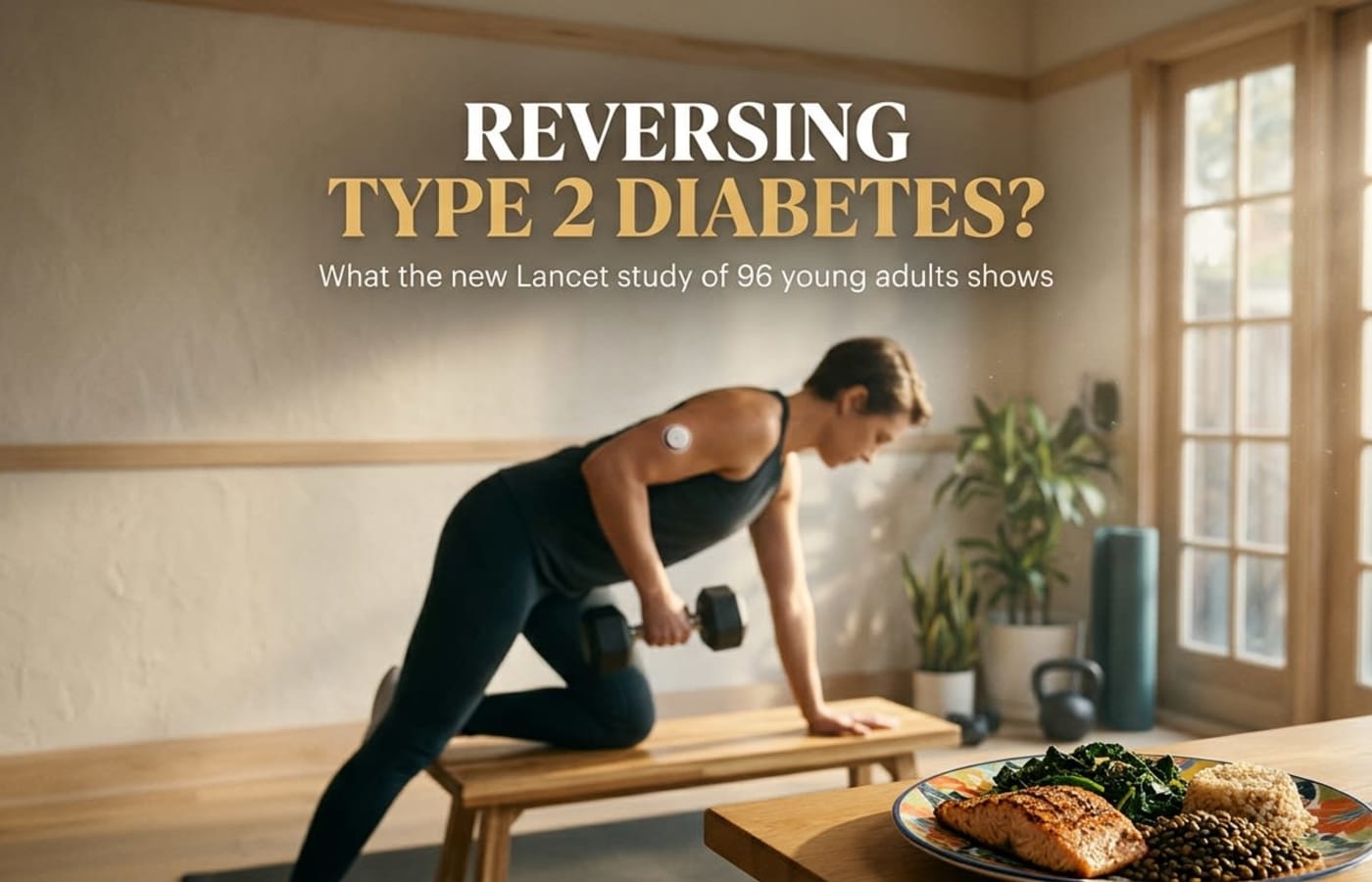
"Can you reverse type 2 diabetes?" is one of the most loaded questions in health. For years the honest answer was "sometimes, in some people, if they lose a lot of weight". This month, a new clinical trial has pushed that conversation toward a group that rarely gets headlines: young adults, diagnosed in their twenties, thirties and early forties, whose diabetes tends to be more aggressive and who face decades of risk.
The study, published on 1 October in The Lancet Regional Health – Americas and explained by CNN on 6 November, found that more than half of the young adults who followed a supervised very-low-calorie diet plus strength and aerobic training reached remission within six months. The headlines are exciting. The details are more complicated, and they matter a great deal if you or someone you love has type 2 diabetes, prediabetes or a strong family history. We read the coverage of the trial, compared it with the landmark DiRECT trial and the research on exercise and blood sugar, and turned it into a practical, safe guide to what the study shows, what it doesn't, and what you can do without an 800-calorie diet.
The short version: in a randomised trial of 96 adults aged 18–45 with obesity and type 2 diabetes diagnosed within the previous six years, 54% of those given an intensive programme (an 800–900 kcal/day diet for 12 weeks plus supervised resistance and aerobic training) were in diabetes remission at six months, versus 4% of those on usual care. The programme group also lost about 7.5 kg (16.5 lb) more body fat without significantly greater muscle loss, and their grip strength improved by about 8%. But it was small, short, run at three specialist centres with heavy support, only about 40% met every adherence criterion, there was no diet-only comparison group, and remission isn't a cure. The most realistic message is that substantial weight loss, plus muscle-preserving exercise, can transform blood sugar in early diabetes, and that a gentler version can still help a great deal.
Why This Study Is in the News
About 38 million Americans have type 2 diabetes, and a growing share are being diagnosed younger. Most trials of weight-loss-induced remission have enrolled older adults, even though younger people live with the disease longest and are at highest cumulative risk of complications such as heart disease and kidney failure. This is among the first randomised trials to test the approach specifically in early-onset disease, and to build supervised resistance training into the programme to protect muscle during rapid weight loss.
The Study at a Glance
| Item | Details |
|---|---|
| Journal and date | The Lancet Regional Health – Americas, published 1 October 2026; explained by CNN on 6 November 2026 |
| Participants | 96 adults aged 18–45 with obesity and type 2 diabetes diagnosed within the previous six years (average age about 38; average diabetes duration just over two years) |
| Where | Three specialised centres in Canada and the UK |
| Design | Randomised: intensive diet-and-exercise programme versus usual medical care |
| Exclusions | People using insulin; people with cardiovascular disease or significant kidney disease, among other conditions |
| Primary outcome | Diabetes remission at six months: HbA1c below 6.5% without glucose-lowering medication for at least three months |
| Main result | 54% remission in the programme group versus 4% with usual care |
| Body composition | About 7.5 kg (16.5 lb) greater loss of body fat than usual care, without significantly greater loss of muscle |
| Fitness and strength | Lower resting heart rate and better exercise capacity; grip strength up about 8% |
| Adherence | About 40% of participants met all adherence criteria |
Why Early-Onset Type 2 Diabetes Is a Different Problem
Early-onset type 2 diabetes means a diagnosis by age 45. It tends to progress faster than diabetes diagnosed later in life, with a higher risk of complications. Someone diagnosed at 30 may live with high blood sugar for decades, and the damage accumulates in blood vessels, nerves, kidneys and eyes. Younger adults with type 2 diabetes also face an increased risk of cardiovascular disease and early death.
This is a particular concern for South Asian populations, where diabetes often appears at a younger age and at a lower body weight than in white European populations, a pattern we explain in our guide to BMI for South Asians.
What "Remission" Actually Means
"Reversal" and "cure" are tempting words. Clinicians prefer "remission", and the definition used in this trial follows the international consensus (American Diabetes Association and partners, 2021): HbA1c below 6.5% for at least three months without taking glucose-lowering medication.
- Remission means blood sugar is back in the non-diabetic range without drugs.
- It doesn't mean the underlying tendency is gone. Blood sugar can rise again, especially if weight returns.
- Ongoing monitoring is still needed, including regular HbA1c checks and screening for complications, because past exposure to high glucose can leave lasting effects.
What Participants Actually Did, Week by Week
| Phase | Diet | Exercise | Support |
|---|---|---|---|
| Weeks 1–2 | Meal replacements only, within an 800–900 kcal/day target | Not yet started | Supervising dietitians and physicians |
| Weeks 3–12 | One regular meal a day plus meal replacements, keeping the 800–900 kcal target | Two supervised sessions a week combining aerobic activity with resistance training (weights or machines), plus a third aerobic session done independently | Physicians monitored blood sugar and blood pressure and adjusted medications as needed |
| Weeks 13–24 | Gradual return to normal food, aiming to maintain weight loss | Continued exercise, mostly independent | Ongoing dietitian and exercise-specialist support |
Notice how much structure there is. The programme was built around frequent professional contact, and medication changes were handled by doctors as weight fell. That's very different from "try an 800-calorie diet at home."
The Results: 54% Versus 4%
At six months, 54% of the programme group had reached remission, compared with 4% of the usual-care group. Alongside that, the programme group lost about 7.5 kg (16.5 lb) more body fat than usual care. Their fitness improved, with a lower resting heart rate and better exercise capacity.
The muscle result is the part the researchers highlighted. People who lose a lot of weight quickly typically lose both fat and muscle, which is a particular problem in diabetes, where muscle function and frailty are already concerns. In this trial, the programme group lost fat without significantly greater loss of muscle than the usual-care group, and their grip strength rose by roughly 8%. As lead author Dr. Dasgupta put it in coverage, the diet drove the weight loss, and the exercise helped make sure it didn't come from muscle.
How It Compares With the DiRECT Trial
The landmark comparison is DiRECT, a UK trial in primary care run by Michael Lean and colleagues (The Lancet, 2018), which used a total-diet-replacement programme of about 825–853 kcal a day for 3–5 months in adults aged 20–65 who had had type 2 diabetes for up to six years.
| Feature | DiRECT (2018–2019) | New early-onset trial (2026) |
|---|---|---|
| Participants | 298 adults aged 20–65 | 96 adults aged 18–45 |
| Diet | Total diet replacement, about 825–853 kcal/day for 3–5 months, then stepped food reintroduction | 800–900 kcal/day for 12 weeks, then gradual reintroduction |
| Exercise | Encouraged increased physical activity (not a supervised programme) | Supervised resistance and aerobic training from week 3 |
| Remission | 46% at 12 months (versus 4% control); 36% at 24 months (versus 3%) | 54% at 6 months (versus 4%) |
| Follow-up | Up to several years | Six months so far |
The results line up well: roughly half in remission after intensive weight loss, with a small minority in the control group. Notice the DiRECT drift: remission fell from 46% at one year to 36% at two, which is exactly why long-term follow-up of the new trial matters.
How Much Weight Loss Is Enough?
DiRECT gave an unusually clear answer to this question, because remission depended on how much weight people lost, not on which person they were:
| Weight lost at 12 months (DiRECT, intervention group) | Share in remission |
|---|---|
| 15 kg or more | 86% |
| 10 to under 15 kg | 57% |
| 5 to under 10 kg | 34% |
| Under 5 kg | 7% |
The pattern is a dose-response: more loss, higher chance of remission. A rough target that emerges from this work is a loss of around 10–15% of body weight for many people, or 15 kg for those with higher starting weights, kept off.
| Starting weight | 10% loss | 15% loss |
|---|---|---|
| 80 kg (176 lb) | 8 kg (18 lb) | 12 kg (26 lb) |
| 90 kg (198 lb) | 9 kg (20 lb) | 13.5 kg (30 lb) |
| 100 kg (220 lb) | 10 kg (22 lb) | 15 kg (33 lb) |
| 110 kg (243 lb) | 11 kg (24 lb) | 16.5 kg (36 lb) |
These are population patterns, not guarantees. Even weight loss that doesn't lead to remission usually improves blood sugar, blood pressure and cholesterol, and can reduce the amount of medication needed.
What Exercise Added: Muscle, Fitness and Blood Sugar
The trial didn't test diet alone against diet plus exercise, so we can't say how much of the remission came from the exercise. But the broader evidence explains why the researchers included it.
- Muscle is a major sink for blood sugar. After a meal, insulin helps move glucose into muscle cells, and exercise improves that uptake and insulin sensitivity. Preserving muscle during weight loss protects this capacity.
- Exercise lowers HbA1c on its own. A meta-analysis in JAMA (Umpierre and colleagues, 2011) found that structured exercise training lowered HbA1c by about 0.67 percentage points in people with type 2 diabetes, with a bigger effect (about 0.89) when people exercised more than 150 minutes a week.
- Resistance training protects lean mass during energy restriction, as shown in many weight-loss trials, which is why we recommend it in our guides on muscle and weight loss.
- Short walks after meals help. In a small crossover study (Reynolds and colleagues, Diabetologia, 2016) in people with type 2 diabetes, a 10-minute walk after each meal reduced blood sugar after meals more than a single 30-minute walk.
What the Study Can't Tell Us
CNN's physician commentator and other experts flagged several limitations, and they matter for how you read the headline:
- It's small. Ninety-six people, with a six-month follow-up.
- The population is narrow. Younger adults with obesity and recent diagnoses. People using insulin and those with cardiovascular disease or significant kidney disease were excluded. The results may not apply to older adults, people with long-standing diabetes or those with more advanced disease.
- No diet-only group. Without one, we can't separate the effect of exercise from the effect of the diet.
- The programme group got much more attention than usual care, which could influence results.
- It was very demanding. Only about 40% of participants met every adherence criterion.
- Specialist setting. Three centres with regular physician, dietitian and exercise-specialist support. We don't know whether results would hold in ordinary clinics.
- Six months isn't forever. Remission can reverse, particularly if weight returns. Longer follow-up will say how many people stay in remission.
Is an 800-Calorie Diet Safe?
Very-low-calorie diets of 800–900 kcal a day are used in clinical programmes, but they're not a do-it-yourself plan. In the trial they were run under physician supervision with nutritionally complete meal replacements, and doctors adjusted medication as people lost weight.
Why supervision matters
- Low blood sugar. People taking insulin or sulfonylureas can develop dangerously low blood sugar when they sharply cut food intake. Doses often need reducing in advance.
- Ketoacidosis risk with SGLT2 inhibitors. Combining very low-calorie or very low-carbohydrate eating with these drugs (such as dapagliflozin or empagliflozin) can cause diabetic ketoacidosis, even when glucose looks normal.
- Blood pressure medication. As weight falls, blood pressure drops, and tablets may need reducing to avoid dizziness or fainting.
- Common side effects: fatigue, headaches, constipation, feeling cold, hair thinning and, with rapid weight loss, an increased risk of gallstones.
- Nutrient and muscle protection. Complete meal replacements, protein targets and resistance training reduce the risk of deficiency and muscle loss.
Who should not try this without specialist advice
- Anyone pregnant, breastfeeding or planning pregnancy.
- People with type 1 diabetes.
- People taking insulin, sulfonylureas or SGLT2 inhibitors.
- Those with a history of an eating disorder.
- People with heart disease, advanced kidney or liver disease, or a history of gallstones or pancreatitis.
- Children, teenagers and frail or older adults.
Our calorie calculators are designed for moderate deficits, not for 800-calorie plans, so please don't use them to set a very-low-calorie target.
A Gentler Path: What to Do If You Have Type 2 Diabetes or Prediabetes
You don't need an 800-calorie diet to benefit from the same principles: substantial but gradual weight loss, preserved muscle and regular movement. Here's a step-by-step approach to discuss with your care team.
- Start with your clinician. Ask whether remission is a realistic goal and which approach is safe for you, especially if you take glucose-lowering drugs.
- Pick a target. A common aim is 10–15% of body weight over 6–12 months. Use the table above.
- Set a moderate deficit. Use the TDEE calculator to estimate maintenance, then a 15–25% deficit with the calorie deficit calculator. Aim for roughly 0.5–1% of body weight a week.
| Maintenance (TDEE) | 15% deficit | 20% deficit | 25% deficit |
|---|---|---|---|
| 2,000 kcal | 1,700 | 1,600 | 1,500 |
| 2,400 kcal | 2,040 | 1,920 | 1,800 |
| 2,800 kcal | 2,380 | 2,240 | 2,100 |
- Protect muscle with protein and lifting. Aim for roughly 1.2–1.6 g of protein per kg of body weight (people with kidney disease need individual advice) using the protein intake calculator, and do resistance training at least twice a week, as in the trial. Use the one rep max calculator to track strength.
- Build the plate around fibre and protein. Vegetables, beans and lentils, whole grains, fish, eggs, yoghurt and nuts, with sugary drinks and refined starches cut back. Both Mediterranean and lower-carbohydrate patterns can work, as our report on a recent keto-versus-Mediterranean trial explains. See our macro calculator guide and carb calculator for the numbers.
- Eat vegetables and protein before starch. Small studies suggest meal order can flatten the after-meal rise, a topic we cover in our article on food sequencing.
- Walk after meals. Ten minutes after each meal is an easy, evidence-supported habit.
- Aim for 150 minutes of moderate activity a week plus resistance training, in line with standard guidelines.
- Sleep and manage stress. Short sleep raises appetite and blood sugar.
- Monitor. Follow your clinician's plan for glucose checks and HbA1c (often every three months), and ask about adjusting medications as you lose weight.
- Plan for maintenance from day one. In DiRECT, remission fell from 46% to 36% between years one and two. Keep protein, strength training, regular weighing and professional support in place.
Check how your own recipes fit with our recipe nutrition calculator and read food labels with our guide to daily calories and nutrition labels.
A Note for South Asian Adults
South Asians develop type 2 diabetes at a younger age and a lower BMI than white Europeans. In a large Canadian analysis (Chiu and colleagues, Diabetes Care, 2011), the diabetes risk seen at a BMI of 30 in white adults was reached at roughly BMI 24 in South Asian adults. That has two practical consequences:
- Don't wait for a high BMI. Check your waist-to-height ratio (aim for under 0.5) and ask about screening, including HbA1c, if you have a family history, even at a "normal" weight. The NICE 2025 guideline uses lower BMI thresholds (23 and 27.5) for people of South Asian background.
- Weight loss and muscle both matter. The Indian Diabetes Prevention Programme (Ramachandran and colleagues, 2006) found lifestyle change cut progression from prediabetes to diabetes by about 28% in Asian Indian adults. The new trial adds to the case for combining modest dietary change with resistance training.
The trial's participants came from Canada and the UK, and the coverage doesn't break down ethnicity, so we can't say how well the results transfer to South Asian populations specifically. That's a research gap worth watching.
Questions to Ask Your Doctor
- Is remission a realistic goal for me, given how long I've had diabetes and which medications I take?
- What weight-loss target should I aim for, and over what time?
- Do any of my medications need to change as I lose weight, and how will we monitor my blood sugar and blood pressure?
- Is a supervised low-calorie programme suitable for me, or should I take a moderate approach?
- How can I protect my muscle (protein, resistance training, and a referral to an exercise specialist or physiotherapist)?
- How often should I check HbA1c, and what's the plan if my numbers rise again?
- Do I need screening for complications (eyes, kidneys, feet) even if my numbers improve?
Also in the News: Fasting Plus Exercise
Another trial reported in October is relevant if you're considering time-restricted eating. In the TEMPUS project from the University of Granada, published in Nature Communications and reported on 22 October, 187 adults with obesity were randomised for 12 weeks. As reported, eight-hour time-restricted eating increased weight loss, and combining it with supervised exercise produced greater body-fat loss and better cardiorespiratory fitness, though no greater reduction in liver fat than standard care. It's another sign that pairing eating strategies with exercise tends to beat either alone, and that benefits for liver fat may need more than a few weeks. We've covered similar trials in our posts on meal timing and calories.
The Bottom Line
This new trial is a strong, carefully reported piece of evidence that early-onset type 2 diabetes can be pushed into remission, in roughly half of young adults within six months, by combining major weight loss with supervised strength and aerobic training that protects muscle. It matches earlier work showing that the more weight people lose, the more likely remission becomes.
But it was small, short, highly supported and demanding, with no diet-only comparison and a six-month window, and remission isn't a cure. The practical takeaway isn't "everyone should eat 800 calories". It's that early diabetes responds powerfully to weight loss, that lifting weights and walking are part of the treatment, and that a safe, moderate plan built with your doctor can deliver a lot of the same benefits. If you've been told your diabetes is "progressive and permanent", this study is a reason to ask what's possible for you.
Frequently Asked Questions
Can type 2 diabetes be reversed?
It can go into remission, meaning HbA1c below 6.5% for at least three months without glucose-lowering medication. In a 2026 trial of 96 young adults, 54% reached remission at six months with an intensive diet and exercise programme, versus 4% on usual care. Remission isn't the same as a cure, because blood sugar can rise again.
What is the definition of type 2 diabetes remission?
HbA1c below 6.5% measured at least three months after stopping glucose-lowering medication, according to the international consensus used in the trial.
How much weight do I need to lose to put diabetes into remission?
It varies. In the DiRECT trial, 86% of people who lost 15 kg or more were in remission at 12 months, versus 57% for 10–15 kg, 34% for 5–10 kg and 7% for under 5 kg. A rough target is 10–15% of body weight.
Is an 800-calorie diet safe for type 2 diabetes?
Only under medical supervision. It can cause dangerously low blood sugar in people taking insulin or sulfonylureas, ketoacidosis risk with SGLT2 inhibitors, and side effects such as fatigue and gallstones. It's not suitable for everyone.
Did the study show diet or exercise was responsible?
It can't say, because there was no diet-only group. The researchers included supervised strength and aerobic training to preserve muscle and fitness during rapid weight loss.
Does exercise lower blood sugar even without weight loss?
Yes. A meta-analysis found structured exercise lowers HbA1c by about 0.67 percentage points in type 2 diabetes, with larger effects at more than 150 minutes a week.
Will my diabetes come back after remission?
It can, especially if weight returns. In DiRECT, remission fell from 46% at one year to 36% at two years. Maintaining weight loss, strength training and regular monitoring all matter.
Does this apply to people who use insulin?
The trial excluded people using insulin, so we don't know. Talk to your doctor before changing food intake or medication.
Is early-onset type 2 diabetes more serious?
It tends to progress faster and carries a higher lifetime risk of complications, which is why early treatment matters.
What if I don't want to follow an 800-calorie diet?
A moderate deficit of 15–25%, adequate protein, resistance training twice a week, 150 minutes of aerobic activity and short walks after meals can still produce large improvements. Work with your clinician or dietitian.
References & Sources
- Intensive weight loss and structured exercise for remission of early-onset type 2 diabetes: randomised trial (2026). The Lancet Regional Health – Americas, published 1 October 2026. PIIS2667-193X(26)00294-2.
- CNN (6 November 2026). Can diet and exercise reverse type 2 diabetes? What a new study found (with commentary by Leana Wen, MD); Fox News (October 2026) coverage of the trial.
- Lean, M. E. J. et al. (2018). Primary care-led weight management for remission of type 2 diabetes (DiRECT): an open-label, cluster-randomised trial. The Lancet, 391(10120), 541–551.
- Lean, M. E. J. et al. (2019). Durability of a primary care-led weight-management intervention for remission of type 2 diabetes: 2-year results of the DiRECT open-label, cluster-randomised trial. The Lancet Diabetes & Endocrinology, 7(5), 344–355.
- Riddle, M. C. et al. (2021). Consensus report: definition and interpretation of remission in type 2 diabetes. Diabetes Care, 44(10), 2438–2444.
- Umpierre, D. et al. (2011). Physical activity advice only or structured exercise training and association with HbA1c levels in type 2 diabetes: a systematic review and meta-analysis. JAMA, 305(17), 1790–1799.
- Reynolds, A. N. et al. (2016). Advice to walk after meals is more effective for lowering postprandial glycaemia in type 2 diabetes mellitus than advice that does not specify timing: a randomised crossover study. Diabetologia, 59(12), 2572–2578.
- Chiu, M. et al. (2011). Deriving ethnic-specific BMI cutoff points for assessing diabetes risk. Diabetes Care, 34(8), 1741–1748.
- Ramachandran, A. et al. (2006). The Indian Diabetes Prevention Programme shows that lifestyle modification and metformin prevent type 2 diabetes in Asian Indian subjects with impaired glucose tolerance (IDPP-1). Diabetologia, 49(2), 289–297.
- National Institute for Health and Care Excellence (2025). Overweight and obesity management (NG246).
- University of Granada (2026). TEMPUS project: intermittent fasting plus exercise in adults with obesity. Nature Communications; MedicalXpress (22 October 2026).
- MacrosMeasure (2026). Free Calorie Deficit Calculator.
- MacrosMeasure (2026). Free Protein Intake Calculator.
Calculate your own numbers — free.
18 science-backed calculators covering everything in this article and more.